


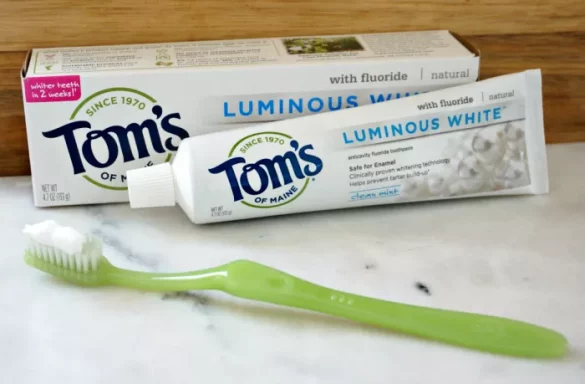
Tom’s of Maine is a long-standing brand in natural oral care. It began as a small family company focused on simpler, plant-and-mineral-based formulations and grew into a nationally recognized name. The brand is known for “natural” positioning, for offering fluoride and fluoride-free options, and for highlighting simple ingredient lists. Tom’s of Maine joined the Colgate family in the mid-2000s, which expanded its distribution while the brand kept its natural-product identity.
People who look for Tom’s usually want a whitening product that avoids strong peroxide bleaching agents, or they want a toothpaste that emphasizes naturally derived abrasives and plant-based cleansers. Several Tom’s whitening formulas are designed to remove surface stains rather than chemically bleach enamel. One Tom’s whitening product — Simply White — has earned the American Dental Association (ADA) Seal of Acceptance for safety and some whitening efficacy when used as directed.
Tom’s of Maine Product Types
Tom’s sells a range of oral-care products that are relevant to whitening and tooth appearance:
Whitening toothpastes. These are the most visible whitening offerings. Tom’s uses naturally derived silicas and plant-based cleansers in variants like Simply White and Whiten Plus. The focus is on removing surface stains with enamel-safe abrasives rather than bleaching.
Antiplaque and whitening formulas. Some products combine antiplaque action with stain removal, offered in both fluoride and fluoride-free versions. These are aimed at people who want both stain control and plaque management.
Fluoride and fluoride-free options. Tom’s splits product lines by fluoride content so users who prefer fluoride-free natural products can choose that route. Whitening products appear in both categories.
Kids’ whitening/cleaning toothpastes. Tom’s also makes kid-targeted toothpastes that prioritize gentle formulas; while these are not marketed as heavy whitening agents, they support stain control appropriate for younger users.
Related oral-care products. While whitening claims are mostly in toothpastes, Tom’s broader oral care range (mouthwashes are less central in some markets) complements whitening routines by improving breath and oral hygiene.
In short, Tom’s approaches whitening via mechanical and mineral-based stain removal rather than peroxides, and it provides consumer choice across fluoride content and product strength.
2025 Teeth Whitening Cost of Tom’s of Maine
Overview of Tom’s of Maine Product Pricing
Tom’s whitening toothpastes are generally priced for mass-market buyers seeking a natural option without premium cosmetics pricing. On Tom’s own site and many U.S. grocery or drugstore listings, the listed regular price for a single tube of whitening toothpaste is typically about $5.99, though sales and multipacks change the effective price per ounce. Online multi-packs (for example, 3-packs) are a common way to lower the unit price. Prices are typically higher in international markets when converted to local currency.
Detailed Cost Breakdown by Product Type
Below is a practical breakdown to help you estimate what you’ll pay for Tom’s whitening offerings. Because retailers change prices frequently, these are typical ranges observed across manufacturer listings and major retailers as of the most recent checks.
1. Single tube — Whitening toothpaste (standard size ~4.0–4.7 oz / 113–133 g)
Typical retail: $4.50 – $7.50 per tube in the U.S.
Example: Tom’s site lists many whitening toothpastes at $5.99 regular price. Amazon and other sellers show similar per-tube equivalents or slightly lower when sold in multipacks.
2. Multi-packs (3-pack, 4-pack, etc.)
Typical retail: $10 – $20 for packs of 2–4, depending on promotions. Multipacks reduce per-tube cost to roughly $3 – $5. Amazon listings frequently convert to a per-ounce or per-tube metric that can be more.
3. Travel or trial sizes
Typical retail: $1.50 – $3.50 per travel-size tube. These are sometimes bundled in travel kits and are useful for sampling.
4. Specialty or limited-edition whitening formulas
Typical retail: pricing usually follows the standard tube pricing; if a product is seasonal or uses specialty ingredients (e.g., coconut oil blends), price may drift to the higher end of the range.
5. International pricing
Outside the U.S., prices on retailer pages (India, Canada, etc.) show local currency conversions and can be substantially higher when accounting for shipping and import duties; expect pricing to vary widely. Example listings in India show per-tube equivalents that convert to different local price points.
6. Subscription & club pricing
Many marketplaces and retailers offer subscriptions or auto-ship discounts that reduce the per-tube price by 10–20% versus one-time purchase. This is a good way to lower long-term costs if you use whitening toothpaste daily.
Factors Influencing the Cost
Several practical factors determine what you’ll actually pay for Tom’s whitening products:
1. Retail channel. Big supermarkets and drugstores often match prices and run loss-leader promos. Online marketplaces may have dynamic pricing and frequent bundle deals. Buying at a bulk retailer or via subscription lightens the cost.
2. Geographic market. Local taxes, import tariffs, and distribution costs change the shelf price. A tube sold in the U.S. will often cost less than the same tube sold in overseas online stores after shipping and duties.
3. Tube size and concentration. Larger tubes lower the cost per ounce; specialty formulas with added botanical ingredients may be priced slightly higher. Tom’s typically releases whitening formulas in standard sizes, but the per-ounce economics still apply.
4. Promotions and seasonal sales. Holiday sales, retailer promotions, and loyalty programs drive price drops. If cost is a prime concern, watch for promotions at major retailers or sign up for store newsletters.
5. Ingredient sourcing and “natural” claims. Natural, plant-based ingredients can carry higher sourcing costs than commodity chemicals; however, Tom’s mass distribution keeps its retail price competitive. Ownership by a large CPG company (Colgate) also helps scale purchasing and distribution efficiencies, which can moderate price.
Benefits of Tom’s of Maine
If you’re considering Tom’s for whitening, here are the main benefits to weigh:
1. Natural-forward formulations. Tom’s emphasizes naturally derived abrasives (silicas) and plant-based cleansers. For users who want to avoid peroxide bleaching agents or many artificial additives, Tom’s offers a clear alternative.
2. ADA-accepted product options. Notably, Tom’s Simply White has ADA acceptance for safety and its ability to remove surface stains when used as directed; that gives clinical credibility to its whitening claims for at least one formulation. ADA acceptance is an important independent signal.
3. Low sensitivity risk. Because Tom’s whitening approach relies on abrasive and polishing action rather than peroxide chemistry, many formulas are marketed as “enamel safe” and less likely to trigger sensitivity that peroxide bleaching can cause. However, individual reactions vary.
4. Choice and transparency. Tom’s offers both fluoride and fluoride-free whitening options, ingredient lists are generally clear, and the company positions itself with sustainability and ingredient transparency messaging. This helps consumers choose based on personal priorities (fluoride use, vegan status, etc.).
5. Accessible price point for a natural brand. Tom’s pricing keeps whitening within reach for shoppers who want natural products without paying high premium cosmetics prices. Multipack options and subscriptions further improve value.
Caveat: Tom’s approaches whitening by removing surface stains. For intrinsic discoloration (e.g., deep staining, tetracycline bands, or aging-related yellowing), professional whitening (in-office or dentist-prescribed bleaching) will typically produce stronger results than over-the-counter whitening toothpastes.
FAQs
Does Tom’s of Maine actually whiten teeth?
Yes—Tom’s whitening toothpastes are designed to remove surface stains using naturally derived silicas and plant-based cleansers. They are effective for extrinsic staining (coffee, tea, smoking, surface discoloration). Results are more gradual and limited compared with peroxide bleaching. The Simply White formula has ADA acceptance for stain removal when used as directed.
Is Tom’s whitening toothpaste safe for enamel?
Tom’s markets whitening formulas as enamel safe, using abrasives formulated to polish rather than excessively abrade enamel. ADA acceptance for a specific Simply White product signals safety in its tested formulation, but proper brushing technique and using a soft toothbrush help protect enamel.
Will Tom’s cause tooth sensitivity?
Many users find Tom’s whitening products cause less sensitivity than peroxide bleaching because they do not use peroxide. That said, some mild sensitivity can still occur if brushing too aggressively or if enamel is already compromised. If you have sensitive teeth, choose formulas advertised as gentle or consult your dentist.
Conclusion
Tom’s of Maine offers a credible, widely available option for people who want to reduce surface tooth stains while prioritizing naturally derived ingredients. Its whitening approach relies on abrasives and plant-based cleansers and is built for stain removal rather than chemical bleaching. The brand balances natural positioning with broad distribution (now under Colgate’s ownership), affordable price points, and at least one ADA-accepted whitening formula. Pricing is consumer-friendly (commonly around $4–$7 per tube in the U.S.), and shoppers can often find better per-unit deals via multipacks or subscription discounts. If your main goal is gentle, everyday stain control and low sensitivity risk, Tom’s whitening toothpastes are a reasonable place to start.