


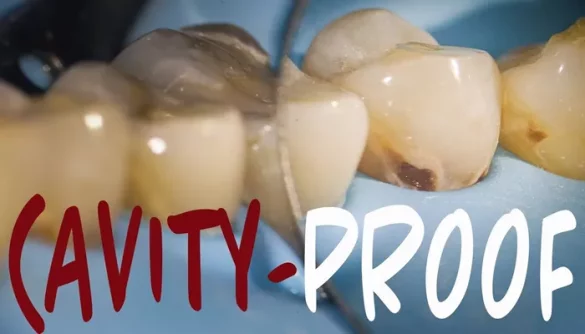
A new dental technology could dramatically reduce the need for repeated dental restorations by preventing secondary cavities. The innovation comes from research funded by the Department of Energy’s (DOE) Office of Science at Oak Ridge National Laboratory (ORNL).
Brazilian dentist Fernando Luis Esteban Florez, a tenured associate professor at the University of Oklahoma College of Dentistry, developed the world’s first long-acting antibacterial adhesive resin for dental restorations, including fillings and crowns. Secondary tooth decay around restoration edges is the primary reason these treatments must be replaced every five to seven years.
“My goal was to create dental adhesives that provide long-term protection against oral bacteria,” said Esteban Florez, lead inventor.
Working with Sharukh Khajotia, associate dean for research and innovation at the college, Esteban Florez accessed DOE’s 28 User Facilities. These facilities offer cutting-edge research tools to scientists worldwide at little or no cost. The team collaborated with ORNL scientists at the Center for Nanophase Materials Sciences and the High Flux Isotope Reactor.
“The DOE user program allowed me, a dentist without advanced scientific training, to access world-leading expertise and equipment,” Esteban Florez said. “It saved six to eight years of development time.”
Together, the researchers engineered multifunctional titanium dioxide nanoparticles with long-lasting antimicrobial properties. These particles generate reactive oxygen species, chemicals that destroy bacteria, viruses, and other microorganisms. Unlike antibiotics, microbes cannot develop resistance to them.
The nanoparticles were embedded in standard dental adhesive resin. Using a helium-ion microscope and small-angle neutron scattering, the team optimized particle shape, modifications, and dispersion within the polymer.
“Bio-SANS allowed us to see how proteins bonded to the nanoparticles and how evenly they dispersed in the resin,” Khajotia explained.
The results showed, for the first time in dentistry, nanoparticles evenly dispersed in the resin without clustering, maintaining strong antibacterial activity without light activation.
Esteban Florez said the patented technology has commercial potential beyond dentistry. “We are in talks with a leading dental products company to bring this technology to market. Its versatility could extend to teeth whitening products, medical devices, and surface coatings in public spaces like hospitals and airports to reduce bacteria and viruses.”
This breakthrough demonstrates how collaboration between dental research and national laboratories can accelerate innovation, potentially changing dental care and public health practices worldwide.