


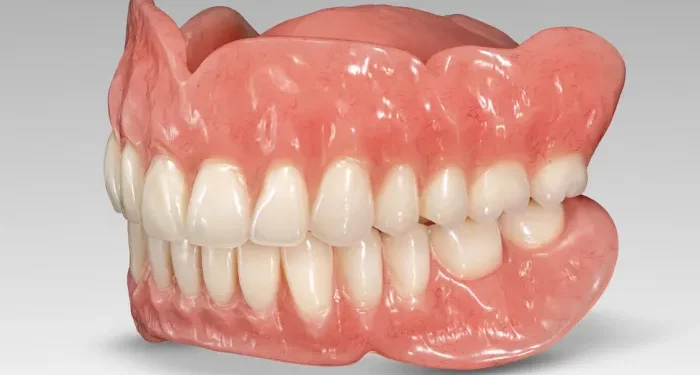
Recent advancements in digital denture manufacturing are significantly changing operations in dental laboratories. Leading industry players are introducing new technologies and materials that allow for more personalized, precise, and efficient production of dentures, improving both patient outcomes and business models for dental laboratories.
HeyGears recently introduced its One-Piece Denture Solution, which employs UltraCraft MMF (Multi-Material Fusion) DLP 3D printing. Unlike traditional dentures that require adhesive bonding between the base and teeth, this new approach creates a unified denture by fusing materials at the molecular level. This results in a single, seamless structure that improves retention strength, reliability, and durability. Precision testing across 15 cases demonstrated exceptional accuracy, with 100% of dentures achieving elevation within 0.8 mm and over half within 0.5 mm—standards that usually need no extra adjustment. In contrast, conventional bonded dentures often require substantial chairside work.
The single-piece process maintains detailed anatomical features, leading to dentures that look and feel more natural while reducing the need for manual finishing. This technology also prioritizes hygiene, as the absence of gaps and seams helps limit plaque build-up and supports better oral health for patients over the long term.
3D Systems has also expanded its digital denture offerings, adding three new gum shades—Dark Pink, Light Pink, and Red Pink—to its NextDent Jetted Denture Solution. These new colors give dental laboratories more options to match natural gum variations, enabling restorations that are individually tailored for each patient. The NextDent system prints both the denture base and teeth together as one monolithic unit, eliminating assembly steps and minimizing post-print processing. The efficiency improvements include up to three times faster production and over 50% less manual labor compared to traditional workflows.
Dental laboratories using these advanced systems have reported strong benefits, including higher quality end products, stability of materials, and an improved overall workflow. With these developments, dental laboratories are able to scale production, reduce hands-on work, and offer better-fitting, more attractive dentures that meet the needs of a diverse patient population.
Tags: denturesteeth Read More