


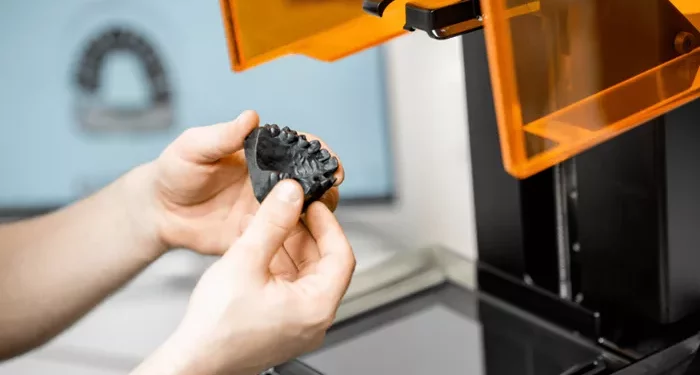
Removable partial dentures (RPDs) are transforming dental care by restoring smiles and improving eating and speaking for patients with missing teeth. As a non-invasive and cost-effective alternative to implants, RPDs are becoming increasingly popular. 3D printing technology has played a key role in making these devices faster and more precise.
Florida-based GPS Digital RPD specializes in partial frameworks and flexible dentures, leveraging a fully digital workflow powered by 3D Systems’ printing solutions. The process begins with a 3D scan of the patient’s mouth, which is used to create a CAD model.
Metal frameworks are then printed on a DMP Flex 200 printer. With two machines in operation, the lab can produce up to 130 frameworks daily. “Our DMP Flex 200 systems enable flawless ‘lights out’ production every night,” said Josh Williams, General Manager of GPS Digital RPD.
Simultaneously, the lab prints monolithic dentures on the FDA-cleared NextDent 300, launched by 3D Systems in 2025. This multi-material printer produces realistic teeth and gums as a single part.
With a build volume of 295 x 211 x 50 mm, it can print around 15 dentures at a time using FDA-approved materials, including NextDent Jet Base LT and NextDent Jet Teeth White and Yellow. “The NextDent 300 delivers incredibly realistic dentures with perfect color and zero delamination,” added Williams.
Once printed, the metal frameworks and dentures are temporarily assembled with wax and sent to clients for fitting. Approved pieces are finalized with acrylic before delivery.
The process has reduced production timelines dramatically. Whereas it once took about 15 working days, the first finished RPDs can now be produced in nine days, and sometimes as fast as four, accounting for weather and power interruptions.
GPS Digital RPD’s adoption of advanced 3D printing illustrates the growing impact of digital dentistry. 3D Systems will showcase its solutions at Formnext 2025 in Frankfurt, Germany, at Hall 11.1, Booth D11.