


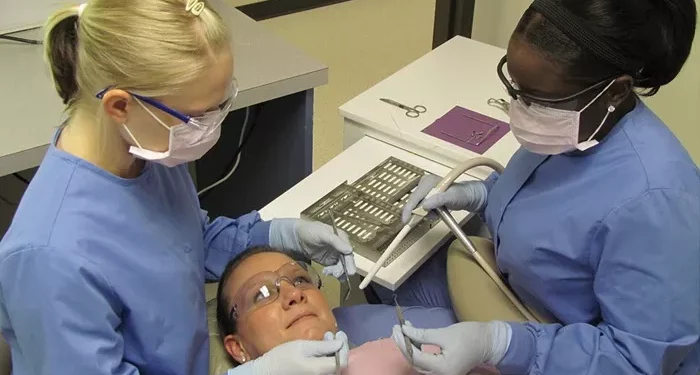
Anne Arundel Community College (AACC) launched a new associate’s degree in dental hygiene this fall, aiming to address the growing shortage of dental health professionals nationwide.
The five-semester program, with an inaugural class of 10 students, combines classroom learning with clinical training to prepare graduates for licensure exams and for careers in dental hygiene, dentistry, or advanced studies.
“There is a critical shortage of dental hygienists,” said B.P. Patel, Director of Dental Education at AACC. “This program will help develop the dental hygienist workforce and ensure students are able to quickly enter the job market.”
According to the U.S. Bureau of Labor Statistics, employment for dental hygienists is projected to grow by 9% from 2023 to 2033, slower than the 38% growth projected from 2018 to 2028.
However, experts note that the profession has shifted from oversaturation to shortage. “A nationwide dental hygienist shortage is imminent,” Lori Hendrick, a dental hygienist from North Carolina, wrote in Dental Hygiene Dimensions magazine.
AACC now joins six other colleges in Maryland that offer two-year dental hygiene programs. Students will receive 15 weeks of practical experience before taking the licensing exam. Low-cost services, such as $35 dental cleanings and $25 dental scans, are available to students, faculty, staff, and the community. The college also accepts patients’ dental insurance.
“This provides an affordable option for those who might otherwise not have access to dental care,” says Patel.
Patel, who holds a master’s degree in dental hygiene from the Massachusetts College of Pharmacy and Health Sciences, notes that graduates can earn annual salaries of up to $140,000.
To qualify for admission, students must complete six prerequisite courses: microbiology, biochemistry, mathematics, English, psychology, and either human biology or anatomy and physiology. Several students in AACC’s dental assisting program are expected to transfer to the new track.
Kailey Howell, a first-year dental assisting student, says the new program provides valuable opportunities for career advancement. “For students like me who want to continue their education and become dental hygienists, this is great,” she says. “I think this program will be successful—a lot of students from nearby universities will come here.”