
Failed Dental Implant: Can It Be Replaced Successfully?
On this page~11 min read
Key Takeaway
A failed dental implant does not automatically mean that implant treatment is over. The first step is to identify what has actually failed: the implant fixture in the bone, the surrounding tissues, or the prosthetic components such as the crown, bridge, screw, or abutment. Many complications can be repaired without removing the implant, while a truly failed or non-restorable implant may need to be removed and replaced after the site is carefully assessed. Long-term evidence remains favorable: a systematic review reported an estimated 10-year implant survival of 96.4% in conventional analysis, although survival varies with patient health, bone quality, oral hygiene, smoking, periodontal history, loading, and maintenance. A newer systematic review of implants placed in previously failed sites reported a 1-year survival rate of 96.7%, supporting reimplantation as a realistic option in appropriate cases.
Featured Answer: Can You Get Another Dental Implant If One Fails?
Yes. In many cases, another dental implant can be placed after a failed implant is removed, provided the cause of failure is identified and the remaining bone and soft tissue can support retreatment. Some patients can receive a replacement implant at the same appointment, while others need healing, infection control, or bone grafting first. A 2024 systematic review and meta-analysis found a 96.7% one-year survival rate for implants placed at sites where a previous implant had failed. However, replacement is not automatically the right choice. If the implant fixture is stable and the problem is limited to a crown, screw, bridge, or abutment, repairing the prosthetic part may be preferable to removing the implant itself.
What Does a “Failed Dental Implant” Actually Mean?
When patients say that a dental implant has “failed,” they may be describing very different problems. Dental implant treatment has several parts: the implant fixture anchored in the jawbone, the abutment that connects the fixture to the restoration, and the visible crown or bridge. Full-arch treatments add even more components, because multiple implants may support a single fixed prosthesis. A crack in the ceramic, a loosened screw, a damaged abutment, and loss of bone around an implant can all feel like the same problem to a patient, but they do not require the same treatment.
A true biological implant failure usually means that the implant has lost or never achieved stable osseointegration, or that progressive disease around the implant has destroyed enough supporting tissue that the implant can no longer function predictably. Early failures occur before or around the initial healing phase and are often associated with failure of osseointegration, infection, inadequate primary stability, or surgical and host-related factors. Late failures occur after the implant has been functioning and may be associated with peri-implantitis, biomechanical overload, prosthetic problems, or a combination of factors. A recent scoping review of the literature emphasized that implant failure is multifactorial rather than the result of one universal cause.
Prosthetic complications are different. A crown can chip, a full-arch bridge can wear or fracture, screws can loosen, and an abutment may become damaged or impossible to reuse. In these situations, the implant fixture in the bone may still be integrated. That distinction matters because removing a stable implant unnecessarily sacrifices bone and makes treatment more invasive. A thorough assessment therefore normally includes clinical examination, checking mobility, evaluating the bite and prosthesis, periodontal probing where appropriate, and imaging to assess bone around the implants.
This is also why a patient who has had implant-supported teeth for many years should not assume that an old restoration has reached a fixed “expiration date.” Implant fixtures and prosthetic teeth age differently. The implant may remain healthy while the restoration above it needs maintenance or replacement. Conversely, an apparently intact crown can hide inflammation and bone loss around the implant. Long-term success depends on both biological stability and the mechanical condition of the restoration.
How Long Do Dental Implants Last, and How Often Do They Fail?
Dental implants are designed as a long-term tooth-replacement option, and survival rates are generally high. In a systematic review of prospective studies with at least 10 years of follow-up, the conventional pooled estimate for implant survival at 10 years was 96.4%. A sensitivity analysis that accounted more conservatively for missing follow-up data produced a lower estimate of 93.2%. These numbers are useful for setting expectations, but they should not be interpreted as a guarantee that every implant will last a specific number of years.
The American Academy of Periodontology notes that with proper oral hygiene and professional maintenance, an implant can potentially last a lifetime. In practice, however, the implant fixture and the prosthetic restoration do not always have the same lifespan. Crowns, bridges, screws, and other restorative components are exposed to chewing forces every day and may need repair or replacement even when the implant itself remains stable. This is particularly relevant for full-arch cases, where one prosthesis distributes forces across several implants and component wear can accumulate over time.
Failure rates also depend on how failure is defined and when it occurs. A 2025 scoping review that summarized decades of implant literature reported early failure ranges of approximately 0.5% to 5.2% and late failure ranges of approximately 0.5% to 7.8% across included reports. Those ranges should be read cautiously because studies use different patient populations, implant systems, follow-up periods, and definitions. The more useful clinical message is that most implants survive, but failure remains possible and risk is not evenly distributed among patients.
Known risk factors include poor plaque control, a history of periodontal disease, smoking, uncontrolled diabetes, poor bone quality, biomechanical overload, and peri-implant inflammation. The American Academy of Periodontology specifically identifies previous periodontal disease, poor plaque control, smoking, and diabetes as important risk factors for peri-implant disease. This is why maintenance visits remain important even when an implant feels completely normal.
Patients should also understand that a high survival rate does not mean “maintenance-free.” Implant restorations still need brushing, interdental cleaning, professional review, and periodic evaluation of the bite and prosthetic components. Bruxism or clenching may increase mechanical stress. If a patient has a full-arch bridge, clinicians may also need to inspect screws, prosthetic wear, hygiene access, and the tissue underneath the bridge. Long-term implant care is therefore closer to maintaining a complex restoration than simply replacing a tooth and forgetting about it.
Signs That a Dental Implant May Be Failing
Some implant problems are painless at first, so regular checkups matter. Others create obvious symptoms. Cleveland Clinic and the American Academy of Periodontology list warning signs such as implant mobility, bleeding or swollen gums, pus, and inflammation around the implant. Peri-implantitis can cause progressive loss of the bone supporting the implant and may require surgical treatment.
- A loose or wobbly implant, or a restoration that suddenly feels mobile.
- Bleeding, redness, tenderness, or swelling around an implant.
- Pus, a bad taste, or signs of infection around the implant site.
- Pain during chewing or new discomfort after a period of normal function.
- A change in the bite, a bridge that feels different, or repeated screw loosening.
- Visible recession or an increasing space around the implant restoration.
- Fracture, chipping, or wear of the crown or full-arch prosthesis.
Mobility deserves special attention. A natural tooth has a periodontal ligament and therefore a tiny amount of physiological movement; a successfully osseointegrated implant does not. If the implant fixture itself is mobile, it generally indicates loss of integration and requires prompt evaluation. However, patients cannot always tell whether the fixture is moving or only the crown, bridge, screw, or abutment is loose. That is another reason not to self-diagnose a failed implant from movement alone.
Can a Failed Dental Implant Be Replaced Successfully?
Often, yes. Replacement treatment is commonly called implant replacement, reimplantation, or retreatment. The treatment sequence depends on the reason for the original failure and the condition of the site. If a failed implant is removed and the site has adequate healthy bone, good primary stability, and no uncontrolled infection, the clinician may consider immediate replacement. If the site has significant infection, bone loss, or poor soft tissue conditions, staged treatment may be safer: remove the failed implant, debride the area, allow healing or perform bone augmentation, and place a new implant later.
Before placing another implant, the clinician should ask why the first treatment failed. If the problem was peri-implantitis, uncontrolled plaque, smoking, poor glucose control, bruxism, insufficient bone, prosthetic overload, or an unfavorable implant position, repeating the same treatment without correcting the cause may recreate the same problem. For this reason, retreatment planning can involve periodontal therapy, hygiene improvement, occlusal adjustment, bone grafting, changing implant number or distribution, or redesigning the prosthesis.
Huangshan Dental Case: Rebuilding a Worn Full-Arch Implant Restoration
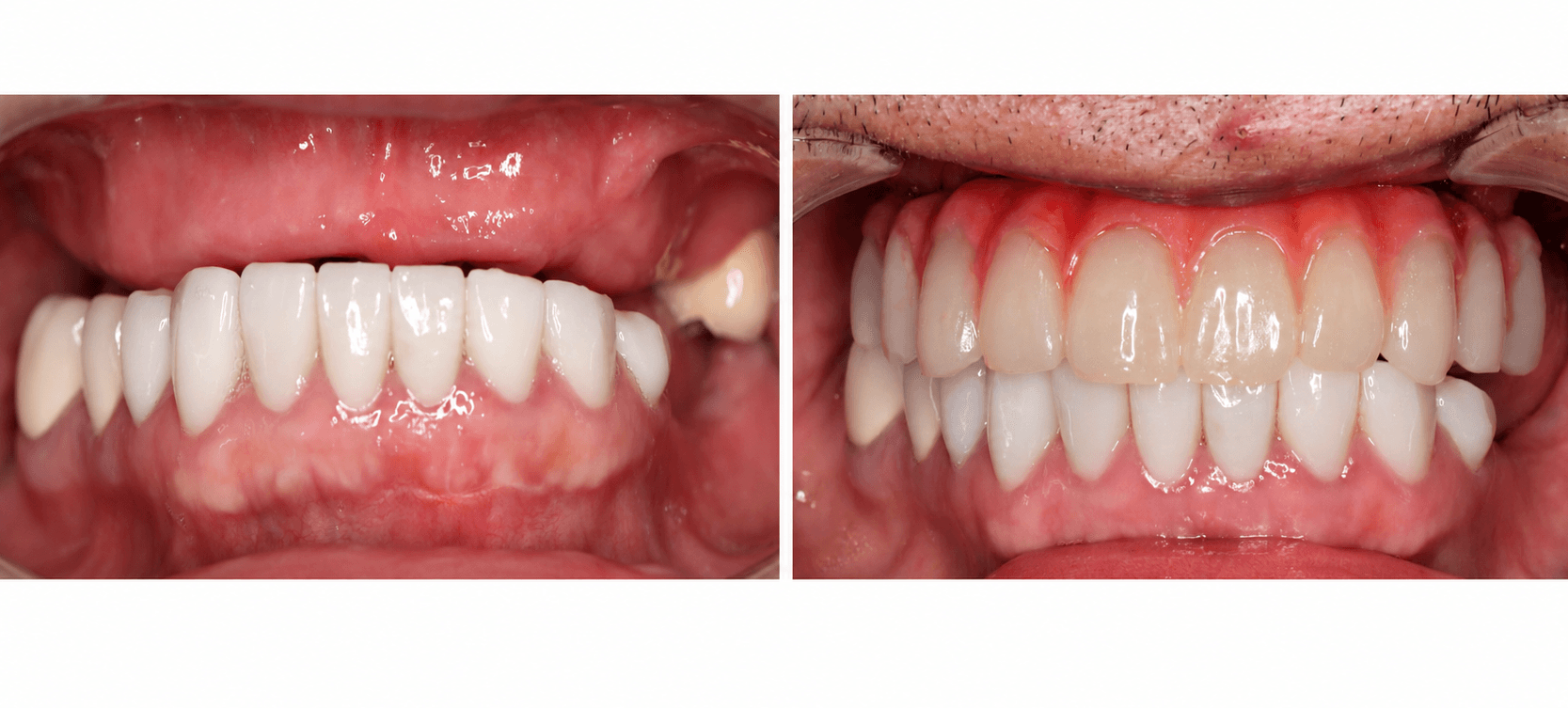
Mr. Marin, age 62, came to Huangshan Dental after having previously received full-mouth all-ceramic restorations at another dental provider. After long-term use, the upper restorations had become damaged. The problem was not approached as a simple matter of replacing a visible broken crown. The Huangshan Dental team first evaluated the condition of the upper full-arch restoration and the supporting components to determine whether the existing system could still be predictably reused.
After the upper prosthetic crowns were removed, the team found that the abutment components could not be reused. His maxillary bone condition, however, was considered suitable for a new implant-supported treatment plan. Based on the clinical assessment, the team decided to reconstruct the upper arch using six Straumann BLT implants in an All-on-6 configuration, combined with bone grafting and an immediate-loading approach.
Immediate loading means that a provisional fixed restoration is connected within a short period after implant placement rather than waiting months before the patient receives fixed teeth. This approach is not appropriate for every patient; it depends on factors such as primary implant stability, bone quality, implant distribution, occlusion, and the clinician's judgment. In Mr. Marin's case, the treatment plan was selected because the team considered his available bone and overall conditions compatible with this protocol.
At postoperative review, the upper arch was healing well and Mr. Marin was able to continue normal daily activities. The case illustrates an important point about a suspected failed dental implant: treatment should not start with the assumption that the old system can simply be repaired, nor with the assumption that every component must be removed. The prosthesis, abutments, implants, bone, soft tissue, and bite all need to be assessed together. In this case, the previous upper restoration and abutment system was no longer serviceable, so a new full-arch implant reconstruction was chosen.
This individual case should not be used to predict another patient's outcome. Full-arch retreatment can differ substantially depending on the cause of failure, number and position of remaining implants, available bone, history of peri-implantitis or periodontal disease, systemic health, smoking, bite forces, and the condition of the opposing arch. A CBCT scan and in-person examination are typically required before deciding whether repair, selective replacement, or complete retreatment is appropriate.
Repair or Replace? Common Failed Dental Implant Scenarios
| Problem | What May Have Failed | Possible Treatment Direction | Does the Implant Need Removal? |
|---|---|---|---|
| Chipped or fractured crown | Crown / ceramic restoration | Repair or replace crown; check bite and occlusion | Usually no, if fixture is stable |
| Loose implant crown or bridge | Prosthetic screw, abutment, restoration | Retighten or replace component after clinical evaluation | Often no |
| Damaged or non-reusable abutment | Abutment / prosthetic interface | Replace abutment or redesign restoration; full-arch cases may need broader reconstruction | Not always |
| Bleeding and bone loss around implant | Peri-implant tissues | Professional debridement; periodontal/peri-implant therapy; surgery may be needed | Only if prognosis is poor or implant is unstable |
| Mobile implant fixture | Osseointegration / supporting bone | Remove failed fixture, assess cause and bone, then consider reimplantation | Often yes |
| Failed implant with adequate bone | Implant fixture | Immediate or delayed replacement depending on infection and primary stability | Failed implant removed; new implant may be placed |
| Failed implant with major bone loss | Implant fixture + supporting bone | Removal, debridement, bone grafting and staged replacement may be considered | Usually yes, followed by site reconstruction |
FAQ
How common is a failed dental implant?
Dental implant failure is uncommon, but it is not zero. A systematic review estimated 10-year implant survival at about 96.4% in conventional analysis, meaning most implants remained in place at 10 years. Failure rates vary with patient health, smoking, periodontal history, bone quality, implant position, oral hygiene, loading, and follow-up. Some studies also distinguish early failure during healing from late failure after the implant has been functioning.
What happens if my dental implants fail?
Your dentist first determines whether the problem involves the implant fixture, surrounding bone and gum, or only the crown, bridge, screw, or abutment. A prosthetic problem may be repaired without removing the implant. A mobile or non-restorable implant may need removal. Depending on bone and infection, another implant can sometimes be placed immediately; in other cases, healing or bone grafting is needed before reimplantation.
Conclusion
A failed dental implant can often be treated, and in selected cases it can be replaced successfully. The most important step is an accurate diagnosis. A broken crown, damaged abutment, loose screw, peri-implant infection, and a mobile implant fixture are different problems and should not be treated as if they were interchangeable. Long-term implant survival is high, but ongoing maintenance remains essential. When an implant truly fails, published evidence supports replacement as a viable option for many patients, although the cause of the original failure should be addressed before retreatment. For complex full-arch cases, treatment planning may involve new implants, bone grafting, prosthetic redesign, or a combination of these approaches. Patients with mobility, swelling, bleeding, pus, persistent pain, or changes in their implant-supported bridge should arrange a dental evaluation rather than waiting for the problem to worsen.
Disclaimer
This article is for general education and does not provide a diagnosis or individualized medical advice. Seek prompt dental care if an implant becomes mobile or if you develop persistent pain, swelling, bleeding, pus, fever, or other signs of infection.