


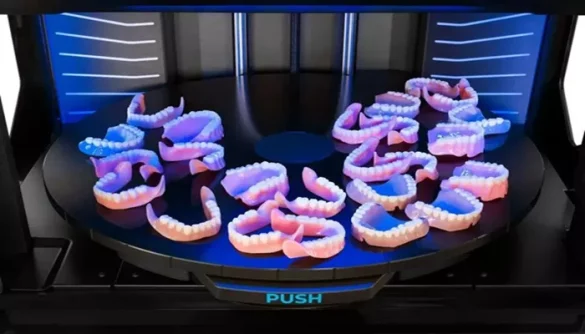
At LMT Lab Day Chicago 2025, Carbon introduced FP3D, a new resin for flexible, removable partial dentures. The material is the first in dentistry to use Carbon’s dual-cure chemistry, a technology that has already transformed industries such as footwear, cycling, and sports equipment.
FP3D differs from traditional single-cure dental resins by adding a secondary heat-activated step that strengthens parts after printing. This process allows dental professionals to achieve both precision and durability, resulting in devices that can better withstand daily use. Carbon describes the resin as delivering “engineering-grade” performance from a 3D printed dental appliance.
Carbon has a history of validating its dual-cure materials in demanding applications. The same technology has been used to produce Riddell’s 3D printed football helmet liners, midsoles for leading running shoe brands, and bicycle saddles designed for comfort and mechanical reliability. Bringing this approach to dental devices aligns with the growing adoption of digital workflows in dental labs.
Alongside FP3D, Carbon announced updates to its automation suite. These include no-code print preparation software and an expanded polishing system compatible with its M3 printers. The tools aim to streamline lab operations, reduce manual labor, and ensure consistent quality in printed parts.
Although FP3D is still under FDA review and not yet available in the United States, its launch signals a shift in dental manufacturing. By combining advanced materials with automation, Carbon is positioning 3D printing as a faster, more reliable, and innovative alternative to conventional methods.
The introduction of FP3D highlights the potential for digital dentistry to meet both clinical and practical demands. Dental labs adopting these technologies may soon offer patients devices that are not only precise and durable but also produced more efficiently.
Carbon’s move demonstrates how cross-industry innovations can reshape healthcare applications. As dental professionals explore these new materials, the company expects its dual-cure approach to set new standards for 3D printed dental devices.