


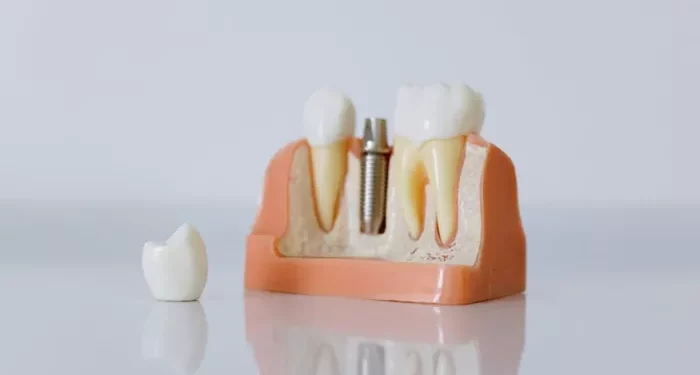
Dental implants have revolutionized modern dentistry, offering a reliable solution for missing teeth. Introduced more than 60 years ago by Dr. Per-Ingvar Brånemark, titanium implants have success rates of up to 98 percent. Yet one challenge persists: peri-implantitis, a bacterial infection that erodes the bone supporting an implant.
Current treatments, including cleaning, flap surgery, or implantoplasty, can be invasive and unpredictable. Failure of these therapies can cause implants to loosen or fall out.
Now, researchers at the University of Louisville may have a solution. Dr. Omar Moustafa, a prosthodontist and researcher, has developed a modular implant design called “Reattach,” currently under provisional patent. The concept aims to improve outcomes for patients at high risk of peri-implantitis.
“The idea came to me during residency,” Moustafa said. “We had a patient with early implant failure, and I wondered if a design modification could help.” He refined the idea with fellow resident Dr. Hassan Alamri at The Ohio State University and pursued it further after joining UofL in 2024.
Engineering expertise was key to turning the concept into a prototype. Moustafa collaborated with the Additive Manufacturing Institute of Science & Technology (AMIST) at UofL’s Speed School of Engineering. AMIST staff, including Coordinator Justin Gillham and student Owen Mattingly, helped model the implant and conducted finite element analysis to ensure its mechanical stability. Within six months, the team produced a large-scale plastic prototype suitable for titanium manufacturing.
While promising, the implant must undergo extensive testing before reaching patients. “Because it goes in the human mouth, it’s considered a medical device,” Moustafa explained. “It must pass bench studies, animal tests, and human trials before FDA approval.”
The project underscores the power of interdisciplinary collaboration. AMIST routinely partners with researchers across campus to apply engineering solutions to challenges in health, athletics, and industry. Moustafa said, “Engineering helped make the concept a reality.” If successful, the modular implant could offer a new approach to dental care for years to come.