


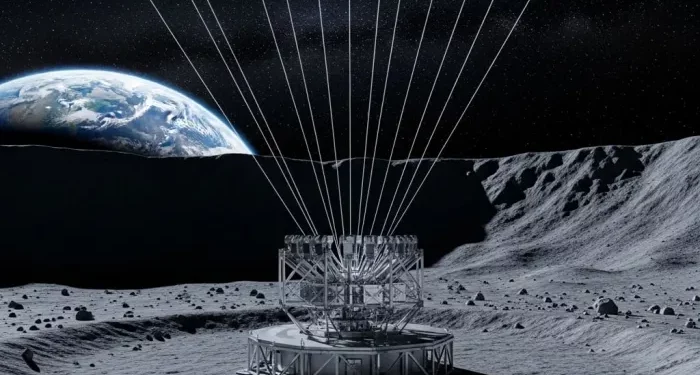
Researchers are pushing the boundaries of physics and engineering by making use of cavity structures for advanced scientific applications both on Earth and on the Moon. Recently, scientists have demonstrated innovative approaches that rely on the unique environments found in lunar craters and sophisticated photonic devices to achieve remarkable performance in precision measurement and quantum light manipulation.
In one significant study, scientists have evaluated the feasibility of building ultrastable optical resonators in the Moon’s permanently shadowed regions (PSRs). These locales are among the coldest places in the solar system, offering an environment with exceptional temperature stability and ultra-high vacuum conditions. According to the analysis, silicon cavities constructed within these PSRs could achieve long-term laser coherence, greatly surpassing the stability of current systems on Earth. Such technology is expected to form the backbone for a variety of space-based applications, including lunar time standards, advanced optical networks, and tests of fundamental physical laws.
The researchers modeled the thermal conditions and predicted that a 10-centimeter silicon cavity could reach temperatures below 100 millikelvin, supporting lasers whose coherence times can exceed one minute. This leap in stability and performance is possible due to the PSRs’ isolation from solar radiation, extremely low seismic and acoustic noise, and the persistent vacuum maintained by the Moon’s weak gravity and lack of atmosphere. These features make lunar cavities ideal for precision instruments and future quantum technologies.
Meanwhile, advances in cavity quantum electrodynamics on Earth are enabling new ways to manipulate light and matter interactions at the quantum level. Scientists have engineered on-chip photonic circuits that integrate high-quality quantum emitters, modulators, and actuators to access exceptional points (EPs), special features in non-Hermitian systems. By tuning the coupling within these cavities, they have achieved novel emission dynamics—such as lifetime modulation and tunable emission chirality—as well as shaped photon emission spectra in unprecedented ways. This work not only sheds light on peculiar quantum phenomena, but also paves the way for topological quantum light sources and enhanced photon control for cutting-edge quantum devices.
Both lines of research highlight the importance of cavities—whether in lunar craters or engineered photonic structures—for advancing our understanding and capabilities in precision measurement, quantum communication, and fundamental physics. As technological progress continues, harnessing the special properties of cavities is expected to drive innovation in space missions, quantum networks, and basic science, with implications for future deep-space exploration and the establishment of planetary standards for time and navigation.
Read More