


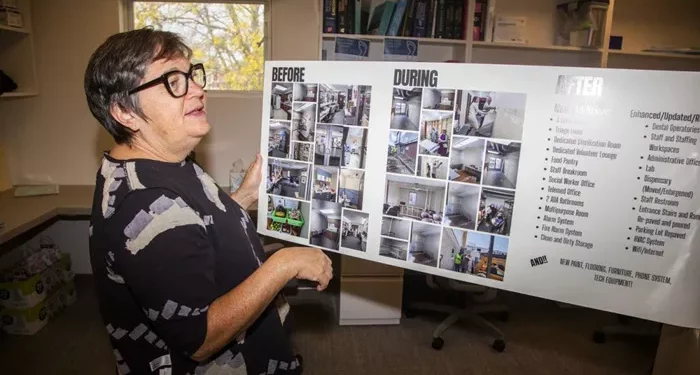
Iowa City — The Iowa City Free Medical and Dental Clinic has completed a $1.35 million renovation intended to expand capacity and modernize facilities as demand for free health services surges.
The upgrades — funded with a $1 million American Rescue Plan Act (ARPA) grant from the City of Iowa City and $350,000 from Johnson County’s ARPA-funded Building Nonprofit Capacity Grant Program — began in December 2023 and concluded with an open house on Oct. 8.
Clinic officials say demand has climbed sharply: the facility treated 6,715 patients in fiscal 2024, up 18 percent from 5,691 in 2023. Nationally, the National Association of Free Charities and Clinics reported in its 2025 data that 81 percent of clinics saw increased need, totaling roughly 6 million visits last year.
“We’re seeing more people who fall through the cracks of insurance,” said Jennie Schmidt, the clinic’s executive director. She pointed to new Medicaid work-verification rules and the impending expiration of some Affordable Care Act subsidies as possible drivers of rising uninsured rates, though she added that the exact causes are unclear.
The renovation focused on efficiency and health: upgrades included a modern HVAC system, three triage exam spaces, a dispensary that is three times larger, expanded staff work areas and replacement of old carpeting.
The new triage room lets staff assess patients quickly so simple needs — blood pressure checks, basic injections — don’t occupy full exam rooms, a change expected to shorten a current three-month waitlist.
“The triage room will free up exam rooms for more serious cases,” Schmidt said.
Clinic leaders hope the modernized space will also attract volunteers and donors. The clinic has hired a dentist for two nights a week and plans to relaunch its volunteer dental program in January, aiming for four to six rotating dental volunteers. Dental services such as fillings, extractions and exams are planned for Mondays and Thursdays.
Lisa Steigleder, the clinic’s development director, said the extra exam rooms will let providers move smoothly between patients and boost throughput.
“Patients can be roomed and ready to go as the provider moves,” she said. She added that an updated facility should help with fundraising and sponsorships.
Dental care remains a significant challenge. According to the CareQuest Institute for Oral Health, about 27 percent of U.S. adults lack dental insurance; Medicaid reimbursement rates are often low, discouraging providers from accepting it.
Rohit Nair, an associate professor at the University of Iowa College of Dentistry, noted Medicare also excludes routine dental benefits, leaving many adults with large out-of-pocket costs.
“When people delay care, minor problems become severe,” Schmidt said, noting many end up in emergency rooms where staff can only provide pain management, not definitive dental treatment.
Operating the clinic cost roughly $950,000 in 2024, according to ProPublica’s Nonprofit Explorer, and the nonprofit continues to rely on local funding, grants, fundraising and private donations to meet demand.
Schmidt said the clinic’s long-term hope is to reduce barriers to care: “Our dream would be to go out of business — to live in a world where there are no barriers to health care.”