


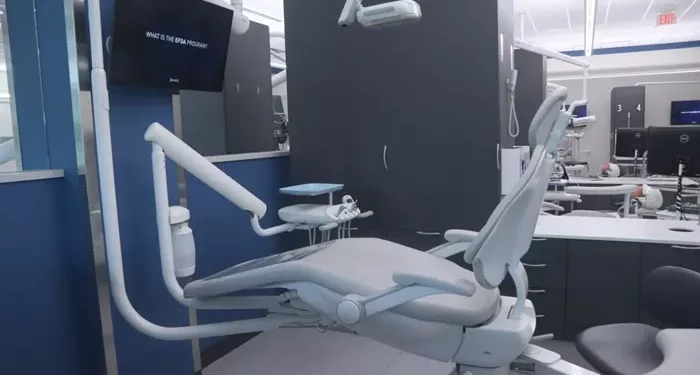
On September 19th, Madison College held a ribbon-cutting ceremony for its new $3.08 million dental clinic, designed to broaden student training and increase access to care throughout Wisconsin.
The clinic features 15 computerized treatment chairs, a central sterilization area, and advanced technology designed to simulate a real-world dental office.
The opening of the clinic coincides with the college’s launch of the Expanded Function Dental Assistant (EFDA) credential, a state-approved credential signed into law by Governor Tony Evers in 2022.
The EFDA certification expands the scope of practice for dental assistants, allowing them to perform tasks such as creating temporary crowns, adjusting dentures, removing oral appliances, polishing, and applying fluoride and sealants.
Madison College’s EFDA program is a semester-long, 11-credit program leading to a Wisconsin-level credential.
The college says the program will not only increase students’ earning potential but also help address the national dental professional shortage.
“This will not only impact our students, but also workforce development, clients, and people we haven’t met yet,” said Dr. Beth Giles-Klinkner. “It will enable our students to earn a livable wage, and it will have a ripple effect throughout the community.”
Madison College cites research showing that assistants with EFDA certification generally earn higher wages. A study in the Dental Post found that EFDA certification increases average hourly wages by $2.67, or about $4,806 per year.
Madison College officials say the expanded training will help close the gap in dental care.
They estimate that more than 867,000 residents in Wisconsin are currently affected by the dental professional shortage, and they hope a new wave of trained assistants will alleviate the demand.
The college also plans targeted outreach to diversify its enrollment. Marissa Tokarcyzk, dean of health sciences, said Madison College is working with local Hispanic centers to recruit underrepresented students and is seeking funding to lower or eliminate tuition barriers for students balancing academics, work, and family responsibilities.
“We built this space to provide an experience like a real dental office,” Tokarczyk said. “Now we want to ensure students can move freely here without having to choose between school and other obligations.”