


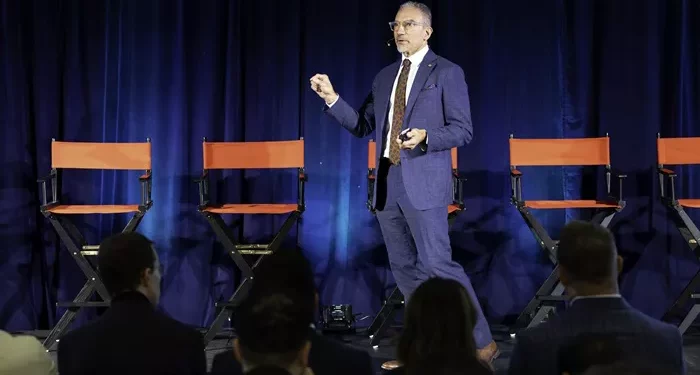
Oral health is part of overall health, and U.S. dental benefits must reflect that connection, American Dental Association President Brett Kessler, D.D.S., said in a keynote at ADA Forsyth dentech 2025.
Speaking Oct. 9 at the ADA Forsyth Institute in Somerville, Massachusetts, Dr. Kessler called for major reforms to a benefits system that, he said, separates the mouth from the body. “The benefit system that we’re in disconnects the mouth from the body,” he told attendees.
Dr. Kessler proposed several policy changes to align dental coverage with broader health care standards. Suggestions included mandated coverage for essential dental services, no-cost preventive care, limits on out-of-pocket spending, and medical loss ratios or similar accountability measures for insurers.
He argued that many services important to oral—and overall—health are not reimbursed under current dental plans. “Oral hygiene instruction, nutrition counseling, smoking cessation and more should all be billable to dental insurance,” he said. “All that’s billable in the medical world; it’s not billable in dentistry.”
Those services, Dr. Kessler added, are already provided by dentists because they improve patient health, but clinicians are rarely paid for them. He urged moving toward outcome-based payment: remunerating practices when coaching and preventive care demonstrably make patients healthier, not only when repairs are performed.
The remarks echo the ADA’s recent advocacy work. In January the association published an editorial by Dr. Kessler in The Washington Post and sent letters to then-President-elect Donald Trump and members of the 119th Congress stressing oral health’s role in public health.
ADA leaders also met at the White House in May with Heidi Overton, M.D., Ph.D., to discuss community water fluoridation, infection control, oral health infrastructure and NIH research funding.
In September, Dr. Kessler and Scott D. Smith, D.D.S., published an editorial in JAMA Health Forum warning that efforts to remove community water fluoridation could reverse decades of progress in public oral health.
The ADA president framed his proposals as part of the association’s mission to help dentists succeed while advancing public health. “Our mission and vision use the word ‘health,’ not just ‘oral health,’” he said, noting that dentistry has a central role in improving people’s overall well-being.