


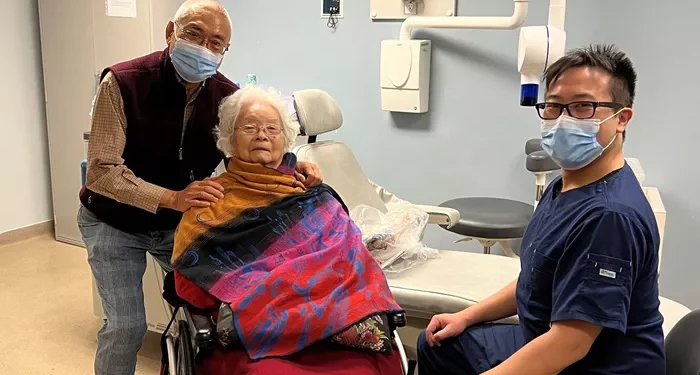
For years, a Florida mother drove five hours and paid nearly $4,000 per visit so her son with intellectual and developmental disabilities (IDDs) could receive routine dental cleanings under sedation. It was the only option that worked — and it came at a steep financial and emotional cost.
That changed when she found Dr. Bryan Smallwood, D.M.D., M.P.H., C.P.H., at the Florida Department of Health in Marion County. A 2022 graduate of the University of Florida College of Dentistry, Smallwood is known for a patient-centered approach that emphasizes communication and trust.
“I talked to the patient, explained each step and worked slowly,” Smallwood said.
For the first time, her son completed a full dental exam, radiographs and a cleaning without sedation. The visit cost less than $100 out of pocket. For the family, it underscored a broader issue: the barrier was not the patient, but a system unprepared to meet his needs.
An estimated 470,000 Floridians live with IDDs, according to the Florida Developmental Disabilities Council. Yet access to dental care remains limited. Nationally, only 56% of adults with disabilities saw a dentist in the past year, compared with 70% of adults without disabilities, according to the State of Oral Health Equity in America survey.
First-year UF dental student Lauren Mai set out to understand why. Working with faculty mentor Astha Singhal, B.D.S., M.P.H., Ph.D., she studied barriers to care as part of the UF College of Dentistry Summer Research Program.
“Most dentists reported minimal or no formal training in treating patients with IDDs in dental school,” Mai said, based on interviews with 15 general dentists across Florida.
Her research identified four key solutions: targeted continuing education, early exposure during dental school, mentorship and systemic support. UF’s training model incorporates all four.
“The training is about learning how to communicate effectively,” Smallwood said, crediting Dr. Timothy Garvey, a longtime UF pediatric dentistry faculty member. “Some patients respond to pictures, others to numbers, and some need every step demonstrated.”
For nearly four decades, UF College of Dentistry faculty have trained residents at college-owned and affiliated clinics across Florida, including sites in Hialeah, St. Petersburg and Naples. Partnerships with organizations such as the Special Day Foundation, CareQuest Institute for Oral Health and the B. Thomas Golisano Foundation have expanded services.
In North Central Florida, UF also delivers preventive care through a mobile dental clinic serving patients at The Arc of Alachua County.
“There is a lack of provider education, financial support and compassion for this population,” said Whitney Haley, a UF-trained dental hygienist who coordinates home-based care for patients with IDDs. “I’ve seen patients move away from sedation, and I’ve seen new dentists go above and beyond to provide compassionate care.”
Since January 2024, 92 UF dental students have rotated through Marion County’s clinic under Smallwood’s supervision, with additional students training through the mobile unit. By October 2025, the clinic had treated 226 patients with IDDs — a more than 5,000% increase in two years.
The demand, educators say, was always present. What was missing were trained providers and adequate infrastructure.
That gap is now being addressed through a major expansion at the UF College of Dentistry. Construction on a 100,000-square-foot addition to the Dental Science Building is set to begin in August 2026, with completion expected in 2028. Renovation of the existing 11-story tower is scheduled to finish by 2030. The project represents the largest state investment in a medical science building at a Florida public university.
“Our Personalized Care Clinic will be designed to expand individualized care for patients with IDDs,” Dean Isabel Garcia said at the December 2025 groundbreaking. “Sensory-adapted rooms will provide a safer, more welcoming environment that reduces fear and improves access.”
For families long forced to travel hours for care, the changes signal a shift — one driven by local dentists trained to see possibility where others once saw limits.