


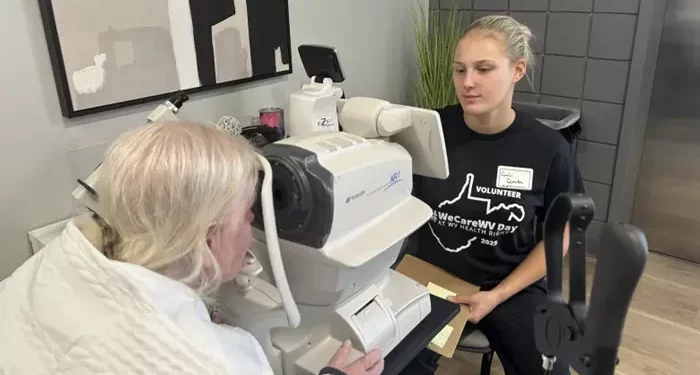
At 4:30 a.m., 80-year-old Mona Barrow boarded a bus from Dunbar to Charleston for a rare opportunity — a free visit to an eye doctor. Living on a fixed income, Barrow’s Medicare and Social Security don’t cover the eye care she needs.
“You work all your life and still have to pay big money just to be covered,” she said.
Last month, Barrow joined about 500 patients at West Virginia Health Right’s free medical, dental, and vision clinic in Charleston’s East End. The one-day event, staffed by 200 volunteers, offered care to people who otherwise couldn’t afford it. Many arrived before sunrise, hoping to secure one of 150 dental or vision slots.
Over the past decade, the clinic’s patient load has tripled to 45,000, said CEO and nurse practitioner Angie Settle. Now, with rising insurance premiums, the looming expiration of Affordable Care Act subsidies, and thousands expected to lose Medicaid under the state’s “Big Beautiful Bill,” the strain is growing.
“We’re already at capacity,” Settle said. “We’re expected to do more with less and just figure it out.”
“I Worked Until 75”
Barrow, who worked for decades in government — including a stint at the CIA — said she pays about $370 a month for a Medicare supplement plan that still doesn’t cover her cataract and vision needs.
“I’ve worked since I was 16,” she said. “You reach the end and realize you can’t afford the basics.”
Despite her patriotism, she doubts political leaders will fix the healthcare system. “Look at our parties,” she said. “It’s like we’re fighting another country.”
Four months pregnant and designated high-risk, Sarahi Prince, 37, held the 74th spot in line for a vision exam. She left her home an hour away at 4 a.m., her husband and two children waiting in the car because she couldn’t afford child care.
Prince, a shift lead at a fast-food restaurant, hasn’t seen an eye doctor in four years. After moving from poverty in Mexico, where her childhood home had tarp walls and dirt floors, she has struggled to afford insurance.
Now uninsured and experiencing bleeding during pregnancy, she has been shuttled among multiple doctors. “By the time I see one, they don’t even remember why I’m there,” she said.
For Kami Graves, 33, the clinic meant relief after years of frustration. She arrived at 8 a.m., too late for a vision slot but managed to see a dentist — her first cleaning in years.
Although she has Medicaid, she says most local providers won’t take new patients. “Every time I call, they tell me the waiting list is too long,” she said.
Graves, a single mother to a 5-year-old with autism, quit her job to focus on her daughter’s therapies. She’s now a part-time worker and college student, helping others with autism learn job skills — experience she hopes will help her daughter in the future.
Recently, stress triggered heart problems that cause dizziness and fainting. The only medication that works costs $300 a month in the U.S., so a friend buys it for her in Mexico for $50.
Still, she says the free dental cleaning will help her face the world with more confidence. “It’s going to boost my confidence, just to have a fresh, clean smile for job interviews.”
The stories of Barrow, Prince, and Graves reflect a broader crisis — one where rising healthcare and dental insurance costs push working Americans to rely on volunteer clinics for basic care.
For West Virginia Health Right and its patients, the need is overwhelming — and growing.
“We can’t turn people away,” Settle said. “But every year, it gets harder to keep up.”