


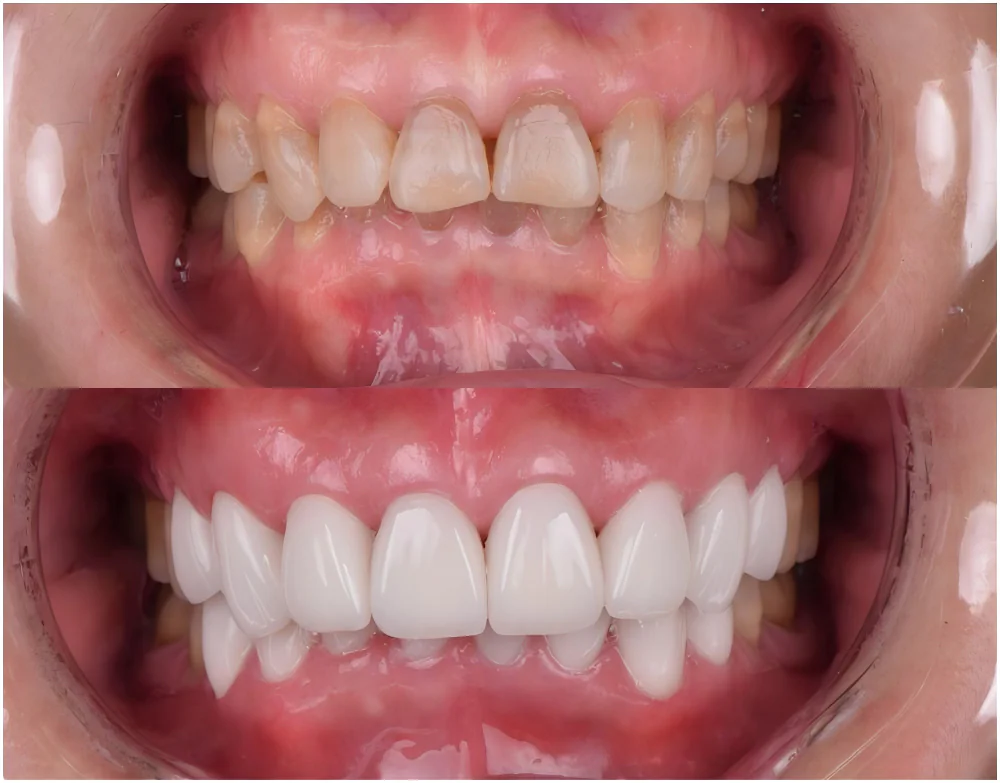
Tetracycline Teeth Case Overview
Tetracycline teeth often create deep color changes. In this Huangshan International Dental Hospital case, the patient had full-mouth brown-yellow discoloration from childhood. In addition, the teeth looked gray and dull. This made the smile appear darker than the patient wanted.
Unlike common surface stains, this type of discoloration usually sits inside the tooth structure. Therefore, daily brushing cannot remove it. Also, normal polishing cannot change the inner color. Many patients feel confused because their teeth stay dark even with good hygiene.
For this patient, the treatment goal was clear. The smile needed better color, better brightness, and better visual balance. However, the result still needed to look natural.
The planned solution was 16 E-MAX porcelain veneers. This plan could cover the visible smile area more evenly. Also, it could improve tooth shape and shade at the same time.
Why Brown-Yellow Teeth Can Be Difficult to Treat
Brown-yellow discoloration can have many causes. However, tetracycline-related staining is more complex. It usually forms when the teeth are still developing. As a result, the color becomes part of the tooth, not just a layer on the surface.
This explains why simple cleaning has limited effect. Cleaning removes plaque, tartar, and some external stains. Yet it cannot remove deep internal discoloration. Therefore, patients may still see dark teeth after professional cleaning.
In many tetracycline cases, the color may include:
- Brown-yellow areas
- Gray shadows
- Uneven bands
- Darker tooth necks
- Dull enamel appearance
- Full-mouth color inconsistency
Because the discoloration is uneven, treatment needs careful planning. A dentist should not only think about “making teeth white.” Instead, the dentist should consider shade masking, smile harmony, and tooth proportion.
For this reason, porcelain veneers can be a strong option. They allow the dentist to control the visible color more precisely.
Why Whitening May Not Be the Best Choice
Teeth whitening can help many patients. However, it may not work well for severe tetracycline discoloration. The whitening gel mainly changes certain color molecules inside the tooth. Yet deep gray-brown shades may remain visible.
In addition, whitening may create uneven results. Some areas may become lighter, while other areas stay dark. Consequently, the smile can still look patchy. For a patient with full-mouth brown-yellow teeth, this can feel disappointing.
Whitening also has limits when the patient wants a major smile change. It cannot change tooth shape. It cannot correct worn edges. It cannot fully cover dark bands. Therefore, whitening alone may not meet the patient’s expectations.
A veneer plan can solve several problems together:
- It can cover deep discoloration.
- It can create a more even tooth shade.
- It can improve tooth shape.
- It can refine smile symmetry.
- It can offer a more predictable visual result.
Therefore, for this case, E-MAX porcelain veneers were a suitable plan.
Why Choose E-MAX Porcelain Veneers
E-MAX porcelain veneers are often used in aesthetic dental restoration. They can provide a natural enamel-like appearance. Also, they offer good strength when designed and bonded correctly.
For tetracycline teeth, the material must do two things. First, it must hide the dark brown-yellow base color. Second, it must still look lively and natural. This balance is very important.
If the veneer is too transparent, the dark tooth color may show through. However, if the veneer is too opaque, the smile may look flat. Therefore, the dentist and dental technician must choose the shade, thickness, and translucency carefully.
E-MAX porcelain veneers can help improve:
- Tooth brightness
- Tooth color uniformity
- Tooth shape
- Smile line
- Edge length
- Surface texture
- Overall facial harmony
In this case, 16 veneers were planned. This number helps cover the main visible smile area. Also, it reduces the risk of obvious color differences between treated and untreated teeth.
The 16-Teeth Veneer Treatment Plan
A 16-teeth veneer plan usually focuses on the teeth that show during smiling and speaking. This often includes the visible front teeth on the upper and lower arches. However, the exact plan should always match the patient’s smile width and facial features.
For this patient, the discoloration affected the full mouth. Therefore, a wider veneer plan made sense. If only a few front teeth were restored, the surrounding teeth might still look dark. As a result, the final smile could look uneven.
The treatment plan may include:
- Oral health examination
- Smile photo analysis
- Tooth shade evaluation
- Bite relationship check
- Smile design discussion
- Temporary veneer preview
- Final E-MAX veneer fabrication
- Veneer bonding and adjustment
This process helps the dentist design a natural result. Also, it gives the patient a clearer idea of the final smile before bonding.
At Huangshan International Dental Hospital, veneer treatment can often be completed in about 3 days, depending on the case. This is helpful for patients who travel from another city or country.
How Smile Design Helps Natural Results
A good veneer case does not depend only on material. It also depends on the design. Even high-quality porcelain can look unnatural if the shape or shade does not fit the patient.
Smile design considers many details:
- Face shape
- Lip line
- Gum line
- Tooth length
- Tooth width
- Tooth edge shape
- Smile curve
- Skin tone
- Personal preference
For tetracycline discoloration, shade design is especially important. The dentist must mask the dark color while keeping a natural look. Therefore, the final shade should not be chosen only by brightness.
Some patients want a very white smile. Others want a softer and more natural white. Both goals can be reasonable. However, the dentist should explain how each shade will look with the patient’s face.
In this case, the main goal was to improve grayish brown-yellow teeth. A clean but natural shade would help the smile look healthier. Also, balanced tooth proportions would support a more refined result.
The Role of the Dental Lab
Porcelain veneer success depends heavily on lab quality. The dental technician must understand the dentist’s design. Also, the technician must manage color, contour, and surface texture.
This is especially important for dark tetracycline teeth. The veneers must block the unwanted color. Yet they still need depth and light reflection. Otherwise, the smile may look too solid.
Huangshan International Dental Hospital has an integrated clinic and in-house lab model. This means dentists and technicians can communicate directly. As a result, they can adjust details faster and more accurately.
This model offers several benefits:
- Better shade communication
- Faster veneer fabrication
- More precise tooth contour
- Easier adjustment process
- Improved aesthetic control
- Shorter waiting time
For international patients, this can make the treatment journey smoother. Instead of waiting for distant lab communication, the clinical team can work closely with the lab team. Therefore, the patient may receive a more efficient and personalized experience.
What Patients Should Know Before Veneers
Porcelain veneers can create a major smile improvement. However, patients should understand the treatment clearly before starting. Veneers are a long-term dental decision. They are not just a temporary cosmetic cover.
In many cases, the dentist needs to prepare a small amount of enamel. This creates space for the veneer and improves fit. The amount depends on tooth position, color, and design goal.
Patients should ask about:
- Tooth preparation amount
- Final shade choice
- Veneer thickness
- Expected treatment time
- Possible sensitivity
- Maintenance needs
- Replacement expectations
- Bite protection
Also, oral health should come first. If the patient has cavities, gum inflammation, or bite problems, the dentist should treat those issues before veneers. A healthy foundation supports a better cosmetic result.
For this case, the veneer plan should focus on both beauty and function. The final smile should look brighter, but it should also feel comfortable.
Benefits for Brown-Yellow Tetracycline Teeth
For patients with brown-yellow tetracycline discoloration, veneers can offer several benefits. Most importantly, they provide more predictable color improvement than whitening in severe cases.
Potential benefits include:
- Stronger coverage of dark tooth color
- More even smile shade
- Improved tooth shape
- Better smile symmetry
- More youthful tooth appearance
- Less visible gray-brown discoloration
- Higher confidence when smiling
Because E-MAX porcelain has good aesthetic qualities, it can create a natural surface. The porcelain can reflect light in a way that resembles enamel. Therefore, the result does not need to look artificial.
However, the dentist must customize the case. A copied “perfect smile” may not suit every patient. Instead, the design should match the patient’s facial features and personal goals.
For this patient, the expected result was a brighter and more even smile. Also, the 16-teeth plan helped create a wider and more complete transformation.
Aftercare for E-MAX Porcelain Veneers
After veneer treatment, daily care remains very important. Porcelain does not decay, but the natural tooth underneath still needs protection. Also, the gum tissue around veneers must stay healthy.
Patients should follow these care tips:
- Brush twice a day.
- Floss once a day.
- Use a soft toothbrush.
- Avoid very abrasive toothpaste.
- Do not bite hard objects.
- Avoid chewing ice.
- Wear a night guard if needed.
- Attend regular dental checkups.
- Clean the veneer edges carefully.
In addition, patients should pay attention to their bite. If one veneer feels too high, it may receive too much pressure. Therefore, the patient should return for adjustment.
Some patients may feel mild sensitivity after treatment. Usually, this improves. However, lasting pain should be checked by the dentist.
With proper care, E-MAX porcelain veneers can remain attractive for many years. Good habits can protect both the veneers and the natural teeth.
FAQ
Can tetracycline teeth be fixed?
Yes, tetracycline teeth can often be improved. The best option depends on stain depth and tooth condition. For deeper brown-yellow discoloration, porcelain veneers may offer a more predictable result.
Can whitening remove tetracycline stains?
Whitening may help mild cases. However, it may not fully remove deep gray or brown-yellow discoloration. Therefore, veneers may be better for moderate or severe cases.
Are veneers good for tetracycline teeth?
Yes, veneers can be a good option. They can cover deep stains and improve tooth shape. However, the dentist must design the shade and opacity carefully.
How many veneers do I need for tetracycline teeth?
The number depends on your smile width and discoloration range. In this case, 16 E-MAX porcelain veneers were planned because the visible teeth had broad discoloration.
Do E-MAX veneers look natural?
Yes, E-MAX veneers can look natural when designed well. The dentist and lab technician must choose the right shade, translucency, and shape.
How long does veneer treatment take?
The time depends on the clinic and case. At Huangshan International Dental Hospital, veneers can often be completed in about 3 days, depending on treatment complexity.
Will veneers hurt?
Most patients only feel mild discomfort or sensitivity. The dentist can use local anesthesia during preparation. After bonding, sensitivity usually improves.
How should I care for veneers?
Brush, floss, avoid biting hard objects, and visit the dentist regularly. Also, wear a night guard if you grind your teeth.
Summarize
This case involved tetracycline teeth with full-mouth brown-yellow and gray discoloration since childhood. Because the stain was deep and uneven, whitening alone might not provide enough improvement. Therefore, the planned treatment was 16 E-MAX porcelain veneers.
This approach can improve tooth color, smile brightness, and overall harmony. Also, it can create a more predictable result for dark internal discoloration. With careful smile design, direct dentist-lab cooperation, and proper aftercare, E-MAX porcelain veneers can help patients achieve a natural and confident smile.