


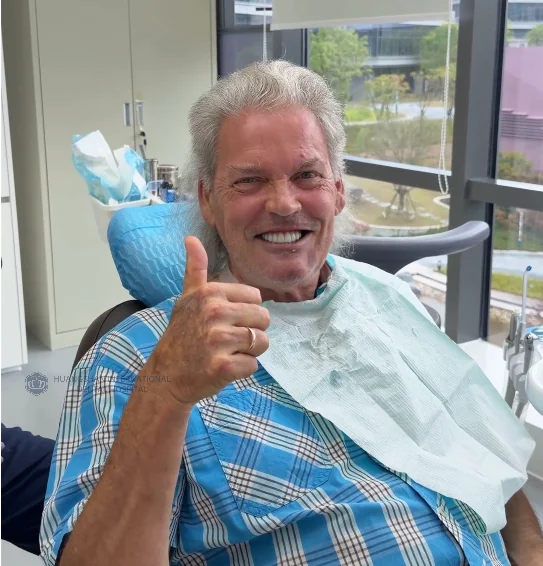
Patient Background
Dental implants can offer a fixed solution for patients who have lost many teeth. However, every patient needs a detailed health and oral assessment first.
This case involved a 68-year-old male patient. He had experienced lower-jaw tooth loss for many years. As a result, chewing had become difficult and inefficient.
The patient also reported a history of coronary heart disease. In addition, he had a history of high blood sugar. He took daily medication to manage both conditions.
Therefore, the Huangshan Dental medical team reviewed his health before planning surgery. The dentists also discussed his medications and general condition. This step helped the team evaluate surgical risks.
During the oral examination, the team found several complex problems:
- Multiple missing teeth in the lower jaw
- Several decayed teeth
- Loose teeth with a poor prognosis
- Unsuitable restorations on the upper front teeth
- Reduced chewing efficiency
- Widespread dental disease
The patient wanted a stable restoration. Moreover, he hoped to regain chewing function without relying on removable dentures.
After careful assessment, the Huangshan Dental team explained three possible treatment plans.
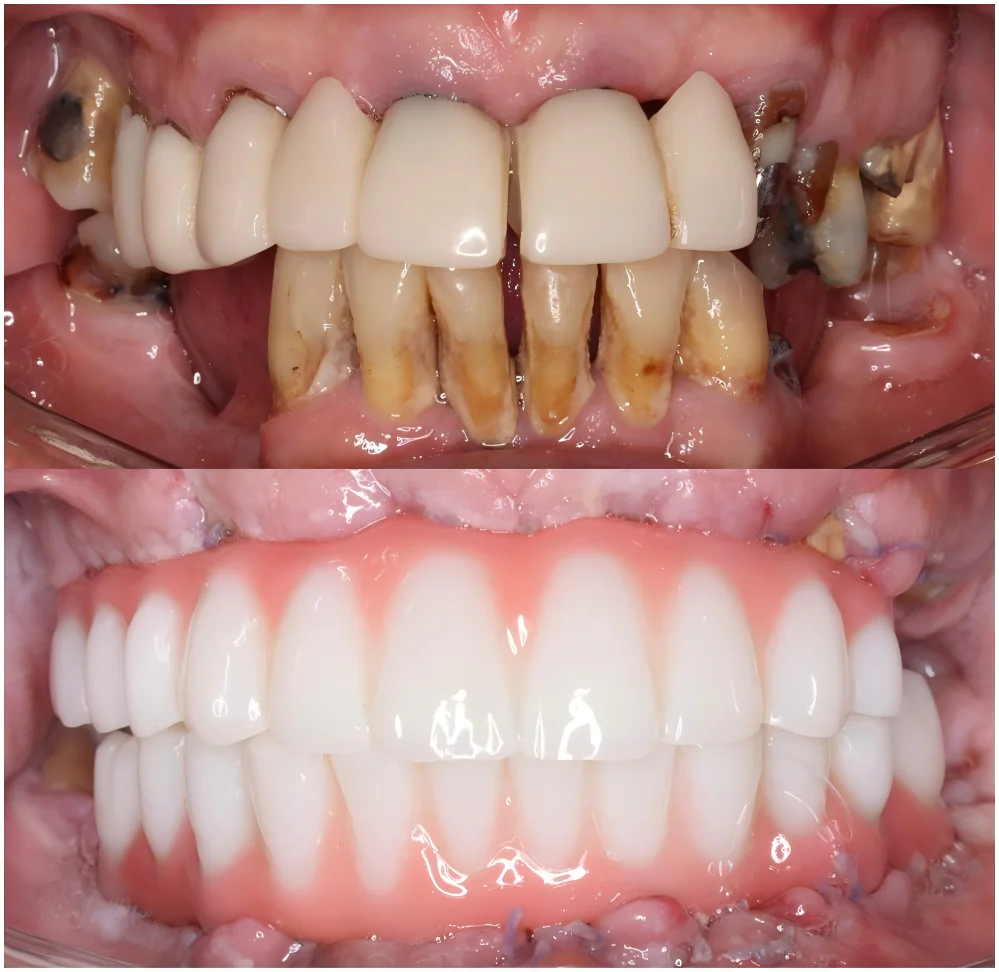
Dental Problems Analysis
First, the patient’s teeth had been missing for years. Long-term tooth loss can reduce chewing efficiency. It can also change how force moves through the remaining teeth.
Second, several remaining teeth had decay. Some teeth also showed mobility. Therefore, these teeth could not provide reliable support for a long-term restoration.
Third, the upper front teeth had unsuitable restorations. These restorations affected appearance and function. They also complicated the final prosthetic plan.
Moreover, the patient had an uneven distribution of remaining teeth. This condition made a conventional fixed bridge difficult.
How General Health Affects Implant Planning
Age alone does not prevent implant treatment. Instead, general health and disease control matter more.
This patient reported coronary heart disease and high blood sugar. Therefore, the team had to assess whether his conditions remained stable.
Patients with controlled diabetes can often receive conventional dental surgery. However, poor glucose control may delay healing. It may also increase the risk of infection and peri-implant complications. The American Dental Association notes that patients with well-controlled diabetes can usually undergo most surgical procedures with standard management.
Coronary heart disease also requires careful review. However, it does not automatically rule out dental implants.
The dentist must understand the patient’s exact heart condition. The Huangshan Dental must also know whether the patient takes anticoagulant or antiplatelet medication.
Patients should never stop heart or diabetes medication without medical advice.
Three Treatment Options Discussed
The medical team explained three treatment options. Each option offered different benefits, timelines, and limitations.
Option One: Immediate All-on-6 Treatment
The first option involved removing all hopeless and infected teeth. During the same visit, the surgeons would place six implants in each jaw.
The team would also perform bone grafting where needed. Then, they would secure a temporary fixed prosthesis.
After osseointegration, the patient would receive the final restorations. The planned final design included a Malo-style fixed bridge and ceramic crowns from teeth 16 to 26 and 36 to 46.
This option offered several possible advantages:
- Fewer surgical stages
- Immediate fixed temporary teeth
- Faster restoration of appearance
- Earlier recovery of basic chewing ability
- Less time without teeth
However, immediate loading requires suitable implant stability. It also requires careful bite control and good patient cooperation.
Option Two: Delayed Implant Placement
The second option involved removing the diseased teeth first. The surgical areas would then heal before implant placement.
Later, six implants would be placed in each jaw. The final fixed restoration would follow after osseointegration.
Option Three: Removable Dentures
The third option involved referral to the restorative department for removable dentures.
After detailed communication, the patient selected option one.
Why the Patient Selected All-on-6
The patient wanted fixed teeth rather than a removable appliance. Therefore, the All-on-6 plan matched his main goal.
All-on-6 treatment uses six implants to support a full-arch restoration. The implants distribute biting forces across the jaw.
Compared with a removable denture, a fixed implant-supported bridge may provide:
- Greater stability
- Better chewing comfort
- Less movement during speech
- No need for denture adhesive
- A more natural fixed feeling
- Improved confidence during meals
However, All-on-6 does not mean every patient receives the same plan.
The dentist must decide the implant number, angle, length, and position. Bone volume also affects the plan. Moreover, the final choice may change during surgery.
Six implants can offer broad support for a full arch. Nevertheless, implant distribution matters as much as implant number.
The team must also design a balanced bite. Excess pressure can damage the temporary bridge or disturb early healing.
Therefore, All-on-6 treatment combines surgery, prosthodontics, laboratory work, and long-term maintenance.
Treatment Process
The patient received treatment under local anesthesia. The clinical team followed the agreed immediate-loading plan.
First, the surgeons removed the diseased and hopeless teeth. They handled the extraction sites carefully to preserve useful bone.
Next, they cleaned the surgical areas. The team removed infected tissue where necessary. This step created a healthier environment for implant placement.
The surgeons then prepared the implant sites in the upper and lower jaws. They placed six implants in each arch.
During surgery, the team evaluated primary stability. Strong initial stability is important for immediate loading. Without it, the implant may move during early healing.
The team also performed bone grafting where required. Bone graft material helped fill selected defects and support the planned implant sites.
After implant placement, the restorative and laboratory teams prepared the temporary fixed prostheses. The dentist then attached the provisional teeth to the implants.
Finally, the team adjusted the bite. This step reduced damaging contact during early healing.
The patient left with fixed temporary teeth rather than a removable full denture.
What Immediate Loading Means
Immediate loading means that a provisional restoration connects to the implants soon after surgery. In some cases, the restoration may be fitted on the same day.
However, immediate loading does not mean that healing has finished.
The implants still need to connect biologically with the surrounding bone. Dentists call this process osseointegration.
Therefore, the temporary bridge must protect the implants during healing. The patient must also follow food restrictions.
Immediate loading usually requires:
- Good primary implant stability
- Careful implant distribution
- A rigid temporary bridge
- Controlled biting forces
- Adequate bone conditions
- Good surgical technique
- Reliable patient cooperation
- Regular follow-up visits
Although the patient receives fixed teeth quickly, the temporary bridge is not the final prosthesis.
The temporary restoration allows the gums to heal. It also lets the team observe the bite and appearance.
Later, the dentist can use this information to design the final bridge. Therefore, the provisional stage plays an important diagnostic role.
Bone Grafting During Full-Mouth Treatment
Long-term tooth loss may change the jawbone. After a tooth disappears, the surrounding bone no longer receives normal stimulation.
As a result, some areas may lose width or height. Infection can also damage bone around diseased teeth.
In this case, the treatment plan included bone grafting. The surgeons performed grafting during the implant procedure where necessary.
Bone grafting may help:
- Fill extraction-site defects
- Support thin bone areas
- Improve the implant environment
- Preserve the jaw contour
- Support soft-tissue appearance
- Prepare selected areas for long-term restoration
However, bone grafting does not replace careful implant positioning.
The dentist must place each implant within a safe three-dimensional area. The implant must also support the future prosthesis.
Moreover, grafted bone needs time to heal. Therefore, patients must avoid heavy chewing during the early stage.
The exact grafting method depends on the defect. Some patients need only minor grafting. Others need a larger staged procedure.
In this case, the team combined grafting with immediate implant placement after clinical evaluation.
Early Follow-Up Examination
At the review visit, the dental team examined the surgical areas and temporary prostheses.
The patient’s oral hygiene was acceptable. The soft tissues around the implants showed good early healing.
The examination found:
- No obvious gingival swelling
- No significant redness
- Stable temporary fixed prostheses
- No visible loosening
- Sutures still present
- No other unusual clinical findings
These findings suggested a stable early recovery. However, they did not yet confirm complete osseointegration.
Early success and long-term success are different. Therefore, the team still needed to monitor implant stability, gum health, hygiene, and bite forces.
The patient also needed to protect the temporary teeth. Hard food could overload the bridge or implants.
Furthermore, the dentist may need to adjust the bite during later visits. Swelling can change after surgery. The patient’s chewing pattern may also change.
Regular reviews help the team find small problems before they become serious.
Before and After Result
Before treatment, the patient had many missing and unhealthy teeth. His remaining teeth could not support normal chewing.
Loose teeth caused instability. Decay also increased the risk of pain and infection. Meanwhile, unsuitable upper-front restorations affected the appearance of his smile.
After surgery, the patient received a fixed temporary full-arch restoration in both jaws.
The immediate result provided several clear changes:
- Diseased teeth were removed
- Both arches received implant support
- Temporary fixed teeth restored the dental arches
- The patient no longer depended on loose teeth
- Basic appearance improved immediately
- Chewing support became more evenly distributed
However, the result at this stage remained provisional.
The patient still needed to complete the healing period. After osseointegration, the team would reassess the implants.
The final restoration could then replace the temporary bridge. The planned final prosthesis included a Malo-style bridge with ceramic crowns.
Therefore, the full result should be judged after final restoration and follow-up. Long-term success also depends on hygiene and maintenance.
From Temporary Teeth to the Final Bridge
The temporary prosthesis supports the patient during the healing stage. However, it uses materials and a design suited to short-term service.
After the implants integrate with the bone, the team can begin the final restorative stage.
This process may include:
- Checking implant stability
- Examining gum healing
- Taking digital or conventional impressions
- Recording the bite
- Testing the tooth position
- Evaluating speech
- Confirming smile appearance
- Trying the bridge framework
- Adjusting the final bite
The final bridge must fit accurately. Poor fit can place stress on implants and prosthetic screws.
Furthermore, the final teeth must allow daily cleaning. Patients need access beneath the bridge.
The dental laboratory also needs accurate clinical information. The dentist and technician must agree on tooth shape, color, bite, and framework design.
In this case, the planned definitive restoration included a Malo-style fixed bridge and ceramic crowns.
The final design aimed to restore function while providing a natural appearance.
Why Choose Huangshan International Dental Hospital
Complex full-mouth implant treatment requires close teamwork. It is not only a surgical procedure.
Huangshan International Dental Hospital brings together implant dentists, restorative dentists, and dental technicians. This multidisciplinary approach supports complex case management.
The hospital’s implant team includes clinicians trained at established dental institutions. Moreover, the doctors follow structured diagnostic and surgical protocols.
This experience matters in All-on-6 cases because the team must coordinate:
- Tooth extraction
- Implant positioning
- Bone grafting
- Temporary restoration
- Bite adjustment
- Soft-tissue management
- Final prosthetic design
- Long-term maintenance
The hospital also operates an integrated clinic and in-house dental laboratory.
Therefore, dentists and technicians can communicate directly. They can review the patient’s bite, tooth shape, bridge design, and restoration fit together.
This model may reduce unnecessary delays. It can also improve coordination during immediate-loading treatment.
For international patients, fewer handoffs can make the treatment process easier to understand. Still, every patient receives an individual plan.
Treatment recommendations depend on oral health, medical history, bone conditions, and clinical examination.
Aftercare During the First Days
Good aftercare protects the surgical sites and temporary bridge.
During the first days, the patient should follow the dentist’s instructions carefully.
Important steps may include:
- Take prescribed medication as directed
- Do not change heart medication without approval
- Control blood glucose closely
- Avoid smoking and alcohol
- Do not touch the surgical sites
- Avoid vigorous rinsing on the first day
- Use prescribed mouthwash correctly
- Apply cold compresses when advised
- Rest after surgery
- Attend every review visit
Some swelling may occur after extensive implant surgery. Mild bruising may also develop.
However, the patient should contact the dental team if swelling worsens suddenly. The same applies to heavy bleeding, fever, severe pain, or bridge movement.
Patients with high blood sugar need careful wound monitoring. Stable glucose control supports healing.
In addition, the patient should maintain suitable food intake. Changes in diet may affect diabetes medication needs.
Therefore, medical and dental instructions must work together.
Eating With Immediate-Load Dental Implants
Fixed temporary teeth may feel strong. However, the implants beneath them are still healing.
Therefore, the patient should not test the bridge with hard food.
A soft diet may include:
- Eggs
- Soft rice
- Noodles
- Tofu
- Fish
- Mashed vegetables
- Soup at a safe temperature
- Yogurt without hard pieces
- Soft fruit
- Nutritional drinks when suitable
The patient should avoid:
- Nuts
- Hard candy
- Ice
- Tough meat
- Sticky food
- Hard bread crust
- Bones
- Seeds
- Chewing gum
- Biting directly into hard fruit
Moreover, food should be cut into small pieces. The patient should chew slowly and evenly.
The exact diet period depends on healing and implant stability. Therefore, the dentist should decide when normal chewing can resume.
A fixed bridge reduces movement. Still, excessive force can affect osseointegration.
The temporary prosthesis can also crack under heavy pressure. Early dietary discipline helps protect both the bridge and implants.
Cleaning a Full-Arch Implant Bridge
A full-arch bridge needs daily cleaning. Although the prosthetic teeth cannot develop natural tooth decay, plaque can still collect around the implants.
Plaque may irritate the gums. Over time, inflammation can damage implant-supporting tissues.
The patient should clean:
- Along the gum line
- Around each implant area
- Beneath the bridge
- Around the back surfaces
- Between accessible spaces
- Across the tongue
Recommended tools may include:
- A soft toothbrush
- An electric toothbrush
- Implant floss
- Floss threaders
- Interdental brushes
- A water flosser
- Dentist-recommended mouthwash
However, patients should not push a brush into a fresh surgical wound. During early healing, the dentist may recommend a modified cleaning method.
Once the tissues heal, the dental hygienist can demonstrate bridge cleaning.
Professional maintenance also remains essential. The dental team can remove deposits that the patient cannot reach.
Poor plaque control and uncontrolled diabetes are recognized risk factors for peri-implant disease.
Therefore, hygiene protects both the gums and the implant investment.
Long-Term Maintenance
Dental implant treatment does not end when the final bridge is fitted.
Long-term maintenance helps detect inflammation, wear, screw loosening, or bite problems.
A maintenance visit may include:
- Gum examination
- Plaque assessment
- Implant probing when appropriate
- Bite evaluation
- Prosthetic screw inspection
- Bridge stability testing
- Professional cleaning
- X-rays when clinically required
- Review of blood glucose control
- Home-care instruction
Patients with previous periodontal disease may need more frequent reviews. The same may apply to patients with diabetes.
Moreover, the patient should report new symptoms early.
Warning signs can include:
- Bleeding around implants
- Persistent swelling
- Bad taste
- Pus
- Pain during chewing
- Bridge movement
- A loose screw
- Food trapping
- Difficulty cleaning
- Changes in the bite
Early treatment can often prevent a minor issue from becoming a major complication.
Therefore, patients should not wait for pain before returning to the dentist.
FAQ
Can a heart patient get dental implants?
Many heart patients can receive dental implants when their condition remains stable.
However, the dentist must review the exact diagnosis, medication list, blood pressure, and previous heart procedures. Medical consultation may also be needed.
Only selected high-risk heart conditions require antibiotic prophylaxis before certain dental procedures. Coronary stents alone do not routinely require this protection.
Patients should never stop blood thinners or heart medication on their own.
What happens if the body rejects a dental implant?
True immune rejection is not the usual cause of dental implant failure.
More often, an implant fails because it does not integrate with the bone. Infection, poor initial stability, overload, smoking, and peri-implantitis can also cause failure.
The dentist may remove the failed implant. Then, the area may need cleaning, healing, or bone grafting.
A new implant may sometimes be placed later.
Should a heart patient avoid a dental procedure?
A heart patient should not automatically avoid dental care.
Untreated oral infection can also affect general health. Therefore, the dentist should assess the patient and coordinate with the physician when necessary.
Elective surgery may need to wait if the heart condition remains unstable. However, stable patients can often receive dental treatment with suitable precautions.
Conclusion
This case shows how full mouth dental implants may restore function for an older patient with widespread tooth loss and failing teeth.
The 68-year-old patient had coronary heart disease and a history of high blood sugar. Therefore, careful health assessment formed an important part of treatment planning.
After discussing three options, the patient selected immediate full-mouth All-on-6 treatment. The Huangshan Dental team removed the diseased teeth, placed six implants in each arch, performed grafting, and fitted fixed temporary teeth.
At the early review, the tissues showed good healing. The temporary prostheses also remained stable.
However, immediate fixed teeth represent only one stage of treatment. The implants still need time to integrate with the bone.
Long-term success depends on medical control, a protected diet, good plaque removal, and professional maintenance.
At Huangshan International Dental Hospital, the implant, restorative, and laboratory teams can coordinate each treatment stage. This integrated approach supports efficient planning for complex full-mouth cases.
Dental implants are not a universal solution. Yet, with proper assessment and maintenance, they may provide stable and functional teeth for suitable patients.
Clinical note: This article presents one patient’s treatment process. Results vary between patients. A dentist and relevant physician must assess individual suitability before implant surgery.