


Case Overview
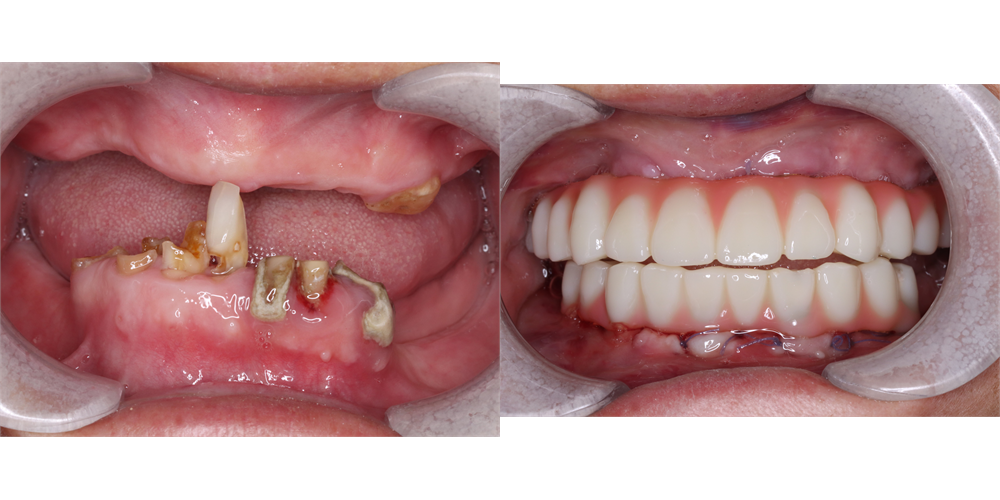
This case involved full mouth dental implants for a 57-year-old female patient from Huangshan. She had multiple missing teeth in both jaws for many years. In addition, she had several decayed teeth, loose teeth, chronic apical periodontitis, and severe periodontal disease. These problems affected both chewing comfort and long-term oral stability.
After examination and treatment discussion, the plan involved removing diseased teeth and placing upper All-on-6 implants and lower All-on-5 implants during the same treatment stage. The team also planned immediate loading, which means a fixed temporary restoration would support the patient during healing. After osseointegration, the final plan included a Malo Bridge and all-ceramic crowns from 16 to 26 and 36 to 46.
Patient Background
The patient was a 57-year-old woman and a local patient from Huangshan. She had lost multiple teeth in the upper and lower jaws over many years. Because of this, her remaining teeth had to handle uneven bite pressure. Over time, this may lead to more wear, looseness, and reduced chewing efficiency.
She also had several decayed and loose teeth. In addition, chronic infection around some root tips and severe gum disease made the remaining teeth less predictable. Therefore, the case required a full-mouth plan rather than one or two single-tooth repairs. A stable result needed infection control, implant support, bite reconstruction, and long-term cleaning.
Dental Problems Analysis
The case description shows a complex oral condition. The patient had multiple long-term missing teeth, several cavities, loose teeth, chronic apical periodontitis, and severe periodontal disease. Chronic apical periodontitis means long-term inflammation near the root tip. Periodontal disease affects the gums and supporting bone around teeth.
When these problems happen together, the mouth can lose stable chewing support. Missing teeth create gaps, and nearby teeth may shift or receive excess force. Meanwhile, gum disease can weaken the foundation around remaining teeth. As a result, the patient may feel that chewing is unstable or uncomfortable.
The main dental problems included:
- Multiple missing upper and lower teeth
- Several decayed teeth
- Loose teeth with poor support
- Chronic infection around some tooth roots
- Severe periodontal disease
- Reduced chewing function
Because of these combined issues, removable dentures were not the only possible solution. A fixed implant-supported restoration offered another option, but it required careful diagnosis and personalized planning.
Treatment Plan
The treatment plan focused on full-mouth reconstruction. The dental team planned extraction of diseased teeth and immediate implant placement. The upper jaw would receive an All-on-6 design, while the lower jaw would receive an All-on-5 design. This means six implants would support the upper full-arch restoration, and five implants would support the lower full-arch restoration.
Immediate loading was also part of the plan. In simple terms, this allows a temporary fixed restoration to attach soon after implant placement. However, this approach requires suitable implant stability and careful bite control. Therefore, dentists select it only after examination, imaging, and case evaluation.
After bone integration, the plan included Malo Bridge restoration with all-ceramic crowns. A Malo Bridge is a fixed implant-supported full-arch restoration. It can help connect several implants and support a stable arch of teeth. In this case, the final restoration areas were planned from 16 to 26 in the upper jaw and 36 to 46 in the lower jaw.
Full Mouth Dental Implants
Full mouth dental implants can help patients who have lost many teeth or who have multiple failing teeth. Instead of replacing each tooth with one implant, dentists often use a full-arch design. This can support a complete fixed restoration with fewer implants than one implant per tooth.
In this case, the upper jaw used an All-on-6 concept, and the lower jaw used an All-on-5 concept. The number of implants depends on bone condition, anatomy, bite force, and prosthetic design. Therefore, the same approach does not fit every patient.
This type of treatment also needs a long-term view. The dentist must consider gum health, bone support, implant placement, temporary teeth, final teeth, and cleaning access. Most importantly, the final goal is not only a better smile. The goal is stable chewing, healthier oral function, and easier maintenance.
Treatment Process
The treatment process began with a full oral examination and treatment planning. Because the patient had severe periodontal disease and chronic root infection, the team needed to identify teeth with poor prognosis. Then the plan focused on removing diseased teeth and rebuilding both arches with implant support.
The general treatment steps included:
- Full-mouth examination and imaging-based planning
- Extraction of diseased teeth
- Upper All-on-6 implant placement
- Lower All-on-5 implant placement
- Immediate fixed temporary restoration
- Healing period for osseointegration
- Final Malo Bridge and all-ceramic crown restoration
Meanwhile, the temporary teeth helped the patient avoid a long period without fixed teeth. Still, the temporary restoration needed careful protection during healing. The implants require time to integrate with the bone before the final bridge can handle regular chewing forces.
Before and After Result
Before treatment, the patient had multiple missing teeth, loose teeth, decayed teeth, chronic root infection, and severe periodontal disease. These conditions can make chewing difficult and unpredictable. In addition, long-term tooth loss can affect bite balance and facial support.
After treatment planning, the goal was to rebuild both arches with fixed implant-supported restorations. The upper All-on-6 and lower All-on-5 design aimed to provide stable support for full-arch teeth. In addition, immediate loading helped the patient receive fixed temporary teeth during the healing stage.
The final before-and-after result would depend on bone integration, soft tissue healing, bite adjustment, and prosthetic design. Because every mouth heals differently, patients should not expect identical results from another person’s case. However, this case shows how a full-arch implant plan can address severe tooth loss and failing teeth in a structured way.
Dentist’s Notes
This case shows why severe tooth loss needs a full-mouth diagnosis. The patient did not only have missing teeth. She also had decay, loose teeth, chronic root infection, and advanced gum disease. Therefore, the treatment plan needed to manage infection first and then rebuild function.
Immediate loading can help selected patients regain fixed teeth quickly. However, it is not a shortcut that skips healing. The implants still need osseointegration, which means bone gradually bonds to the implant surface. Because of this, the temporary teeth must be designed to reduce harmful pressure during early healing.
Every patient’s oral condition is different. A final treatment plan should be made after a dental examination, imaging, and a personalized consultation. In addition, patients with severe periodontal disease need long-term periodontal maintenance after implant treatment. Healthy gums and careful plaque control help protect the implants.
Why Choose Huangshan Dental
Huangshan International Dental Hospital is well suited for complex full-arch reconstruction because it has a multidisciplinary dental team. Implant dentists, periodontists, and restorative dentists can work together on surgery, gum health, bite design, and final teeth. This team approach matters because full mouth dental implants involve more than placing implants.
In addition, the hospital uses an integrated clinic and in-house dental lab model. Dentists and technicians can communicate directly about tooth shape, bite balance, temporary restorations, and final bridge design. As a result, treatment can move more efficiently while still focusing on precision.
This model also helps patients who need coordinated care. For example, a case with All-on-6, All-on-5, immediate loading, and Malo Bridge restoration requires both surgical and lab planning. Therefore, direct communication between the clinic and the lab can support better-fitting restorations and smoother treatment steps.
Aftercare Tips
After full-mouth implant treatment, daily care becomes very important. Implants cannot decay like natural teeth, but the gums and bone around them can become inflamed. Therefore, cleaning around the implant bridge helps protect long-term stability.
Useful aftercare habits include:
- Brush around the implant bridge every day
- Use tools recommended by the dentist for cleaning under the bridge
- Avoid hard foods during early healing
- Attend follow-up visits and bite checks
- Keep professional cleaning appointments
- Report swelling, bleeding, pain, or looseness early
Because this patient had severe periodontal disease, maintenance is especially important. Gum disease history can increase the need for regular monitoring. Meanwhile, good home care helps reduce plaque and inflammation around implants.
Frequently Asked Questions
Who is suitable for full mouth dental implants?
Full mouth dental implants may suit patients with many missing teeth or multiple failing teeth. However, the dentist must check bone condition, gum health, bite force, and medical history. Some patients may need grafting or staged treatment first.
What is the difference between All-on-6 and All-on-5?
All-on-6 uses six implants to support a full arch, while All-on-5 uses five implants. The number depends on anatomy, bone quality, and prosthetic planning. Therefore, the best design differs from patient to patient.
Can implants be placed immediately after extraction?
In selected cases, dentists can place implants immediately after removing diseased teeth. However, infection control, bone support, and implant stability matter. If conditions are not suitable, delayed placement may be safer.
What is a Malo Bridge?
A Malo Bridge is a fixed full-arch implant restoration. It connects to multiple implants and supports a full row of replacement teeth. Dentists may use it when they need stable full-arch function and a planned prosthetic design.
How long does healing take?
Healing often takes several months because bone needs time to integrate with the implants. During this period, the dentist monitors stability and soft tissue health. The final restoration usually follows after the dentist confirms healing.
Summary
This case involved a 57-year-old female patient from Huangshan with long-term missing teeth, decayed teeth, loose teeth, chronic apical periodontitis, and severe periodontal disease. Because her oral condition affected chewing, the treatment plan focused on full-mouth reconstruction. The plan included upper All-on-6 implants, lower All-on-5 implants, immediate loading, and later Malo Bridge restoration with all-ceramic crowns.
The case highlights the importance of comprehensive planning. Dentists must consider infection control, gum health, bone support, implant stability, bite balance, and final restoration design. In addition, long-term maintenance matters because patients with severe gum disease need careful follow-up after implant treatment.
For patients with many missing or failing teeth, full mouth dental implants may offer a fixed restoration option in suitable cases. However, each patient needs a complete examination, imaging, and personalized consultation before choosing the final treatment plan.