


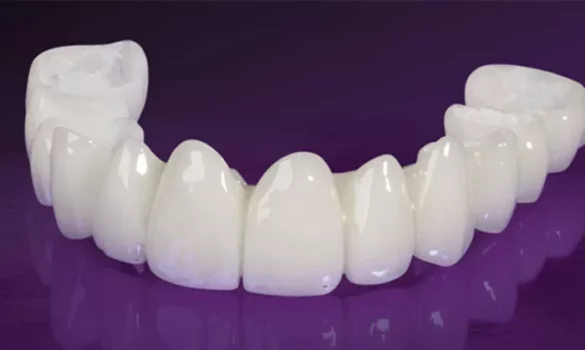
Researchers at the University of Texas at Dallas (UT Dallas) have unveiled a breakthrough method that could allow dentists to 3D print permanent zirconia crowns and other dental restorations in hours, rather than days.
The technique, detailed in the journal Ceramics International, addresses one of the slowest steps in zirconia 3D printing: debinding. This process removes the resin binder that holds zirconia particles together during printing. Traditionally, debinding can take up to 100 hours because the resin must be burned away gradually to prevent cracks in the final product.
The UT Dallas team’s method dramatically shortens this stage to under 30 minutes. Their work, supported by the National Science Foundation (NSF) and the U.S. Air Force Office of Scientific Research, has received $550,000 from the NSF’s Partnerships for Innovation – Technology Translation program to support commercialization.
Collaboration on the project extended beyond UT Dallas, including contributions from Pan-AM Dental Laboratory, 3DCeram Sinto, and Dr. Amirali Zandinejad, an Arlington-based prosthodontist and former Associate Professor at the Texas A&M University College of Dentistry.
Faster Turnaround for Durable Restorations
Zirconia is among the strongest materials used in dental restorations and is commonly applied in crowns, bridges, and veneers. Current same-day 3D printed crowns are typically made from resin-based ceramics, which are less durable than zirconia. Alternatively, dentists can create zirconia crowns through milling, a process that carves the crown from a solid block of material. While effective, milling can limit design flexibility and occasionally cause micro-cracks.
The UT Dallas method uses porous graphite capable of reaching temperatures above 2,550 °F, combined with a vacuum system. This setup allows gases released during heating to escape safely, preventing the fractures that have historically limited 3D printed zirconia. Once debinding is complete, the crown undergoes sintering, a high-temperature step that fuses zirconia particles into a dense, solid form suitable for permanent dental restorations.
Dr. Majid Minary, Professor of Mechanical Engineering at UT Dallas and the project lead, identified the prolonged debinding process as the main barrier to same-day zirconia printing. “By combining heat transfer with vacuum-based systems, we can allow gases to escape efficiently and eliminate the need for the traditional multi-day burnout period,” he said.