


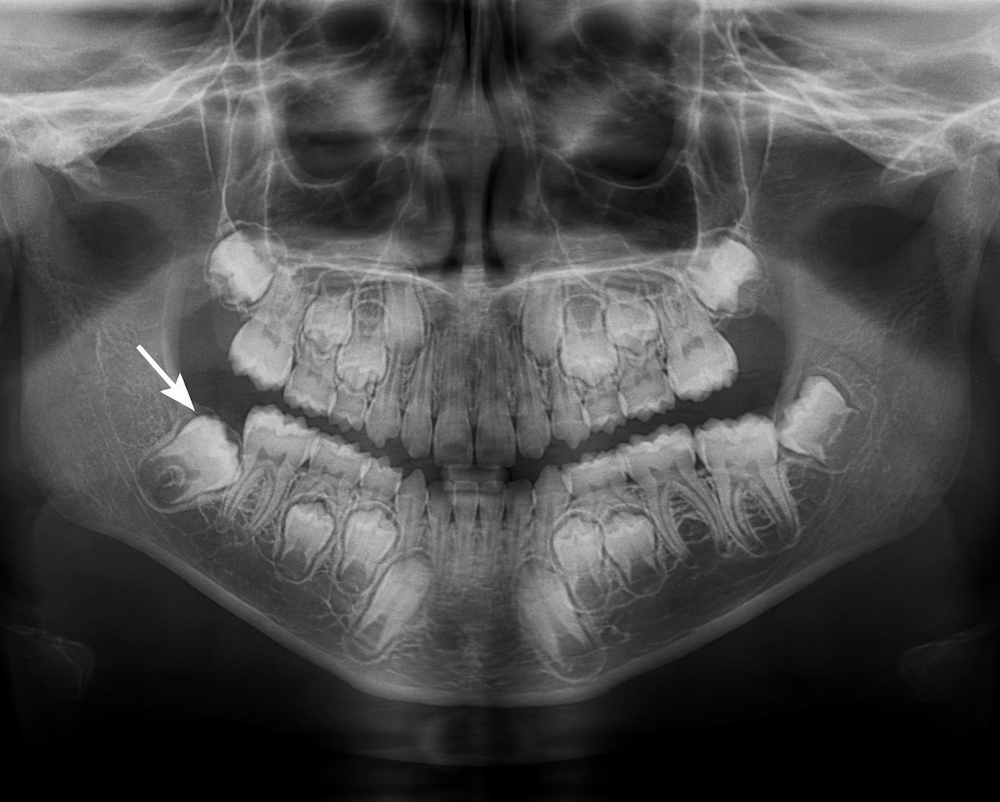
Delayed Tooth Eruption Is Not Always Calcium Deficiency
Many parents worry when a child’s tooth does not erupt on time. So, they may think about calcium deficiency first. However, tooth eruption depends on more than nutrition.
Delayed eruption may relate to:
- Lack of space in the dental arch
- Retained baby teeth
- Abnormal tooth germ position
- Extra teeth blocking eruption
- Thick gum tissue
- Jaw development problems
- Previous trauma to baby teeth
- Impacted permanent teeth
Therefore, parents should not guess the cause at home. A dental check and X-ray can show the real reason.
If a baby tooth falls out and no permanent tooth appears after several months, parents should pay attention. Also, if one side erupts but the other side does not, a dental visit is wise.
In short, calcium may matter for growth. Yet delayed eruption often needs dental imaging, not only supplements.
What Are Impacted Teeth?
An impacted tooth is a tooth that cannot erupt normally. It may stay fully or partly trapped in the jawbone, gum tissue, or both. Because of this, the tooth fails to enter the dental arch by itself.
This can happen during tooth development. The tooth may point in the wrong direction. Also, there may not be enough space for eruption. Sometimes, a baby tooth stays too long and blocks the permanent tooth.
Common causes include:
- Crowded dental arches
- Narrow upper jaw
- Early or late baby tooth loss
- Retained baby teeth
- Abnormal tooth angle
- Extra teeth
- Dental trauma
- Genetic factors
In children, upper front teeth and upper canines are common sites. Parents often call upper canines “eye teeth” or “fang teeth.” In some children, both a front tooth and a canine can become impacted.
Therefore, early screening is important during the tooth replacement years.
Common Early Warning Signs
Parents can notice several signs at home. These signs do not confirm impaction. However, they suggest that a dental check is needed.
Watch for these warning signs:
- A baby tooth falls out, but no permanent tooth appears after six months.
- A baby tooth does not loosen at the expected age.
- The gum swells repeatedly in one area.
- The child feels gum soreness or pressure.
- A front tooth gap looks unusually wide.
- One side erupts, but the other side does not.
- The gum has a small one-sided bulge.
- The upper jaw feels painful or tight.
In addition, parents should compare both sides of the mouth. Children often show asymmetry before obvious pain appears.
If the child has a history of front tooth injury, dental checks become more important. Trauma can affect the position of the developing permanent tooth.
Therefore, do not wait for pain. Many impacted teeth stay silent for a long time.
Why Upper Front Teeth and Canines Need Attention
Upper front teeth affect a child’s smile, speech, and bite. Therefore, delayed eruption in this area can worry parents quickly. Still, some parents wait because they believe the tooth will “come out later.”
Upper canines also need attention. These teeth have long roots and play an important role in bite guidance. However, they also travel a long path before eruption. Because of that, they may lose direction.
High-risk areas include:
- Upper central incisors
- Upper lateral incisors
- Upper canines
- Upper premolars in some children
When a canine becomes impacted, it may press on nearby roots. As a result, it can damage healthy teeth. Sometimes, it can also cause crowding or midline shift.
Therefore, dentists often monitor upper canine eruption between ages 8 and 10. Early checks can find problems before the tooth becomes harder to guide.
Why Imaging Matters
A clinical exam can show gum swelling, missing teeth, and retained baby teeth. However, it cannot show the full position of a hidden tooth. Therefore, imaging plays a key role.
A panoramic X-ray can give a broad view. It can show missing teeth, extra teeth, and eruption direction. However, it is a two-dimensional image.
CBCT can provide three-dimensional details when needed. It can help dentists see:
- Tooth depth
- Tooth angle
- Root development
- Relation to nearby roots
- Relation to nerves or sinuses
- Bone coverage
- Cyst-like changes
- Available space
This information helps the dentist choose a safer plan. For example, a tooth close to important structures may need observation. Another tooth with a good root and position may suit orthodontic traction.
Therefore, imaging is not only for diagnosis. It also guides treatment.
Three Treatment Directions
Treatment depends on the tooth’s position, symptoms, and risk level. Dentists usually consider three main directions.
The three directions are:
- Regular observation
- Surgical exposure plus orthodontic traction
- Early removal when risk is high
No single plan fits every child. Instead, the dentist must evaluate the impacted tooth and the whole mouth. Age, root growth, crowding, bite, and gum health all matter.
Also, parents should understand the treatment goal. Sometimes, the goal is to save the natural tooth. Sometimes, the goal is to protect nearby teeth. In rare cases, the safest choice may be removal.
Therefore, the best plan should come from a full diagnosis. Parents should ask the dentist to explain the reason behind each option.
Option One: Regular Observation
Observation may suit some impacted teeth. However, the conditions must be strict. The tooth should not cause symptoms or damage.
Observation may be considered when:
- The tooth lies very deep.
- Surgery may cause high trauma.
- The tooth sits close to key structures.
- The child has no pain or swelling.
- Imaging shows no cystic change.
- The tooth does not press on nearby roots.
- The bite and dental arch remain stable.
In this plan, the dentist does not ignore the tooth. Instead, the team monitors it regularly. The child may need a review every six months.
The dentist checks:
- Tooth position
- Dental follicle changes
- Nearby root health
- Gum symptoms
- Jawbone changes
- Bite development
If new risk appears, the plan should change. For example, root resorption, swelling, or cyst formation needs action.
Therefore, observation means active monitoring, not waiting blindly.
Option Two: Surgical Exposure and Orthodontic Traction
For many children and teenagers, dentists prefer to save the natural tooth when possible. Surgical exposure and orthodontic traction can help.
This plan often suits:
- Impacted front teeth
- Impacted upper canines
- Impacted premolars
- Teeth with healthy root development
- Teeth with a reasonable eruption path
- Children with enough treatment time
The process usually includes several steps:
- Detect the impacted tooth.
- Use imaging to locate it.
- Create space with orthodontics.
- Perform minor surgical exposure.
- Bond a small traction attachment.
- Apply gentle orthodontic force.
- Guide the tooth into the arch.
- Adjust the final tooth position.
This approach aims to preserve the natural tooth. Therefore, it may reduce the need for future implants or dentures.
However, traction takes time. It also requires cooperation. The child must attend follow-up visits and maintain good oral hygiene.
How Orthodontic Traction Works
Orthodontic traction uses gentle and controlled force. The dentist or orthodontist attaches a small device to the impacted tooth. Then, braces or another appliance guide the tooth slowly into position.
The force must stay light and precise. Strong force can harm the root or nearby teeth. Therefore, treatment should follow a three-dimensional plan.
Orthodontic traction can help:
- Bring the tooth into the dental arch
- Preserve the natural root
- Improve smile symmetry
- Support normal bite function
- Avoid unnecessary tooth loss
- Reduce future restoration needs
However, not every impacted tooth can be pulled into place. If the tooth lies upside down, has severe root problems, or blocks other teeth, traction may not work well.
Therefore, dentists must evaluate each case carefully. The earlier the problem is found, the better the chance of saving the tooth.
Option Three: Early Removal
Some impacted teeth should be removed early. This is especially true when they threaten nearby teeth or jawbone health.
Removal may be recommended when:
- The tooth presses on nearby roots.
- Root resorption has started.
- The area becomes inflamed repeatedly.
- The tooth causes swelling or pus.
- A cystic lesion appears.
- The tooth position is extremely abnormal.
- The tooth has no realistic eruption path.
- Orthodontic treatment needs more space.
In some crowded cases, removal may simplify treatment. The dentist may use neighboring teeth to replace the function of the impacted tooth. However, this decision needs careful orthodontic planning.
Early removal can prevent larger problems. For example, untreated impaction may damage a healthy incisor root. It may also cause bone loss or cyst formation.
Still, removal should not be the first choice for every child. When the tooth can be saved safely, preservation often gives a better long-term result.
FAQ
Will traction damage nearby healthy teeth?
Usually, careful planning can reduce this risk. Dentists use imaging and step-by-step force control. Therefore, standardized traction helps protect nearby roots.
Is surgical exposure a big operation?
In many cases, it is a minor outpatient procedure. The dentist opens a small gum area and removes limited bone if needed. Healing often takes about one week.
Will surgical exposure leave a visible scar?
Usually, no visible facial scar appears. The procedure happens inside the mouth. Oral mucosa also heals well in most children.
Can the tooth last for life after traction?
Many successfully guided teeth can function long term. However, the tooth needs stable roots, healthy gums, a good bite, and proper cleaning.
Does every impacted canine need removal?
No. Many impacted canines can be guided into place. Removal is considered when the tooth causes damage or has no good eruption path.
What age is best for checking impacted teeth?
The mixed dentition stage is important. Ages 8 to 10 are often useful for screening upper canine and front tooth eruption problems.
Family Prevention Tips
Parents cannot prevent every impacted tooth. However, they can reduce some risks and find problems earlier.
Helpful steps include:
- Schedule regular dental checks during tooth replacement.
- Take dental X-rays when the dentist recommends them.
- Treat cavities in baby teeth early.
- Remove retained baby teeth when advised.
- Watch front teeth and upper canines closely.
- Follow up after dental trauma.
- Encourage chewing with suitable firm foods.
- Avoid long-term soft-food-only habits.
- Keep daily brushing consistent.
- Ask about jaw growth and crowding.
Chewing harder, fiber-rich foods may support jaw development. However, children should not bite unsafe hard objects. Parents can choose foods like apples, carrots, and lean meat when age appropriate.
In addition, baby teeth matter. A decayed or retained baby tooth can block the permanent tooth. Therefore, baby tooth care supports permanent tooth eruption.
When Parents Should See a Dentist
Parents should book a dental visit when eruption looks delayed or uneven. Early checks are simple. Also, they can prevent bigger problems.
Seek dental advice if:
- A permanent front tooth does not appear after six months.
- A baby tooth refuses to loosen.
- One side erupts much later than the other.
- The gum swells again and again.
- The child has upper jaw soreness.
- A tooth looks severely tilted.
- The child had a front tooth injury.
- There is crowding during mixed dentition.
Do not wait until pain appears. Many impacted teeth do not hurt at first. Yet they may still affect nearby roots or bone.
A dentist can check the eruption path. If needed, imaging can show whether the tooth is blocked, tilted, or impacted.
Therefore, early visits protect more options. Late visits may limit treatment choices.
Why Early Intervention Matters
Early intervention gives the dentist more room to work. In children, jaw growth continues. Roots may still develop. Also, orthodontic guidance may work better.
Early management may help:
- Save the natural tooth
- Avoid root damage to nearby teeth
- Reduce the risk of cyst formation
- Protect jawbone health
- Improve bite development
- Reduce future treatment complexity
- Lower the chance of extraction
However, late treatment can be harder. The impacted tooth may move deeper or press on nearby roots. The dental arch may also become crowded. Then, treatment may take longer.
This is why parents should not dismiss delayed eruption as slow growth. A simple image can answer many questions. More importantly, it can help the dentist act at the right time.
Conclusion
Delayed tooth eruption is common, but it should not be ignored. Sometimes, the cause is harmless. However, the cause can also be an impacted tooth hidden inside the jaw.
Parents should watch for missing front teeth, delayed canines, retained baby teeth, gum swelling, and uneven eruption. If these signs appear, a dental check is important.
Treatment may involve observation, surgical exposure with orthodontic traction, or removal. The right choice depends on tooth position, root health, symptoms, and nearby tooth safety.
Most importantly, early screening can help save natural teeth. It can also prevent root resorption, cysts, crowding, and bite problems.