


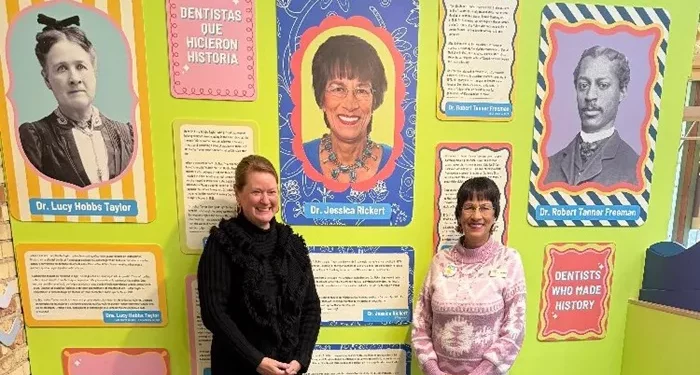
In 1975, Jessica A. Richter graduated from the University of Michigan School of Dentistry and became the first female American Indian dentist in the United States.
Half a century later, she is still committed to addressing inequality in oral health care and inspiring a new generation of Native American dentists.
Get 87% OFF plus 3 extra months. Stay private and protected online.Surfshark | SponsoredSponsored Get Offer
Her story is included in the Grand Rapids Children’s Museum’s (GRCM) new “Mitten Children’s Dentistry Exhibition,” which aims to promote oral health education in a fun and interactive way.
Secret Functions In Cars No.8 Is In Every Car And Nobody Knows ItTipgalore | SponsoredSponsored
The exhibition has added interactive elements and a large wall to emphasize diverse representation in the field of dentistry, highlighting many historical dentists, including Richter.
Always Put a Plastic Bottle on Your Tires when Parked, Here’s WhyTipgalore | SponsoredSponsored
“Whenever I ask children, ‘Have you ever seen an American Indian dentist?’ They always say ‘No.’ This exhibition is just the thing to change that perception,” said Richter.
The exhibition allows children to play dentists and patients, experience dental procedures, operate dental instruments and X-rays, and even brush the teeth of puppet patients.
The latest immersive giant mouth exhibit allows children to learn to brush their teeth and remove dental plaque in games, which is both vivid and effective in alleviating the fear of going to the dentist and inspiring their interest in a future dental career.
GRCM CEO Maggie Lancaster said: “Games are the best learning tools. I was afraid of going to the dentist when I was a child, but through this exhibit, children can experience dental care firsthand, so that they feel that the dentist is a friend, not a source of fear.”
The exhibition is sponsored by Mitten Children’s Dentistry and Orthodontics, supported by the Michigan Dental Association Foundation and the West Michigan Dental Foundation
As a member of the American Indian Dentist Association, Richter is not only an author, but also designed a multi-purpose children’s tooth-shaped pillow. She was also inducted into the Michigan Women’s Hall of Fame in 2009 and was included in the 2017 National Institutes of Health publication “The Power of Role Models: A Collection of Native American Role Models”.
She is currently an Anishinaabe Dental Extension Specialist at Delta Dental in Michigan and has long been committed to narrowing the gap in oral health between Indians and the general population.
Richter visited 12 Indian reservations and several urban Indian centers in Michigan to raise awareness of preventive dental services in the community.
According to statistics, there are only about 400 American Indian dentists in the United States, far less than the 3,000 needed to achieve equity. She attributed this to a lack of role models.
Recalling her youth, Richter was interested in math and science, and a family doctor encouraged her to consider medicine when she was 12 years old.
When she graduated from dental school, she was one of only six women in her class and the only Native American.
A member of the Prairie Potawatomi, Richter is a direct descendant of Indian Chief Wahbememe (White Dove). Her grandmother was one of the “lost generation” who were forcibly sent away for assimilation.
Although Richter grew up in the suburbs of Grand Rapids, Wyoming, her family often visited relatives on the Saginaw Chippewa and Gun Lake reservations. She described those areas as poor and backward, lacking basic living facilities, and difficult conditions.
As the eldest of seven children, Richter’s family believed in the power of education. She eventually attended a top university and a competitive dental school, which was rare at the time.
She talks about the resistance she encountered when she enrolled: “The faculty was mostly white men, and they didn’t welcome us women and minority students.
But then they saw our abilities and recognized that we could do dental surgery and study.” She points out that although the situation has improved, there is still a severe shortage of American Indian dentists, and many tribes don’t even have a dentist.
After graduation, Richter opened a private dental practice in the southeast Michigan community of Birmingham while raising three children with her husband.
Today, they have 11 grandchildren. She believes that dentistry is an ideal career that can balance work and family and provide a stable income.
Richter, who now lives in Traverse City, continues to promote oral health education as an Anishinaabe Ambassador for Delta Dentistry.
She frequently visits urban Indian centers and reservations to promote public awareness of the connection between oral health and overall health.
“Many tribal health and education leaders do not understand the importance of oral health, and I spread the knowledge by setting up information booths and participating in tribal ceremonies. Tribal leaders welcome this very much.”
Talking about his career, Richter emphasized: “Every patient deserves the best care, which requires my full commitment. This is the responsibility of a dentist.”