


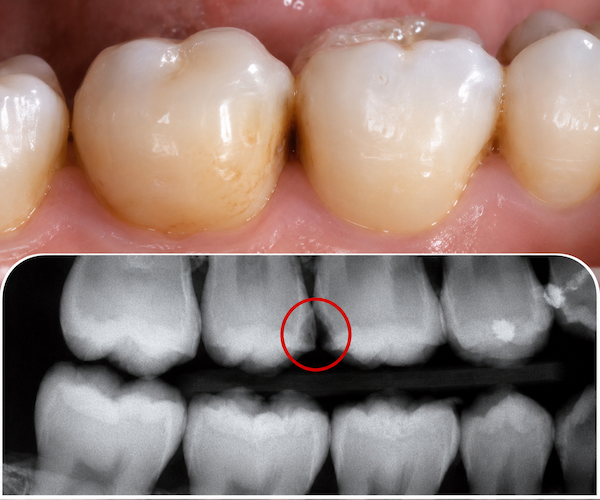
My Tooth Looks Fine—Why Is the Decay So Deep?
Many patients ask this question:
“Doctor, my tooth surface looks perfectly fine. How can it be so badly decayed?”
In clinical dentistry, this is actually very common. The condition is known as hidden caries, and the most frequent type is interproximal caries—decay that develops between teeth.
Because of its hidden location, it often goes unnoticed until symptoms like sensitivity or pain appear—by then, the decay is usually advanced.
What Are Hidden Cavities?
Hidden cavities refer to tooth decay that occurs in areas not easily visible to the naked eye. There are two main types:
Interproximal Caries (Most Common)
This type occurs on the surfaces where two teeth touch.
- Hidden between adjacent teeth
- Difficult to detect visually
- Tooth may look intact externally
- Internal damage can already be severe
Subsurface Fissure Caries
Common on the chewing surfaces of molars:
- Enamel surface appears normal
- Decay develops underneath deep grooves
- A “healthy-looking” tooth may already be compromised
Why Are Interproximal Cavities So Hard to Detect?
Interproximal caries are often called “invisible danger zones” for several reasons:
Hidden Location
These areas are not visible during routine brushing or when looking in the mirror.
Strong Outside, Weak Inside
The enamel surface may remain intact while the underlying dentin is already decayed.
Minimal Early Symptoms
Most patients feel no pain in the early stages.
Symptoms like cold sensitivity or food impaction usually appear after the decay has progressed.
Common Causes of Interproximal Caries
The main cause is plaque buildup due to inadequate cleaning between teeth.
Key risk factors include:
- Tight tooth contact making cleaning difficult
- Plaque accumulation turning into tartar
- Lack of flossing or improper cleaning habits
- Frequent consumption of sugary foods and drinks
Even if you’ve never had fillings, poor interdental cleaning can still lead to decay.
How Are Hidden Cavities Diagnosed?
Hidden cavities cannot be reliably detected by visual examination alone.
Dentists typically use:
- Bitewing X-rays
- Periapical radiographs
On X-rays, interproximal caries often appear as:
Triangular dark shadows beneath the contact area
This indicates demineralization and structural damage inside the tooth.
That’s why regular dental check-ups are essential—even without symptoms.
How to Prevent Hidden Cavities
Prevention is all about consistent daily habits and early intervention:
✔ Use Interdental Cleaning Tools
- Tight spaces: use dental floss
- Wider gaps or braces: use interdental brushes
- At least once daily
✔ Limit Sugar Intake Frequency
- Reduce sugary snacks and drinks
- Avoid constant snacking
✔ Regular Dental Check-Ups
- Every 6–12 months
- Follow your dentist’s recommendations for X-rays
✔ Treat Early Demineralization
- Professional intervention can stop progression
- Prevents cavity formation
Final Thoughts: A Healthy-Looking Tooth Isn’t Always Healthy
Hidden cavities develop silently and often go unnoticed until significant damage occurs.
The area between your teeth is one of the most commonly neglected zones in oral care.
To protect your teeth:
✔ Floss daily
✔ Get regular dental exams
✔ Maintain a balanced diet
These simple habits can make a big difference in preventing hidden tooth decay.