


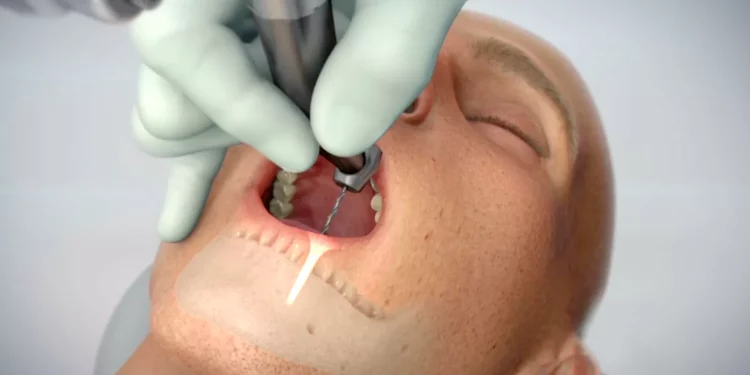
Neocis has introduced the Yomi S, an upgraded robotic system designed for dental implant surgeries. The new version utilizes YomiPlan, an AI software that enhances surgical precision, streamlines workflows, and ensures high-quality patient outcomes.
During dental implant procedures, Yomi assists dentists by helping them drill precise holes in the bone and place implants accurately. The Yomi S can now be operated by a single practitioner using a foot pedal and touchscreen, making it easier to control, according to Neocis, based in Miami.
The updated system features a more compact design, improved dexterity, enhanced visibility, and a new AI-powered planning suite that automates complex preoperative tasks. Neocis collaborates closely with leading clinicians to develop technologies that improve patient care. Their investors include NVIDIA’s NVentures, Intuitive Surgical’s Intuitive Ventures, DFJ Growth, Mithril Capital Management, Norwest Venture Partners, and surgical robotics pioneer Fred Moll.
Alon Mozes, the CEO and founder of Neocis, shared insights about the Yomi S updates, the challenges of introducing robotics to dentistry, and how the company navigates these hurdles. Despite the large need—nearly 200 million Americans are missing at least one tooth—Neocis remains one of the few robotics companies focused on dental care.
“There are challenges and opportunities in the dental market,” Mozes explained. “It’s a very separate space. Big medical tech companies like Johnson & Johnson or Stryker don’t typically get involved in dental care.” Dental supply companies tend to be smaller than medical tech firms, which limits cash flow, investor interest, and development speed.
“Venture capital in dental is smaller, which is unfortunate because the dental market is huge. It’s even larger than many medical markets,” Mozes noted. “In medicine, you usually sell to hospitals—about 5,000 in the U.S. In dentistry, there are 200,000 dental practices.”
Being a pioneer in dental robotics, Neocis worked with the U.S. Food and Drug Administration (FDA) to gain approval for Yomi. While the system follows similar guidelines as surgical robots, dental technologies are reviewed by a different FDA division, adding complexity to the approval process.
“When we first applied around 2015, we thought the process would be straightforward,” Mozes said. “Although the dental procedure is less invasive than orthopedics, it actually took longer to get approval because the dental branch hadn’t encountered this kind of technology before.”
Although dental surgeries may seem similar to other surgical procedures, Mozes emphasized that Yomi must provide higher precision for the dental space, which involves more intricate work than typical surgery robots handle. He explained that the precision required for dental work is tighter than in other fields like orthopedics.
“You need closer accuracy—around a millimeter—compared to 2 or 3 millimeters in orthopedics,” Mozes said. “Dental clinicians also work in much smaller spaces and need to approach procedures from various angles. It’s challenging.”
Moreover, the adaptability of Yomi is crucial for procedures involving patients under different levels of anesthesia. Mozes explained that even when patients are asleep, they may move involuntarily, adding further complexity to the procedure.
“Sometimes, patients under anesthesia move in a rhythmic pattern,” Mozes said. “The robot adjusts to keep the drill on track, compensating for the patient’s movements.”
One of the standout features of the Yomi S is the YomiPlan AI, which automates the segmentation of critical anatomy, such as nerves and sinuses, from cone beam CT (CBCT) scans, accelerating the planning stage. Neocis leveraged data from nearly 100,000 implants performed since 2016 to refine this technology.
“When placing an implant, it’s not just about drilling in the right spot; it’s about creating an implant that fits well in the patient’s mouth,” Mozes explained. “We now have software that acts like Photoshop for teeth, allowing dentists to design crowns that fit perfectly.”
Additionally, Yomi alerts the dentist during surgery to prevent complications. For instance, it monitors bone density and provides color-coded alerts—green for optimal bone density, yellow for weaker bone, and red for potential issues like fenestration.
The new Yomi S system also integrates the drill into its platform, offering real-time monitoring and control of speed and torque. This allows dentists to adjust the system with verbal commands.
In response to feedback, Neocis redesigned Yomi S to make it more versatile and suitable for a wider range of dental offices. The robotic arm is now longer, providing greater flexibility in positioning and maneuvering around patients. The cart is also 30% smaller, making the system easier to deploy in smaller offices.
“We’ve customized the arm design so that dentists can use it in smaller operating rooms with fewer staff members,” Mozes said. “Yomi S can fit in a compact space and be operated by a solo practitioner.”
The increased precision and real-time monitoring offered by Yomi S help ease the anxiety that many dentists experience during procedures, particularly in tight spaces or with difficult angles. By giving dentists more information about drilling depth and proximity to essential anatomy, the system reduces the risks associated with implant placement.
For many dentists, Yomi also presents a business opportunity. “It’s a great way for dental practices to expand,” Mozes noted. “They can take on new associates and improve patient flow with the help of this advanced technology.”
Related Topics:
- University of Oklahoma College of Dentistry Provides Free Dental Care to 109 Children During Annual Kids’ Day Event
- Dental Clinic in Bradford Offers Specialized Consultations to Help Nervous Patients Overcome Dental Anxiety
- DentScribe Receives Patent for AI-Driven System Transforming Dental Clinic Documentation and Operational Efficiency
Tags: dental caredental implantteethtooth Read More