


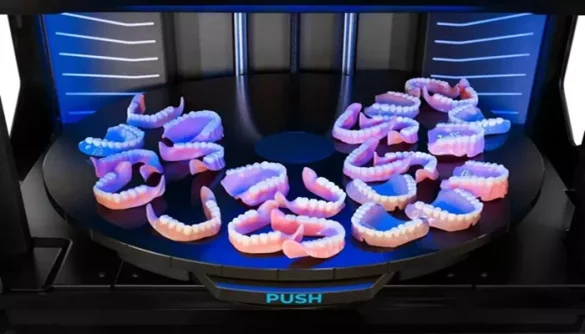
Researchers at the University of Texas at Dallas have developed a groundbreaking technology that could transform dental restorations. The innovation allows for same-day, 3D-printed dental crowns made from zirconia, the industry’s gold-standard material for permanent dental work.
Zirconia crowns are prized for their strength, durability, and natural appearance. They are commonly used to cap damaged or decayed teeth and to support dental bridges that replace missing teeth. While 3D printing in dentistry has grown in popularity due to its ability to create highly customized restorations with precise color matching, existing same-day 3D-printed crowns are typically made from ceramic resins. These resins, though convenient, do not match the strength and longevity of zirconia.
Currently, same-day zirconia crowns are available, but they are not 3D-printed. Instead, they are milled, a process that carves each crown from a solid block of zirconia. Milling presents challenges, including design limitations and the risk of micro-cracks forming during the cutting or sintering processes.
The UT Dallas team has tackled a major hurdle in 3D-printing zirconia: the lengthy post-printing process. Their findings, published in the September print edition of Ceramics International, focus on two critical steps that follow 3D printing—debinding and sintering.
Debinding involves slowly heating the printed crown to remove the resin that holds zirconia particles in place during printing. This process traditionally takes 20 to 100 hours. After debinding, the crown is sintered—exposed to high temperatures to fuse zirconia particles into a dense, hardened solid. This step is akin to firing clay in a kiln.
“Debinding has been the bottleneck in the process,” explained Minary, the study’s corresponding author. “If the resin is burned off too quickly, gas trapped inside the crown can cause cracks or fractures. A 20- to 100-hour debinding process makes same-day zirconia crowns impossible.”
The new technology drastically shortens debinding time to less than 30 minutes. It combines improved heat transfer with porous graphite felt that can withstand temperatures above 2,550 degrees Fahrenheit. The felt covers the printed crown, allowing gas to escape safely, while a vacuum system removes it from the chamber.
“The combination of these features is what makes it work,” Minary said. “With our technology, a dentist could provide a 3D-printed zirconia crown to a patient within just a few hours.”
The project is supported by a $550,000 grant from the National Science Foundation’s Partnerships for Innovation – Technology Translation program. UT Dallas is collaborating with Pan-AM Dental Laboratory, 3DCeram Sinto Inc. in Michigan, and Dr. Amirali Zandinejad, a prosthodontist and former associate professor at Texas A&M University College of Dentistry.
Contributors from UT Dallas include Mahdi Mosadegh, first author and mechanical engineering doctoral student; Moein Khakzad; chemistry doctoral student Zahra Sepasi; mechanical engineering graduate student Kalyan Nandigama; and Dr. Golden Kumar, associate professor of mechanical engineering. Additional support for the research came from the U.S. Air Force Office of Scientific Research.
If successfully commercialized, this technology could make strong, customized, 3D-printed zirconia restorations available in dental clinics, reducing costs, waste, and waiting time for patients.