


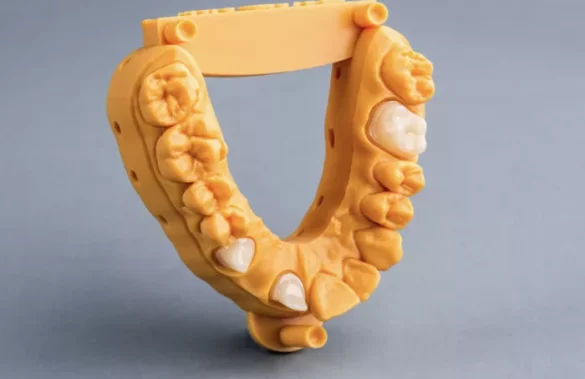
Researchers at the University of Texas at Dallas are developing a technology that could transform dental care. Their new method allows zirconia dental restorations—including crowns, bridges, and veneers—to be 3D-printed and completed in a single day, according to a university news release.
Currently, most same-day dental restorations are made from ceramic resins. While convenient, these materials do not have the strength of zirconia, a durable ceramic commonly used in permanent dental work. Zirconia restorations are usually created through milling, a process that carves the crown from a solid block. Milling has limitations, including design restrictions and a risk of microcracking during production.
The new 3D-printing technique aims to overcome these issues. “We are excited to be advancing the commercialization of chair-side 3D-printed, all-ceramic zirconia permanent dental restorations,” said Majid Minary, PhD, a professor of mechanical engineering at the university.
The potential benefits are significant. 3D-printed zirconia restorations can offer better customization, more precise color matching, and faster production. The approach could also reduce costs and minimize material waste.
One of the main challenges in 3D-printing zirconia has been the post-processing step. After printing, zirconia typically requires debinding—a slow heating process that removes the resin—and sintering, which strengthens the material. This process can take up to 100 hours. Using advanced heat transfer techniques and porous graphite felt, the research team reduced this step to under 30 minutes.
This breakthrough could allow dental practitioners to offer zirconia crowns to patients within a few hours. “With our technology, if a practitioner wants to offer a 3D-printed zirconia crown chair-side, they could provide it to a patient within just a few hours,” Minary said.
Before the technology becomes widely available, it must undergo clinical testing and receive regulatory approval. However, researchers are optimistic about its commercial potential. The project is supported by a $550,000 grant from the U.S. National Science Foundation, underscoring its significance in advancing dental care.
Experts say that if successful, the new method could change the standard for dental restorations. Patients may no longer need to wait days or weeks for crowns or bridges, and dentists could produce high-quality zirconia restorations directly in their offices. The combination of speed, strength, and customization positions 3D-printed zirconia as a promising alternative to traditional methods.
As research continues, the University of Texas at Dallas team hopes their approach will soon bring the convenience of same-day, durable, and aesthetically precise dental restorations to dental practices nationwide.