


Dental bonding sellers are vital in restorative dentistry, making sure that restorations like composite fillings securely adhere to the enamel’s shape. Successful medical consequences rely on the proper software of those adhesives, and information the proper protocol can assist save you screw ups and decorate the sturdiness of dental work.
What Are Dental Bonding Agents and How Do They Work?
Dental bonding sellers characteristic as adhesives that join restorative substances along with composites to the herbal shape of teeth. Their effectiveness is based on each micromechanical retention—in which the adhesive penetrates microscopic pores withinside the enamel—and chemical bonding, primarily based totally at the formulation’s capacity to have interaction with dentin and tooth. Advancements in dental adhesives have caused numerous generations of bonding structures, every providing unique strategies and theoretical underpinnings.
Generations of Dental Bonding Agents: Core Differences
Early bonding structures (regularly known as first and 2nd generation) have been constrained via way of means of negative adhesion, focusing handiest on tooth with little impact on dentin. Modern adhesives are categorized via way of means of their software protocol and chemistry:
- Total-Etch (Etch-and-Rinse, usually 3-step or 2-step): Uses phosphoric acid to put off the smear layer, exposing collagen withinside the dentin. This permits deeper penetration of the primer and adhesive, growing sturdy bonds. Over-drying the dentin after etching can result in crumble of the collagen network, lowering bond strength—a completely unique vulnerability addressed via preserving moisture (the so-called “moist bonding” technique).
- Self-Etch (1-step or 2-step structures): These simplify the manner via way of means of incorporating acidic additives that concurrently put together the enamel floor even as making use of the primer or adhesive. The intensity of demineralization is shallower, keeping a few smear layer and minimizing sensitivity. Some one-step structures require more than one primer or adhesive layers to make certain ok coverage, in particular for rather mineralized areas. Universal adhesives are a more recent evolution, well matched with more than one strategies.
- Selective-Etch: A hybrid approach that applies acid handiest to tooth (for advanced adhesion) and preserves dentin, minimizing chance of sensitivity via way of means of following with self-etch or familiar adhesive.
Key Steps in Applying Dental Bonding Agents
Preparation and Isolation
Ensure the enamel stays dry and uncontaminated. Use rubber dams or cotton rolls to defend the field. If infection occurs (saliva or blood), you have to clean, re-isolate, and repeat key bonding steps to assure a a success outcome.
Total-Etch Technique
- Etch all worried surfaces with phosphoric acid. Follow the product’s timing carefully (typically 15–30 seconds).
- Rinse away the etchant. Gently blot the surface—keep away from leaving it too moist or over-dry, aiming for a wet dentin appearance.
- Apply primer (for three-step systems), air-dry lightly to inspire infiltration; if the use of two-step, observe mixed primer/adhesive solution. Cover all etched surfaces meticulously, and make sure collagen fibers aren’t disturbed.
- Remove the solvent through mild air-drying. Test the air syringe first to save you unintentional water spray.
- Apply the proper adhesive if now no longer but mixed, then mild remedy as directed.
Self-Etch Technique
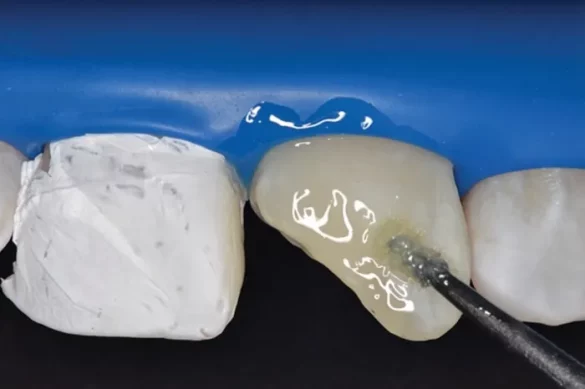
- Apply the self-etch primer, very well masking the preparation. Scrubbing the primer for 20 seconds can enhance infiltration, mainly with dense dentin.
- Gently air-dry to provide a thin, even movie. Use an air-best syringe.
- Apply the adhesive if the gadget separates primer/adhesive steps; with one-step products, a 2d coat can also additionally assist make sure right penetration and movie thickness, mainly in areas with thick smear layers.
- Air-dry again. Immediately mild remedy for the endorsed time.
Selective-Etch Technique
- Etch tooth margins with phosphoric acid, averting the dentin entirely.
- Rinse and lightly dry the tooth.
- Apply familiar adhesive to tooth and dentin, scrubbing for thorough insurance. For a few adhesives, more than one layers in addition enhance bond reliability.
- Air-dry—continually use simply sufficient to dispose of solvent with out stressful the adhesive. Light remedy adequately.
Nuances, Tips, and Clinical Recommendations
- Always near bonding agent bottles right away to restriction evaporation and contamination.
- Test your air syringe previous to every use, making sure it emits best air—now no longer water. This prevents unintentional overwetting.
- If dentin seems over-dried (no glistening, stupid surface), rehydrate with a mild utility of a hollow space cleanser, desensitizer, or a wet micro-brush earlier than intending with primer.
- Multiple primer or adhesive coats are every so often beneficial—mainly in one-step self-etch or familiar systems—to boost even insurance and saturate collagen networks.
- Proper mild-curing is crucial; often take a look at your curing mild with a radiometer, as vulnerable output consequences in under-cured adhesives and compromised bonds.
Common Errors Made When Using Dental Bonding Agents
- Over-drying Dentin: This results in disintegrate of uncovered collagen fibrils, decreasing capacity for resin infiltration and selling postoperative sensitivity. Always goal for a visibly wet floor after etching.
- Contaminating the Operative Field: Any creation of saliva, blood, or water after acid-etching can appreciably weaken bonds. In such cases, re-isolate, smooth the field, and repeat etching and adhesive software.
- Failing to Close Adhesive Bottles: Prolonged bottle beginning reasons solvent evaporation, changing the adhesive’s consistency and effectiveness. Open bottles simplest lengthy sufficient for dispensing.
- Incomplete Air-Drying: Leaving extra solvent can save you right polymerization. Always use mild, managed air bursts.
- Under-software of Primer/Adhesive: Applying a unmarried skinny layer, specifically with one-step structures, can cause incomplete infiltration. Two coats can be suggested for strong results.
- Rushing or Skipping Steps: Each phase—etching, drying, priming, curing—ought to be accompanied meticulously as opposed to abbreviated.
Troubleshooting Bonding Failures: Clinical Scenarios & Solutions
- Bond Weakness or Sensitivity Post-Placement: Consider whether or not the dentin floor changed into over-dried. Rehydrate with a mild moistener (desensitizer, saline, or hollow space cleanser) and repeat the adhesive protocol.
- Adhesive Layer Peeling or White Margin Formation: May imply under-curing or infection in the course of placement. Check curing mild output and repeat the mild-curing step over the region. Re-etch and bond if delamination is observed.
- Inconsistent Results Despite Protocol Adherence: Re-take a look at your substances for expiration dates and integrity (e.g., adhesives now no longer left open too lengthy). Also, don’t forget a few structures require a couple of layers—assessment the manufacturer’s technical bulletin.
- Difficulty Achieving Isolation: Minor infection ought to be accompanied via way of means of instant re-cleansing and reapplication of all bonding steps. Persistent moisture can also additionally gain from auxiliary isolation which includes retraction cords or a chunk block.
Conclusion
Applying dental bonding retailers efficiently is important for lengthy-time period achievement in restorative treatments. Mastery of every procedural nuance, an knowledge of bonding device generations, and interest to each medical element and manufacturer’s hints empower dental experts to reap the strongest, maximum dependable bonds.
FAQs
If I over-dry dentin, can I get better the bond quality?
Often, you could treatment over-dried dentin via way of means of lightly rehydrating the floor earlier than primer software—use both a wet micro-brush, a desensitizer, or a hollow space cleanser.
Is it awful to do a couple of coats of primer or adhesive?
In many structures, specifically one-step self-etch and established adhesives, layers decorate insurance and bond strength. Always affirm this with the product instructions.
What must I do if the bond fails time and again in spite of cautious work?
Check for operative contamination, adhesive evaporation, or gadget malfunction (including a vulnerable curing light). Switch out compromised substances and repeat the whole method if needed.
Do all structures require the identical technique?
No. Different generations and types can also additionally ask for various procedures—constantly comply with particular producer commands for superior results.