


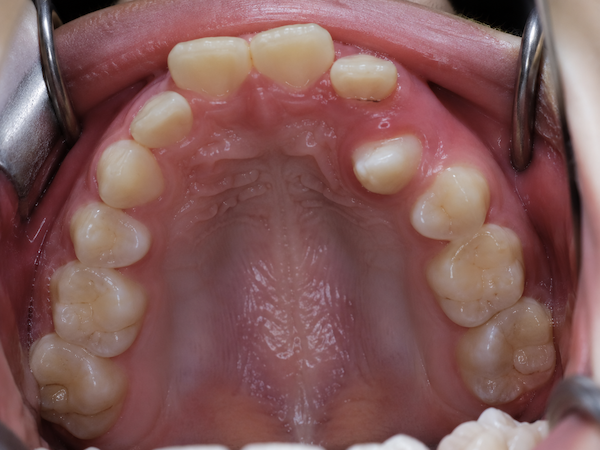
What Is an Impacted Tooth in Children?
An impacted tooth in children is a permanent tooth that exists inside the jawbone or gum tissue but fails to erupt into its normal position. Many parents become concerned when one permanent tooth appears while the matching tooth on the opposite side remains missing for months.
In most cases, the tooth is not absent. Instead, it is trapped beneath the gum or within the jawbone.
Normally, permanent teeth erupt according to a predictable schedule. However, various factors can interrupt this process. As a result, the tooth remains hidden and cannot join the dental arch naturally.
Common signs include:
- One permanent tooth erupts while the opposite tooth does not
- A baby tooth remains in place beyond the normal age
- Unexpected spacing develops between the front teeth
- Teeth begin to shift out of alignment
- Localized gum swelling occurs repeatedly
Therefore, parents should not assume that delayed eruption is always normal.
Early evaluation often leads to simpler treatment and better outcomes.
Understanding Different Types of Impacted Teeth
While this article mainly focuses on impacted tooth cases in children, impacted teeth can occur at different ages and in different parts of the mouth.
The most common examples include:
- Impacted canine teeth
- Impacted premolars
- Impacted molars
- Impacted wisdom tooth
- Multiple cases of tooth impaction
In teenagers and adults, a very common problem is an impacted wisdom tooth. In these cases, the third molar does not have enough room to erupt normally.
Many patients discover that their wisdom tooth is impacted after experiencing:
- Jaw pain
- Swollen gums
- Recurrent infections
- Difficulty opening the mouth
- Pressure on neighboring teeth
When symptoms occur, dentists may recommend wisdom teeth removal or impacted tooth surgery to prevent future complications.
Potential risks of untreated wisdom tooth impaction include:
- Tooth decay
- Gum infection
- Cyst formation
- Damage to adjacent teeth
- Crowding of existing teeth
Therefore, regular dental examinations and X-rays are important for both children and adults.
Cost of Impacted Tooth Treatment at Huangshan International Dental Hospital
The cost of treating an impacted tooth depends on the position of the tooth, treatment complexity, and whether surgical or orthodontic procedures are required.
For patients requiring oral surgery, common fees include:
| Treatment | Price |
| Sedation Wisdom Tooth Extraction (Upper) | 1,500 RMB |
| Tricky Tooth Extraction | 2,000 RMB |
For impacted teeth that require orthodontic traction, treatment costs vary according to:
- Tooth position
- Difficulty of movement
- Orthodontic appliances used
- Overall treatment duration
At Huangshan International Dental Hospital, patients receive a personalized treatment plan and transparent pricing before treatment begins.
Why Do Permanent Teeth Become Impacted?
The causes of impacted teeth can vary. In many situations, more than one factor contributes to the problem.
Insufficient Space
The most common reason is a lack of room in the dental arch.
When space becomes limited:
- Teeth cannot follow their natural eruption path
- Neighboring teeth block movement
- The impacted tooth remains trapped
Retained Baby Teeth
Sometimes a primary tooth does not fall out on time.
As a result:
- The permanent tooth loses its eruption pathway
- Normal development becomes disrupted
- Delayed eruption occurs
Supernumerary Teeth
Extra teeth may develop between normal teeth.
These additional teeth can:
- Occupy valuable space
- Block eruption
- Cause tooth displacement
Abnormal Eruption Direction
In some children, the tooth develops at an unusual angle.
Consequently:
- The tooth moves toward the wrong position
- Normal eruption becomes impossible
- Orthodontic intervention may become necessary
Dental Cysts or Odontomas
Less commonly, developmental growths can interfere with eruption.
These conditions require professional assessment and treatment planning.
How Can Parents Detect an Impacted Tooth Early?
Many impacted teeth remain hidden because they cause little discomfort.
Therefore, regular dental examinations are extremely important.
Parents should pay attention to the following warning signs:
Delayed Tooth Eruption
If one permanent tooth erupts but the matching tooth remains absent for more than six months, an examination is recommended.
Persistent Baby Teeth
A baby tooth that remains stable long after the expected shedding age may indicate an underlying problem.
Unexplained Gaps
Unexpected spacing in the front teeth may suggest that a tooth is trapped beneath the gums.
Crowding or Midline Shift
The dental arch may begin to move unevenly.
Consequently, the smile can become asymmetrical.
Recurrent Gum Swelling
Occasional swelling above an unerupted tooth may indicate pressure from the impacted tooth below.
Because these symptoms are often subtle, imaging plays a crucial role in diagnosis.
How Dentists Diagnose an Impacted Tooth
Visual examination alone cannot confirm the position of an impacted tooth.
Instead, dentists combine clinical findings with advanced imaging technology.
Common diagnostic tools include:
Panoramic X-Ray
A panoramic radiograph provides a broad overview of the teeth and jaws.
This image helps dentists identify:
- Missing teeth
- Extra teeth
- Tooth positions
- Developmental abnormalities
Periapical X-Ray
This examination provides more detailed information about specific teeth.
CBCT Scan
For complex cases, Cone Beam Computed Tomography (CBCT) offers a three-dimensional view.
CBCT allows clinicians to evaluate:
- Exact tooth location
- Root development
- Relationship to neighboring teeth
- Potential treatment risks
At Huangshan International Dental Hospital, advanced AI-assisted imaging technology helps improve diagnostic accuracy. As a result, treatment planning becomes more predictable and efficient.
Does Every Impacted Tooth Need to Be Removed?
No.
One of the biggest misconceptions is that all impacted teeth require extraction.
In reality, treatment depends on several important factors:
- Patient age
- Tooth position
- Root development
- Available space
- Impact on surrounding teeth
Many impacted teeth can be preserved successfully.
However, delaying treatment may create additional complications.
Possible consequences include:
Root Resorption
The impacted tooth may press against neighboring roots.
Over time, permanent damage can occur.
Tooth Crowding
The dental arch may become increasingly crowded.
Bite Problems
Impacted teeth can contribute to malocclusion.
Smile Aesthetic Issues
Missing visible teeth can affect appearance and self-confidence.
More Difficult Treatment Later
As children grow older, orthodontic traction often becomes more challenging.
Therefore, early diagnosis remains the key principle.
Early detection. Early evaluation. Early treatment.
How Orthodontic Treatment Helps Impacted Teeth Erupt
Orthodontics plays a central role in managing impacted teeth.
In many cases, braces can guide a hidden tooth into its correct position.
Step 1: Evaluate Eruption Potential
The orthodontist first determines:
- Whether the tooth is healthy
- Whether movement is possible
- Whether the tooth can function normally after treatment
Step 2: Create Space
Often, insufficient space is the main obstacle.
Therefore, orthodontic appliances may be used to:
- Expand the arch
- Align neighboring teeth
- Open adequate space
Step 3: Surgical Exposure
If the tooth cannot erupt independently, a minor surgical procedure may be necessary.
During this procedure:
- The crown of the tooth becomes accessible
- Orthodontic attachments are placed
- Controlled traction can begin
Step 4: Orthodontic Traction
A gentle pulling force gradually guides the tooth toward its proper position.
Unlike what many parents imagine, the tooth is not pulled suddenly.
Instead:
- Small movements occur over time
- Biological adaptation remains safe
- Surrounding tissues stay healthy
Step 5: Final Alignment
Once the tooth enters the dental arch, comprehensive orthodontic treatment continues.
This stage improves:
- Tooth positioning
- Root alignment
- Bite function
- Smile aesthetics
The entire process requires patience. However, the long-term benefits are significant.
Why Early Orthodontic Evaluation Matters
The mixed dentition stage provides an ideal opportunity to identify eruption problems.
During this period:
- Teeth are still developing
- Bone responds well to treatment
- Orthodontic movement is more efficient
As a result, younger patients often achieve better outcomes.
Furthermore, intervention at an early age may prevent:
- Complex surgeries
- Extensive orthodontics
- Permanent damage to neighboring teeth
At Huangshan International Dental Hospital, patients benefit from a multidisciplinary team that includes orthodontists, pediatric dentists, and oral surgeons. This collaborative approach helps manage complex impacted tooth cases more effectively.
In addition, every patient receives a personalized treatment plan based on age, dental development, and individual needs.
Can Impacted Teeth Be Prevented?
Not all impacted teeth can be prevented.
However, several measures may reduce the risk of severe complications.
Parents should:
- Schedule regular dental checkups
- Monitor tooth eruption patterns
- Address retained baby teeth promptly
- Seek evaluation when eruption delays occur
- Follow orthodontic recommendations early
These simple steps can make a significant difference.
Most importantly, they increase the likelihood of preserving natural teeth.
FAQ About Impacted Teeth in Children
What is the most commonly impacted tooth?
The upper canine is one of the most frequently impacted teeth after wisdom teeth.
At what age should a delayed permanent tooth be checked?
If one permanent tooth erupts and the opposite tooth remains absent for six months or longer, a dental examination is recommended.
Can an impacted tooth erupt on its own?
Sometimes it can. However, many impacted teeth require orthodontic treatment or surgical assistance.
Is orthodontic traction painful?
Most children experience only mild discomfort after adjustments. The force applied is gentle and controlled.
Conclusion
An impacted tooth in children is more common than many parents realize. Fortunately, modern dentistry offers effective solutions when the problem is identified early.
If one permanent tooth erupts while another remains hidden, do not assume it will eventually appear on its own. Instead, seek a professional evaluation. Early diagnosis can prevent complications and improve treatment success.
With proper imaging, orthodontic planning, and timely intervention, many impacted teeth can be successfully guided into the dental arch. As a result, children can achieve healthy function, proper bite alignment, and a confident smile for years to come.