


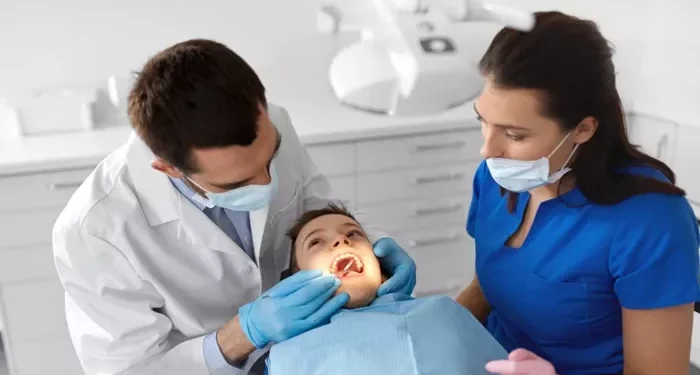
FLORENCE, Ala. — Dr. Carson Cruise, a 36-year-old pediatric dentist in northwest Alabama, faces a stark financial choice: continue treating a mostly Medicaid patient base at a loss, or drop those patients and earn the same by seeing fewer privately insured children.
About half of Cruise’s patients rely on Medicaid and travel from rural communities — sometimes an hour — to his clinic. He maintains a four- to five-month waitlist. “I have great relationships with a lot of these families,” he said. “I don’t want to leave them hanging, but it’s getting to a point where it’s really difficult to keep working at the pace we’re working and seeing the volume that we’re seeing.”
Alabama’s situation reflects a national problem. State Medicaid programs typically reimburse dentists far less than private insurers.
In Alabama, reimbursement averages roughly 46% of dentists’ billed charges, and the state has among the fewest dentists per capita — second only to Arkansas, according to the American Dental Association.
Several counties have no dentist at all; other areas are considered dental deserts, where patients must drive at least 30 minutes to reach care.
Low payments push many dentists out of the Medicaid market. Cruise said some procedures pay so little that dentists lose money providing them. The result: fewer providers accept Medicaid, longer waits for care, and higher rates of untreated disease among low-income children.
Nearly 25% of Alabama third-graders had untreated tooth decay in 2022, above the national average. The burden falls disproportionately on children at lower-income schools and on Black and Hispanic children, state data show. More than half of Alabama children are enrolled in Medicaid.
“Those gaps in care aren’t a geographical fluke, but the result of political choices,” said Zachary Schulz, a public-health historian at Auburn University who contributed to the state oral-health report. He and others argue policy determines access and quality of dental services.
Alabama stands out for its limited adult dental coverage. The state’s Medicaid program offers no dental benefits for adults except women who qualify temporarily because of pregnancy. By contrast, about half of states provide a broader range of adult dental services.
The shortage of providers also affects urgent and complex care. Cruise described treating children with severe decay and infections that require hospital procedures under anesthesia.
But operating-room access is limited: his hospital waitlist is about six months, and until recently many hospitals refused Medicaid pediatric dental cases because reimbursements didn’t cover operating-room costs. Some families previously had to travel two hours to Birmingham, where waitlists could reach a year.
“It gets to a point where you feel like you’re having to triage kids and do Third World care in a First World country,” Cruise said.
State officials and dental leaders say they have taken steps to improve payments. Alabama lawmakers approved a 19% increase in Medicaid funding this year, and dental reimbursement rates have risen three times since 2021. The program also added a temporary $10 per-patient-per-visit payment for dentists, which providers appreciate but say is not enough.
Dr. Stephen Mitchell, a professor at the University of Alabama at Birmingham’s dental school, said state officials are constrained by limited budgets. “We’re not the wealthiest state,” he said. “We’ve got to be smart. A dollar of prevention saves a hundred dollars in treatment.”
Cross-border differences can be decisive. Cruise noted a pediatric dentist friend who practices just over the Mississippi line and is paid about 25% more for the same procedures. For example, Alabama’s Medicaid pays roughly $64 for a child’s tooth extraction; Mississippi pays about $83.
The federal policy landscape adds uncertainty. The recent tax and spending law referenced by federal officials will reduce Medicaid funding over the coming decade, a change whose local effects remain unclear. Cruise warned that any further cuts could push more dentists to stop accepting Medicaid.
“If we cut that even more, it’s going to turn what’s a very tight profit margin into a negative,” he said. “Most of us have a heart for helping these kids and we’ll do it. But you’ve got to move the needle.”
For now, dentists who continue to serve Medicaid patients often absorb costs. Cruise said he values helping children in his community but is increasingly torn between professional mission and family obligations.
He and other providers say meaningful change will require sustained increases in reimbursement and policy decisions that prioritize oral health as part of overall health care.