


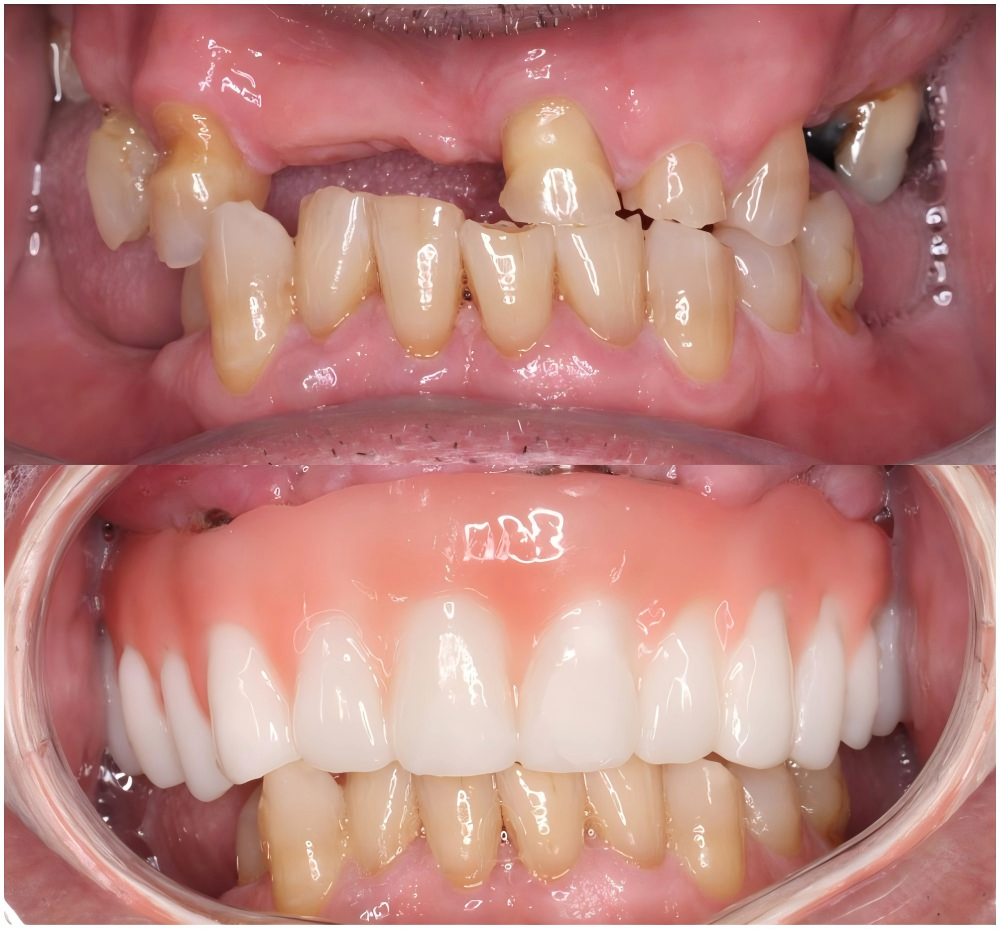
Case Overview
This case involved upper jaw All-on-6 dental implants for a 60-year-old male patient with long-term missing teeth, multiple decayed teeth, and loose teeth. He felt that his oral condition had affected chewing for a long time. Therefore, the treatment goal was not only to replace missing teeth, but also to rebuild upper-jaw function and improve bite support.
The patient chose extraction of failing upper teeth, immediate implant placement, immediate loading, and bone grafting. One week after surgery, he returned for suture removal. At that visit, the soft tissue around the upper implants showed good healing, and the fixed temporary prosthesis remained stable.
Patient Background
The patient had been missing several teeth in both jaws for many years. Because of this, his remaining teeth had carried uneven chewing pressure. Over time, this can lead to more wear, more looseness, and further bite collapse. In addition, missing teeth may allow opposing teeth to over-erupt into empty spaces.
He also had several damaged and loose teeth. These teeth could no longer provide reliable chewing support. Therefore, the case needed a full-arch treatment plan instead of small isolated repairs. The dental team discussed different options and explained the possible prognosis before treatment.
Dental Problems Analysis
The oral examination showed several serious dental problems. The patient had over-erupted opposing teeth, moderate to heavy calculus, gum recession, severe tooth wear, and defects close to the pulp chamber. In simple terms, some damaged teeth had lost too much structure and were close to the inner nerve space.
The patient also had chronic apical periodontitis and severe periodontal disease. Chronic apical periodontitis means long-term inflammation around the root tip. Periodontal disease affects the gums and supporting bone around teeth. As a result, several teeth had a poor long-term outlook.
The main problems included:
- Multiple missing teeth in the upper and lower jaws
- Several decayed and loose teeth
- Heavy calculus and gum recession
- Severe tooth wear and bite collapse
- Chronic infection around some roots
- Severe periodontal disease
Because these problems appeared together, the treatment had to focus on infection control, implant support, bite stability, and long-term maintenance.
Treatment Options
The dental team discussed three treatment options with the patient. The first option was to remove the diseased upper teeth and place upper All-on-6 implants during the same appointment. After osseointegration, the plan included a Malo Bridge and all-ceramic crown restoration for the upper arch.
The second option was a delayed implant plan. In this approach, the diseased teeth would be extracted first, and upper and lower All-on-6 implant restoration would happen later. This can suit some patients, especially when the bone or soft tissue needs more healing before implants.
The third option was removable denture treatment through the restorative department. Removable dentures may help some patients restore basic chewing. However, they may feel less stable than fixed implant restorations. After full communication, the patient chose the first option.
Upper Jaw All-on-6 Dental Implants
Upper jaw All-on-6 dental implants use six implants to support a fixed full-arch restoration. This approach can help patients with many missing or failing upper teeth. However, it requires careful diagnosis, enough implant stability, and a well-designed bite.
In this case, the dentist planned extraction of teeth 13, 15, 18, 21, 22, 23, 26, and 27 under local anesthesia. Then the team planned upper All-on-6 immediate implant placement, immediate loading, and bone grafting. Immediate loading means a fixed temporary prosthesis attaches soon after implant placement.
This approach can reduce the time a patient spends without fixed teeth. Still, it does not suit every case. The dentist must evaluate bone condition, implant position, infection risk, gum health, and bite force before choosing immediate loading.
Treatment Process
The treatment process started with diagnosis and treatment discussion. Because the patient had several failing teeth, the team explained the benefits and limits of each plan. Most importantly, the patient understood that the final result would depend on healing, implant stability, and later maintenance.
The main treatment steps included:
- Removing diseased upper teeth under local anesthesia
- Placing six implants in the upper jaw
- Performing bone grafting where needed
- Attaching an immediate fixed temporary prosthesis
- Checking early healing after surgery
- Removing sutures during the follow-up visit
Meanwhile, the temporary restoration helped restore appearance and basic chewing support during healing. However, the patient still needed to protect the implants from heavy chewing force. The bone needs time to integrate with the implant surface before the final restoration.
One-Week Follow-Up Result
One week after surgery, the patient returned for review and suture removal. His oral hygiene was acceptable. In addition, the soft tissue around the upper implants healed well. The gums showed no obvious redness or swelling at that visit.
The immediate fixed temporary prosthesis stayed in place and showed no looseness. This was a positive early sign. However, one week is still an early healing stage. The dentist still needs to monitor implant stability, gum health, bite pressure, and oral hygiene over time.
After osseointegration, the plan includes a Malo Bridge and all-ceramic restoration. A Malo Bridge is a fixed full-arch implant restoration. It connects multiple implants and supports a stable dental arch. Therefore, it can help rebuild chewing function in suitable full-arch cases.
Before and After Result
Before treatment, the patient had multiple missing teeth, loose teeth, deep decay, gum recession, calculus, severe wear, and loss of bite support. These problems affected chewing and reduced the reliability of the remaining teeth. Because of this, the upper jaw needed a more complete reconstruction plan.
After treatment, the upper jaw had six implants and a fixed temporary prosthesis. This helped the patient regain fixed upper teeth during the healing phase. In addition, the one-week follow-up showed stable soft tissue healing and no obvious gum swelling.
The before-and-after result should be understood with care. Early improvement does not mean the final outcome is complete. The final result depends on osseointegration, prosthetic design, bite control, and long-term cleaning habits. Therefore, regular follow-up remains essential.
Dentist’s Notes
This case shows why full-mouth planning matters. The patient did not only have missing teeth. He also had periodontal disease, chronic root infection, tooth wear, tooth defects, and bite collapse. Therefore, the dentist needed to consider both surgical and restorative needs.
Immediate loading can be useful for selected patients. For example, it can reduce the time without fixed teeth and improve comfort during healing. However, the dentist must control bite force carefully. Too much pressure too early may affect implant healing.
Every patient’s oral condition is different. A final treatment plan should be made after a dental examination, imaging, and a personalized consultation. In addition, patients with a history of severe periodontal disease need long-term maintenance to protect both implants and remaining teeth.
Why Choose Huangshan Dental
Huangshan International Dental Hospital is well suited for complex full-arch cases because it has a multidisciplinary dental team. Implant dentists, restorative dentists, and periodontal specialists can work together on diagnosis, surgery, prosthetic design, and follow-up care. This matters because All-on-6 treatment is not only an implant procedure.
In addition, the hospital’s integrated clinic and in-house dental lab model helps improve treatment efficiency. Dentists and technicians can communicate directly about bite, tooth shape, temporary teeth, and final restoration design. As a result, patients can receive faster adjustments and more coordinated care.
For international patients, this model can also reduce unnecessary waiting. However, speed should not replace proper diagnosis. Huangshan Dental combines efficient workflows with personalized treatment planning, which is especially important for full-arch implant restoration.
Aftercare Tips
After immediate loading dental implants, early care affects healing. Patients need to keep the mouth clean and avoid stressing the implants during the first healing phase. However, each patient should follow the exact instructions from the treating dentist.
Helpful aftercare steps include:
- Brush gently around the surgical area as advised
- Avoid hard or sticky foods during early healing
- Keep follow-up appointments on schedule
- Report swelling, bleeding, pain, or looseness quickly
- Maintain professional cleanings after healing
- Control plaque around implants and remaining teeth
Because this patient had severe periodontal disease and calculus, hygiene is especially important. Implant restorations still need daily cleaning. In addition, regular dental maintenance helps reduce inflammation around implants.
Frequently Asked Questions
What are upper jaw All-on-6 dental implants?
Upper jaw All-on-6 dental implants use six implants to support a fixed upper-arch restoration. They may help patients with many missing or failing upper teeth. However, the dentist must first check bone condition and bite stability.
Can All-on-6 implants be loaded immediately?
Immediate loading may be possible in selected cases. The implants need strong initial stability and careful bite control. Still, some patients need delayed loading for safer healing.
Is bone grafting needed for All-on-6 implants?
Bone grafting may help when some areas lack enough bone support. It can improve the implant site in selected cases. However, not every patient needs grafting.
How long does healing take after All-on-6 implants?
Healing often takes several months because bone needs time to integrate with the implants. During this stage, the dentist monitors implant stability and gum health. The final restoration usually comes after the dentist confirms healing.
Is All-on-6 better than removable dentures?
All-on-6 can provide a fixed restoration, so it may feel more stable than removable dentures. However, removable dentures may suit some patients better. The best choice depends on bone condition, health, budget, and treatment goals.
Summary
This case involved a 60-year-old male patient with long-term tooth loss, loose teeth, severe decay, calculus, gum recession, chronic infection, periodontal disease, and bite collapse. After reviewing three treatment options, he chose extraction of failing upper teeth with immediate All-on-6 implant placement, immediate loading, and bone grafting.
At the one-week follow-up, the upper implant soft tissue showed good healing. The gums had no obvious redness or swelling, and the fixed temporary prosthesis remained stable. Still, long-term success depends on osseointegration, bite control, hygiene, and regular maintenance.
For suitable patients with failing upper teeth and reduced chewing ability, upper jaw All-on-6 dental implants may offer a fixed full-arch restoration option. However, each case needs careful examination, imaging, and a personalized treatment plan before any final decision.