


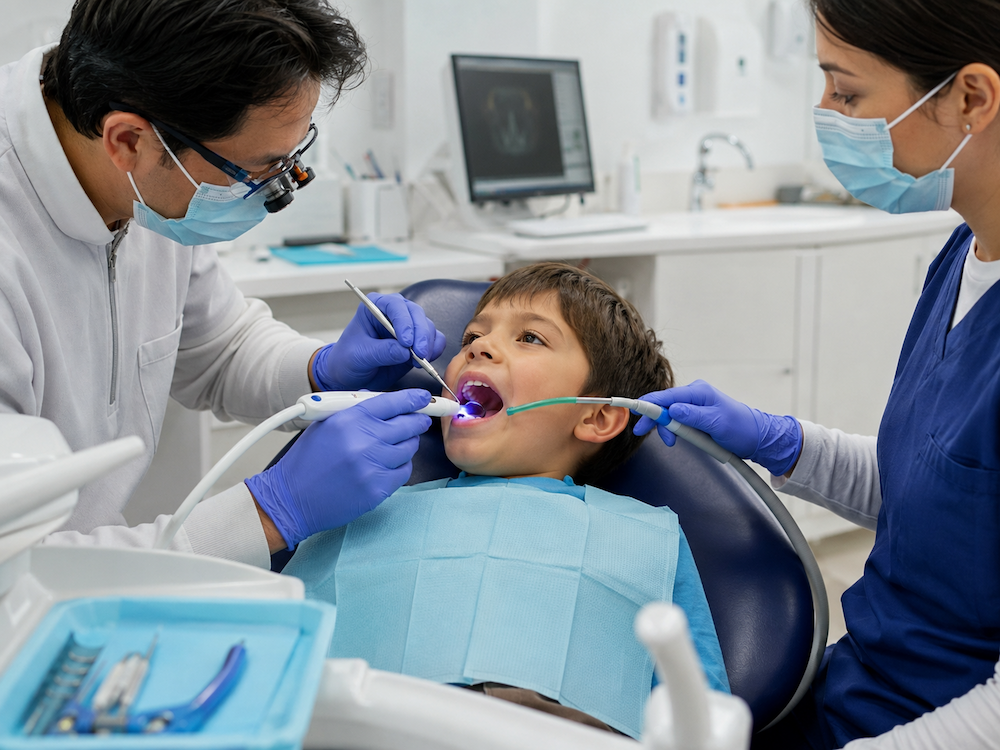
Protect Your Child’s Teeth With Fissure Sealant
Some dental decisions can affect a child for many years. Applying a fissure sealant to newly erupted permanent molars is one of them.
At around six years old, four important permanent teeth usually begin to appear. Dentists call them the first permanent molars. Parents often call them six-year molars.
These teeth erupt behind the last baby molars. Therefore, no baby tooth needs to fall out first. Because of this, many parents mistake them for temporary teeth.
However, six-year molars should remain in the mouth for life.
Their chewing surfaces often contain deep pits and narrow grooves. Food debris and dental plaque can easily collect inside them. Meanwhile, toothbrush bristles may not reach the deepest areas.
As a result, these teeth face a high risk of early decay.
A fissure sealant forms a thin protective layer over these grooves. Therefore, it makes the chewing surface smoother and easier to clean.
The treatment does not replace daily brushing. However, it adds useful protection during a cavity-prone stage of childhood.
When Should Six-Year Molars Be Sealed?
Many children receive sealants between six and nine years old. However, age alone does not decide the correct time.
The best time usually comes soon after the first permanent molars have erupted enough for treatment.
For many children, this happens around six or seven years old. Still, every child develops at a different pace.
Some teeth erupt earlier. Others appear later. Therefore, parents should not wait for a certain birthday before arranging a dental examination.
The dentist first checks whether the tooth has erupted enough. The chewing surface should be accessible. In addition, the dentist must keep it dry during treatment.
A partly erupted tooth can be difficult to isolate. Gum tissue may still cover part of its chewing surface. Saliva may also reach the area easily.
In that case, the dentist may:
- Wait until the tooth erupts further
- Use a material that tolerates moisture better
- Apply a temporary protective material
- Review the tooth again after several months
Therefore, the ideal time depends on tooth eruption, groove depth, hygiene, and cavity risk.
Early assessment remains important. A dentist should examine the permanent molars soon after they appear.
What Are Six-Year Molars?
The six-year molars are the first permanent molars.
They usually erupt behind the second baby molars. Therefore, they do not replace any primary teeth.
Most children develop four first permanent molars:
- One on the upper right
- One on the upper left
- One on the lower right
- One on the lower left
Development begins long before these teeth enter the mouth. Their tooth buds start forming during fetal development. After birth, the crowns continue to mineralize.
The crowns usually complete much of their development during early childhood. Then, the teeth begin to erupt at around six years old.
However, eruption times vary.
Some children may receive their first permanent molars before age six. Others may not have all four teeth until age seven or later.
Parents can look behind the last baby molars. A new broad tooth in that area may be a permanent molar.
Nevertheless, home observation cannot replace a dental examination. New permanent molars may remain partly hidden under the gum.
Therefore, regular dental visits help parents identify these important teeth early.
Why Do Parents Mistake Them for Baby Teeth?
The first permanent molars arrive while many baby teeth remain in the mouth.
In addition, they do not push out another tooth. Instead, they erupt at the back of the existing dental arch.
Therefore, parents may not notice them immediately.
Some parents assume every tooth present at age six will eventually fall out. However, this assumption can lead to delayed treatment.
A cavity in a six-year molar will not disappear when the child grows older. The tooth will not receive a natural replacement.
If decay progresses, the child may need:
- A dental filling
- Pulp treatment
- A crown
- Root canal treatment
- Tooth extraction in severe cases
Early loss may also affect chewing and tooth alignment.
Therefore, parents should learn the difference between baby molars and first permanent molars.
A dentist can explain which teeth are permanent. Dental records can also track their eruption and condition.
Once these teeth emerge, they need careful cleaning from the first day.
Moreover, parents may need to help with brushing. Many six-year-old children still lack the hand control needed for thorough cleaning.
What Is a Fissure Sealant?
A fissure sealant is a thin protective dental material.
The dentist places it over the pits and grooves on a tooth’s chewing surface. It then hardens and bonds to the enamel.
The sealant creates a smoother surface. Therefore, food particles and plaque have fewer deep spaces in which to collect.
Most sealants look white, clear, or slightly tooth-colored. As a result, they usually blend with the natural tooth.
The treatment mainly protects the chewing surfaces of back teeth. It does not cover every part of the tooth.
A sealant may be recommended for:
- First permanent molars
- Second permanent molars
- Deeply grooved premolars
- Selected primary molars
- Teeth with deep pits or narrow fissures
- Children with a higher risk of cavities
The dentist makes the decision after examining the tooth.
Not every groove needs sealing. A shallow, easy-to-clean surface may have a lower risk.
However, deep and narrow grooves often benefit from extra protection.
Sealants can also help manage selected early, non-cavitated lesions. Still, the dentist must first confirm that the tooth does not need a filling.
Why Are New Molars Vulnerable to Cavities?
Newly erupted molars have several features that increase their cavity risk.
First, their chewing surfaces are not flat. Instead, they contain raised cusps, pits, and branching grooves.
Some grooves are narrow at the entrance but wider underneath. Therefore, toothbrush bristles cannot always enter them.
Second, a new molar may take months to erupt fully.
During this period, part of the tooth may remain under the gum. Its position at the back of the mouth also makes brushing difficult.
Third, children may not brush carefully enough.
They may move the toothbrush quickly across the teeth. However, they often miss the back molars or fail to brush them for long enough.
In addition, frequent sugary snacks increase the risk.
Oral bacteria use sugars and produce acids. These acids attack tooth enamel. Repeated attacks can eventually create a cavity.
Therefore, several factors may work together:
- Deep grooves
- Difficult access
- Incomplete eruption
- Poor brushing technique
- Frequent sugar exposure
- High plaque levels
A sealant addresses the groove-related risk. However, families must still manage the other factors.
How Is Fissure Sealant Applied?
Fissure sealing usually involves a simple series of steps.
First, the dentist or dental professional examines the tooth. The tooth should not have a cavity that requires a filling.
Next, the surface is cleaned. Plaque and food debris must be removed from the grooves.
Then, the tooth is isolated from saliva.
Keeping the surface dry is very important. Moisture can weaken the bond between resin sealant and enamel.
After that, the professional applies a conditioning gel. This gel gently prepares the enamel surface.
The tooth is then rinsed and dried.
Next, the liquid sealant flows into the pits and fissures. The dentist checks for bubbles or uncovered areas.
Finally, a curing light hardens the material.
The main steps include:
- Examination
- Cleaning
- Isolation
- Enamel conditioning
- Rinsing and drying
- Sealant placement
- Light curing
- Bite checking
The procedure usually requires no drilling. It also normally requires no injection.
Therefore, most children tolerate it well.
Does Fissure Sealing Hurt?
Fissure sealing should not cause pain.
The dentist does not usually remove healthy tooth structure. In addition, the procedure does not normally require local anesthesia.
The child may feel the dental professional cleaning the tooth. They may also notice air, water, cotton rolls, or a suction device.
However, these steps should not hurt.
The conditioning gel remains on the enamel for a short time. It does not reach the tooth nerve.
After the sealant hardens, the dentist checks the bite.
At first, the child may feel that the tooth surface is slightly different. However, the material should not interfere with comfortable chewing.
If the bite feels too high, the dentist can adjust the sealant.
Some children may struggle to keep their mouths open. Others may dislike the taste of dental materials.
Therefore, simple explanations can help.
Parents can tell the child that the dentist will “paint a protective coat” onto the back teeth.
However, parents should avoid promising that the child will feel nothing at all. Calm and honest preparation often works better.
Is the Material Safe for Children?
Dental professionals have used pit and fissure sealants for many years.
Once the material hardens, it forms a stable coating over the enamel.
The dentist uses only a small amount. In addition, the material remains on the tooth rather than entering the body.
Parents sometimes worry about resin ingredients. They may also have concerns about bisphenol A, commonly called BPA.
Some resin-based dental materials may contain related compounds or release very small trace amounts for a short period. However, current dental use involves limited exposure.
The dental team can also reduce surface residue after curing. For example, they may wipe or rinse the sealed surface.
Other sealant materials also exist.
Glass ionomer materials may be useful when keeping a tooth completely dry proves difficult. They can also release fluoride. However, they may not remain intact as long as some resin-based materials.
Therefore, the dentist chooses a material based on:
- Tooth eruption
- Moisture control
- Cavity risk
- Cooperation
- Tooth anatomy
- Clinical judgment
Parents can ask which material the clinic plans to use.
Why Are Six-Year Molars So Important?
Six-year molars perform major work in the permanent dentition.
They have broad chewing surfaces. Therefore, they help grind food efficiently.
They also erupt early and become important reference teeth for the developing bite.
The first permanent molars help support:
- Effective chewing
- Stable contact between upper and lower teeth
- Development of the dental arch
- Positioning of other permanent teeth
- Maintenance of posterior bite height
However, these teeth do not single-handedly control facial development.
Jaw growth depends on genetics, muscles, breathing patterns, tooth eruption, and many other factors.
Therefore, the original idea that six-year molars alone preserve normal facial development would be too strong.
Still, losing one early can create important dental problems.
Nearby teeth may tilt toward the empty space. The opposing tooth may also move further into the gap.
As a result, the bite may become more difficult to manage.
Therefore, protecting these teeth from decay supports both chewing and long-term dental stability.
Why Do These Strong Teeth Decay So Easily?
Six-year molars are large and strong. However, strength does not make them immune to decay.
Their wide chewing surfaces contain several cusps. Between the cusps lie pits and grooves.
These areas help grind food. However, they also trap plaque.
Moreover, the teeth erupt during a challenging stage.
At six or seven years old, children often brush by themselves. Still, many lack the patience and skill to clean every surface.
Parents may also focus on the front teeth because they are easier to see.
Meanwhile, the new molars remain at the back of the mouth. Their partly erupted position makes them easy to miss.
In addition, children may frequently consume:
- Candy
- Sweet biscuits
- Sugary yogurt
- Juice
- Soft drinks
- Sweetened milk
- Sticky snacks
Frequency matters greatly.
Eating or drinking sugar many times each day creates repeated acid attacks.
Therefore, a strong tooth can still decay quickly when deep grooves, plaque, and frequent sugar exposure occur together.
What Happens If a Six-Year Molar Develops Decay?
Early decay may not cause pain.
The child may continue eating and sleeping normally. Therefore, parents may not notice the problem.
However, the cavity can grow.
Once decay reaches the deeper dentine, the tooth may become sensitive to cold, sweets, or chewing.
Later, bacteria may reach the pulp inside the tooth.
The child may then develop:
- Persistent toothache
- Night pain
- Pain while chewing
- Swelling
- A gum abscess
- Fever in more serious infections
Untreated dental infection can spread into nearby tissues. In severe cases, facial swelling may require urgent care.
However, it is inaccurate to say that an ordinary cavity directly causes diseases such as rheumatic arthritis, kidney inflammation, or heart disease.
Dental infections can affect general well-being. They may disrupt eating, sleep, school attendance, and growth.
In addition, oral bacteria can create serious complications in certain vulnerable patients.
Still, the relationship between oral disease and systemic conditions is complex.
Therefore, parents should seek treatment early without relying on exaggerated claims.
A Fissure Sealant Cannot Replace Brushing
A fissure sealant only protects the sealed grooves.
It does not protect the entire mouth.
Therefore, children still need daily oral care.
Parents should help young children brush twice each day with fluoride toothpaste.
The most important brushing time is before bed. After brushing, the child should avoid further snacks or sugary drinks.
Children should clean:
- The outer surfaces
- The inner surfaces
- The chewing surfaces
- The gumline
- The back of the last molars
Parents should pay particular attention to newly erupted teeth.
A toothbrush can be angled toward a partly erupted molar. Small circular movements may help clean the chewing surface and gumline.
In addition, the amount of fluoride toothpaste should suit the child’s age and ability to spit.
Children should spit out the toothpaste rather than rinse repeatedly with water. This allows more fluoride to remain on the teeth.
However, parents should follow local dental guidance because fluoride concentrations and recommendations may vary.
Sealants and fluoride work together rather than competing with each other.
Build Good Oral Hygiene Habits Early
Parents can begin oral care before a child can brush independently.
Once teeth appear, an adult should clean them regularly.
At around two years old, many children can begin learning simple routines. However, an adult should still perform or supervise the actual brushing.
As children grow, parents can teach them a clear sequence.
For example:
- Brush the outer surfaces
- Brush the inner surfaces
- Brush every chewing surface
- Move slowly from one side to the other
- Spend extra time on the back molars
Old advice sometimes tells children to brush upper teeth downward and lower teeth upward.
However, a strict up-and-down method is not the only acceptable technique.
The more important goals are gentle brushing, full surface coverage, fluoride use, and adequate time.
A small, soft-bristled toothbrush usually works well.
Moreover, parents should continue checking the child’s brushing for several years.
Many children still need help until they can write neatly, tie shoelaces well, or show similar hand control.
Control Sugar Frequency, Not Only Sugar Amount
Parents often focus on the total amount of sweets.
However, how often the child consumes sugar also matters.
Each sugary snack or drink starts an acid attack in dental plaque.
Saliva needs time to reduce the acidity and support enamel recovery.
Therefore, frequent sipping and snacking can create repeated attacks throughout the day.
To reduce risk:
- Keep sweet foods to mealtimes
- Offer water between meals
- Avoid sugary drinks in bedtime bottles
- Limit sticky sweets
- Do not use candy as a frequent reward
- Check sugar in processed snacks
- Encourage balanced meals
Fruit, milk, and yogurt can support a healthy diet. However, dried fruit, sweetened dairy products, and juices may expose teeth to concentrated sugars.
Plain water remains the best drink between meals.
In addition, “sugar-free” does not always mean harmless.
Acidic drinks can still contribute to enamel erosion.
Therefore, families should consider both sugar and acidity.
A fissure sealant protects grooves from plaque retention. Still, better eating habits protect every tooth surface.
Arrange Regular Dental Examinations
Children should receive regular dental examinations.
The exact interval depends on their oral health and cavity risk.
Some children may need a review every six months. However, others may need shorter or longer intervals.
Therefore, “every six months” should not be treated as an unchangeable rule.
During an examination, the dentist can check:
- New tooth eruption
- Plaque levels
- Early enamel changes
- Existing cavities
- Gum health
- Sealant retention
- Tooth alignment
- Brushing technique
- Diet-related risks
Early decay may look like a white, chalky area rather than a hole.
At this stage, improved hygiene, fluoride, diet changes, and professional care may help control the lesion.
However, a true cavity usually needs restorative treatment.
Regular visits also help children become familiar with the dental setting.
As a result, they may feel calmer during future care.
Parents should not wait until pain appears.
Pain often means that disease has already progressed.
Preventive visits usually involve simpler and more comfortable care.
What If the Tooth Already Has a Cavity?
A fissure sealant is mainly a preventive treatment.
However, dentists may also seal selected early lesions that have not formed a cavity.
The dentist must examine the tooth carefully before making this decision.
If the enamel has a clear hole, sealant alone may not provide suitable treatment.
The child may need a filling.
For a deeper cavity, treatment depends on how close the decay lies to the pulp.
Possible treatments include:
- A small filling
- A larger restoration
- Pulp therapy
- A stainless steel crown in selected cases
- Root canal treatment for a permanent tooth
- Extraction when the tooth cannot be saved
Dentists usually try to preserve a restorable permanent molar.
However, not every badly damaged six-year molar should automatically receive complex treatment.
The child’s age, tooth development, orthodontic condition, prognosis, and other permanent teeth all matter.
In selected cases, planned extraction at the correct developmental time may be considered.
Therefore, parents should discuss difficult cases with a dentist. Orthodontic input may also be useful before extracting a first permanent molar.
Do Not Extract a Permanent Molar Too Quickly
A severely decayed six-year molar can be difficult to manage.
However, parents should not decide on extraction based only on temporary pain.
The dentist first assesses whether the tooth can be restored.
A restorable permanent molar may receive pulp treatment, root canal therapy, or a crown.
However, treatment should offer a reasonable long-term outlook.
The dentist considers:
- Amount of remaining tooth structure
- Root development
- Infection level
- Gum and bone condition
- Child cooperation
- Future orthodontic needs
- Condition of other molars
- Cost and maintenance
- Expected lifespan of the restoration
If extraction becomes necessary, timing matters.
Removing the tooth at the wrong stage may leave a difficult space or cause unwanted tooth movement.
In contrast, carefully planned extraction may sometimes allow another molar to move forward.
Therefore, families should follow professional advice.
A “false tooth” is not always placed immediately after removing a six-year molar. The child’s age and dental development determine how the space should be managed.
What Should Parents Do After Treatment?
Most children can return to normal activities after sealant placement.
They can usually eat and drink soon afterward because the material hardens during the appointment.
However, the tooth may feel slightly different at first.
The child should tell the dentist if the bite feels high or uncomfortable.
At home, parents should continue normal brushing.
The sealant does not require a special toothbrush or toothpaste.
Still, avoid letting the child chew very hard objects, such as ice, pens, or nutshells. These habits can damage both teeth and dental materials.
Parents should also attend review appointments.
During each visit, the dentist checks whether the sealant remains complete.
If part of it has worn away, the dentist may add more material.
Parents should not try to judge sealant retention only by looking in the mouth.
Clear or tooth-colored materials can be hard to see.
Therefore, professional inspection remains useful.
Most importantly, keep controlling plaque and sugar exposure.
Sealants provide extra protection, but daily habits determine the health of the whole mouth.
Frequently Asked Questions
At What Age Should a Child Get Fissure Sealant?
Many children receive it around age six or seven, soon after the first permanent molars erupt. However, the dentist should base timing on tooth eruption and cavity risk, not age alone.
How Long Does Fissure Sealant Last?
A sealant may protect a tooth for several years. However, it can wear or detach. Therefore, the dentist should check it during routine examinations.
Can a Child Eat After Fissure Sealing?
Yes. The material usually hardens during the appointment. Therefore, most children can eat afterward unless the dentist gives different instructions.
Does Fissure Sealant Damage Enamel?
No. The procedure usually requires no drilling of healthy enamel. The conditioning step creates a microscopic surface that helps the material bond.
Can Cavities Form Under a Sealant?
A well-placed and intact sealant reduces the risk. However, a leaking or partly lost sealant needs review. Regular dental checks remain important.
Final Summary
A fissure sealant acts like a protective coat for the deep grooves of a child’s back teeth.
The first permanent molars often erupt at around six years old. Because they appear behind the baby teeth, parents may mistake them for temporary teeth.
However, these four molars should serve the child throughout life.
Their broad chewing surfaces make them highly useful. Yet their deep pits and fissures also trap plaque and food debris.
Therefore, early dental assessment is important.
Many children can receive sealants soon after these molars erupt. However, the ideal time depends on eruption, moisture control, tooth anatomy, and cavity risk.
The procedure is usually quick and painless. It normally requires no drilling or injection.
Still, a sealant cannot replace daily care.
Children need fluoride toothpaste, careful brushing, sensible eating habits, and regular dental examinations.
Parents should also remember that sealants require monitoring. If the material wears or falls away, the dentist may repair it.
If decay has already created a cavity, the tooth may need a filling or other treatment.
Protecting a six-year molar early is usually easier than repairing advanced decay later.
Therefore, parents should check the back of the child’s mouth and arrange a dental visit when new molars appear.
A timely fissure sealant, combined with good home care, can help those important permanent teeth stay healthy, comfortable, and functional for many years.