


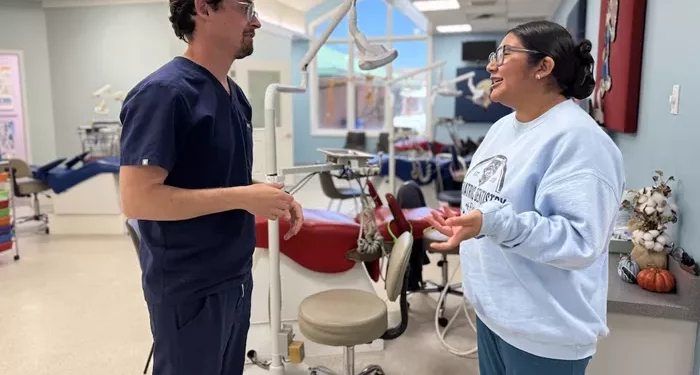
FLORENCE, Ala. — Dr. Carson Cruise, a 36-year-old pediatric dentist in Florence, often runs the practice’s finances in his head. The math, he says, is stark: if he stopped accepting Medicaid patients, he could earn the same income while working far fewer hours.
Cruise treats only children. About half of his patients rely on Medicaid and travel from across the region — in some cases an hour each way. His clinic has a four- to five-month waitlist. He is the only board-certified pediatric dentist in much of the area still taking Medicaid, he said.
Undo
The situation in Alabama is part of a larger, national problem: most state Medicaid programs reimburse dentists far less than private insurers. Low payment rates push many dentists to stop accepting Medicaid, shrinking access for low-income families and lengthening waits for care.
Undo
Alabama has one of the lowest dentist-to-population ratios in the country, second only to Arkansas, according to the American Dental Association. Several counties have no dentists at all, and parts of Lauderdale County are considered dental deserts, where patients must drive at least half an hour for care. In many counties more than half of dentists are 60 or older, and nearly half of counties lack dentists under 40.
Undo
State policy plays a major role. Alabama Medicaid reimburses dentists, on average, about 46% of their usual charges. For some procedures, payments are so low that dentists lose money providing them. Cruise says that economic reality forces clinicians to consider whether subsidizing care for the state is sustainable.
“If I only took privately insured or self-pay patients, I could cut my volume, reduce staff and overhead, work fewer days and still make more,” he said. “I love helping these kids, but I can’t subsidize this care for the state of Alabama.”
The funding gap has clinical consequences. Nearly a quarter of Alabama third-graders had untreated tooth decay in 2022, higher than the national average. Tooth decay is concentrated among children at lower-income schools and disproportionately affects Black and Hispanic children.
For complex pediatric cases — such as a young child with cavities in all 20 baby teeth — treatment often requires hospital-based procedures under anesthesia.
But hospital operating-room availability for Medicaid pediatric dental cases has been limited; some hospitals stopped accepting them because reimbursements did not cover operating-room costs.
Cruise said advocacy and modest rate increases recently persuaded a nearby hospital to resume operating-room privileges for Medicaid dental patients, reducing travel that once required families to go two hours to Birmingham.
Alabama lawmakers approved a 19% increase in Medicaid funding this year, and the state has raised dental reimbursement rates three times since 2021. Still, many dentists say payments remain too low to make accepting Medicaid financially viable.
Differences with neighboring states underline the problem. For example, Alabama Medicaid reimburses about $64 for a child’s tooth extraction; Mississippi Medicaid pays roughly $83 for the same procedure. Alabama recently began providing an extra $10 per patient visit for dental care, a small help that dentists appreciate but say is insufficient.
Public-health experts note that dental coverage sits apart from broader health care systems. Many states limit adult dental benefits under Medicaid; Alabama provides no routine dental services for adults except for pregnant women who temporarily qualify.
Medicare generally does not cover dental care. These gaps matter: poor oral health has been linked to heart disease, pregnancy complications and other serious conditions, and it can affect employment and social mobility.
Researchers and clinicians say the shortage of providers willing to see Medicaid patients reflects policy choices, not inevitability. “The reason we have the health system we do is because of the policies that dictate it has to be that way,” said Zachary Schulz, a public-health historian at Auburn University.
For now, Cruise and his staff try to manage demand and prioritize urgent cases. He keeps lists of children who are in pain or have infections and moves them ahead when possible. When surgery slots are months away, he sometimes prescribes antibiotics to control infection until a procedure can be scheduled.
“It gets to a point where you feel like you’re having to triage kids and do Third World care in a First World country,” he said. “Most of us have a heart for helping these kids and we’ll do it. But you’ve got to move the needle.”