


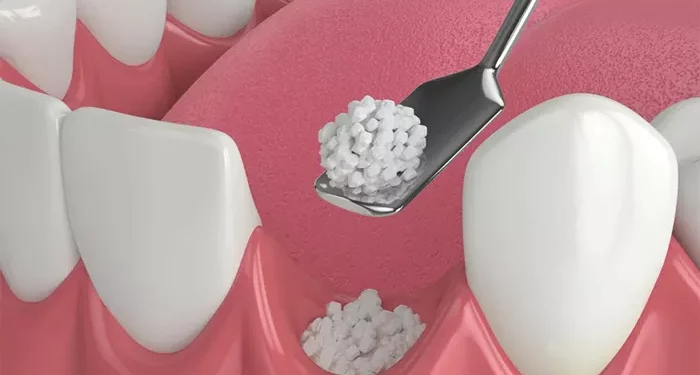
LOWELL, Mass.—RevBio, Inc. has received approval from the U.S. Food and Drug Administration to begin a pilot clinical trial evaluating the safety and effectiveness of TETRANITE®, its regenerative bone adhesive, for dental ridge augmentation procedures.
The trial will assess whether TETRANITE can be used without traditional containment devices such as membranes or meshes, or fixation aids including screws and tacks. The product is designed to adhere directly to surrounding bone, forming a stable scaffold that is gradually replaced by natural bone during healing.
“The ability to bond to existing bone is a fundamentally unique feature of TETRANITE,” said Rahul Jadia, Ph.D., RevBio’s R&D Manager of Technology Development. He added that the material maintains volume, adhesive strength, and mechanical integrity while being replaced by bone within a clinically relevant timeframe, potentially shortening and simplifying complex dental procedures.
Dental ridge augmentation is commonly required for patients who have experienced bone loss after losing a tooth. About 44% of patients seeking dental implants begin treatment with a missing tooth, often requiring grafting to rebuild jawbone height and width.
Current grafting methods rely on particulate materials and fixation devices, yet more than 30% of procedures fail to achieve adequate results, sometimes necessitating repeat surgeries and increasing treatment time and cost.
Development of TETRANITE has been supported by $1.8 million in grants from the Translational Resource Center (TRC), funded by the National Institute of Dental and Craniofacial Research (NIDCR), along with an additional $2 million Direct to Phase II Small Business Innovation Research grant from NIDCR to complete preclinical studies.
“The TRC is excited about this technology, which addresses a significant unmet clinical need,” said David H. Kohn, Ph.D., Director of the Translational Resource Center and professor at the University of Michigan. “We are pleased to see it advance to first-in-human clinical trials.”
RevBio said the study marks an important step toward improving outcomes and efficiency in dental implant-related procedures.