


What Is Interproximal Reduction in Orthodontics?
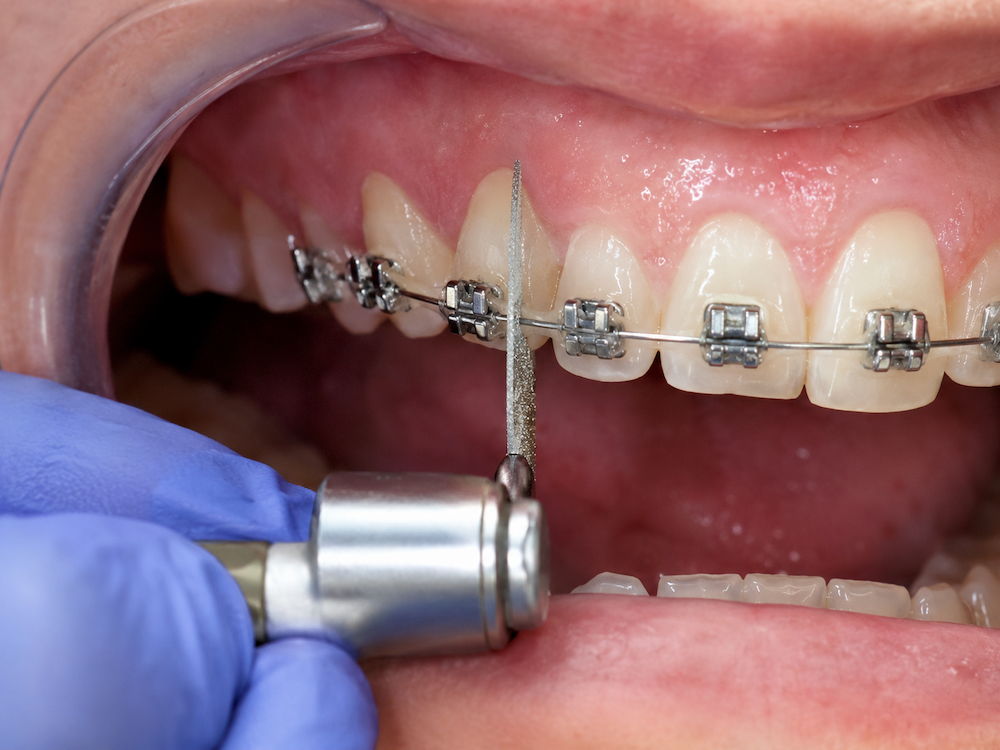
Interproximal reduction in orthodontics is a controlled enamel-removal procedure. Orthodontists often call it IPR.
During IPR, the dentist removes a very small amount of enamel between two teeth. Therefore, the treatment creates extra space without removing a whole tooth.
The dentist works only on the side surfaces of the teeth. These are the areas where neighboring teeth touch.
IPR does not involve drilling deep into the tooth. Instead, the dentist reshapes the outer enamel layer with precise instruments.
The main features include:
- Only a small amount of enamel is removed
- The work takes place between neighboring teeth
- The dentist measures the planned reduction
- The treated surfaces are smoothed afterward
- The procedure supports planned tooth movement
Because enamel contains no nerves, IPR usually causes little or no pain. However, some patients may feel pressure or mild sensitivity.
Therefore, IPR is very different from treating a cavity. It is a planned orthodontic technique rather than a repair procedure.
Why Orthodontists Need Extra Space
Teeth need enough room to move into proper positions.
However, many patients have mild or moderate crowding. Their jaw may not provide enough space for every tooth to align.
Therefore, the orthodontist must create room before moving the teeth.
Several methods can create space:
- Expanding the dental arch
- Moving teeth backward
- Removing selected teeth
- Adjusting tooth position
- Using interproximal reduction
- Combining several methods
IPR works well when the space shortage is small.
For example, a patient may need only a few millimeters across the full dental arch. Removing a premolar could create too much space.
In that case, small reductions across several contact points may provide a better balance.
Therefore, IPR often acts as a middle option. It can create more room than simple alignment alone, yet less space than extraction.
Still, the orthodontist must calculate the exact amount.
Too little reduction may not solve the crowding. In contrast, too much reduction can change tooth shape and contact quality.
How Much Enamel Does IPR Remove?
The amount removed during IPR is usually small.
However, there is no single safe number for every tooth. Enamel thickness changes by tooth type, surface, age, and individual anatomy.
Therefore, orthodontists must plan each contact point separately.
A common plan may remove a fraction of a millimeter from one or both neighboring surfaces.
For example, the dentist may remove:
- A small amount from one side of a tooth
- Equal amounts from two neighboring teeth
- Different amounts at different contact points
- More space in one arch than the other
The total space can become useful when several teeth receive minor reduction.
For instance, a few tenths of a millimeter across many contact points may create several millimeters of space.
Therefore, IPR relies on accumulation rather than aggressive grinding.
The orthodontist should record the planned and completed amounts.
In addition, the dentist should preserve enough enamel around every tooth.
Safe treatment depends on controlled reduction, not on using one fixed amount for everyone.
When Mild or Moderate Crowding May Need IPR
Mild and moderate crowding are common reasons for IPR.
Crowding occurs when the teeth need more space than the dental arch provides.
As a result, teeth may overlap, rotate, or lean outward.
IPR can help when:
- Front teeth overlap slightly
- Teeth have minor rotations
- The arch needs limited extra space
- Extraction would create too much room
- Expansion alone may not remain stable
- The patient needs a more balanced tooth position
Therefore, IPR may reduce the need to push front teeth too far forward.
This point matters because excessive forward movement can affect the bite and lip profile.
However, IPR cannot solve every crowded case.
Severe crowding may require tooth extraction, expansion, or other advanced mechanics.
In addition, patients with very thin enamel may not suit extensive reduction.
Therefore, the orthodontist should assess the full arch rather than one crooked tooth.
IPR works best when it forms part of a complete movement plan.
How IPR Can Improve Tooth Shape
Some teeth have wide or rounded contact areas.
For example, a front tooth may look broad near the biting edge but narrow near the gum line.
This shape can make the teeth appear triangular.
When the orthodontist aligns triangular teeth, a small dark space may remain near the gums.
Careful IPR can reshape the contact area.
Therefore, the teeth can move closer together near the gum line.
Potential shape-related benefits include:
- Improving contact between neighboring teeth
- Reducing visible gaps near the gums
- Making tooth width more balanced
- Improving symmetry between left and right teeth
- Creating a smoother alignment
- Reducing food-trapping areas in selected cases
However, IPR cannot completely change the natural anatomy of a tooth.
The orthodontist must preserve a realistic and healthy shape.
In addition, excessive reshaping may make a tooth look too narrow.
Therefore, the goal is subtle improvement rather than dramatic alteration.
IPR as an Alternative to Tooth Extraction
Some patients fall between extraction and non-extraction treatment.
Without extraction, the teeth may remain crowded. However, removing a whole tooth may create more space than the case needs.
Therefore, IPR can offer a compromise in selected situations.
The orthodontist may choose IPR when:
- The crowding is limited
- The facial profile does not need major change
- The teeth are relatively broad
- The enamel thickness allows reduction
- The bite can improve with small space changes
- Long-term stability supports the plan
However, IPR does not always replace extraction.
Severe crowding often needs more space than enamel reduction can safely provide.
Likewise, some patients need extraction to improve protrusion or bite relationships.
Therefore, the decision should depend on the whole treatment goal.
Patients should not view extraction and IPR as competing choices.
Instead, both are tools. The orthodontist selects the method that creates suitable space with the least unnecessary change.
Can IPR Help Reduce Black Triangles?
Black triangles are small dark spaces near the gum line between teeth.
They may appear after crowded teeth become straight.
Before treatment, overlapping teeth can hide the true shape of the gum and contact areas.
After alignment, the space may become visible.
Several factors can cause black triangles:
- Triangular tooth shape
- Gum recession
- Bone loss
- Age-related tissue changes
- Wide spacing near the roots
- A contact point positioned too high
- Previous periodontal disease
IPR may help when tooth shape contributes to the problem.
The orthodontist reshapes the contact area and then moves the teeth closer together.
Therefore, the contact point may extend farther toward the gum line.
However, IPR cannot regrow missing gum tissue or bone.
If periodontal loss causes the black triangle, improvement may remain limited.
Therefore, the dentist should explain realistic expectations.
In suitable cases, IPR can make black triangles less noticeable. Still, it may not remove them completely.
Does IPR Hurt?
Most patients do not describe IPR as painful.
Enamel contains no nerves. Therefore, reducing only the enamel should not cause sharp pain.
However, patients may notice:
- Pressure between the teeth
- Vibration from the instrument
- A scraping sensation
- Mild gum irritation
- Temporary sensitivity
- Water spray during polishing
The gums may feel tender if the instrument touches the soft tissue.
Still, the discomfort usually remains mild and short-lived.
Local anesthesia is not always necessary.
However, the dentist may use numbing methods if the patient feels anxious or sensitive.
In addition, the treatment may take place over more than one appointment.
This approach allows the orthodontist to create space as the teeth move.
Therefore, patients may receive IPR in several small stages rather than all at once.
Patients should tell the doctor if they feel sharp pain. The dentist can then stop and examine the area.
Is IPR Safe for Tooth Enamel?
IPR can be safe when a trained clinician plans and performs it carefully.
The main safety principle is simple: the dentist must remain within the enamel layer.
Enamel forms the hard outer surface of the tooth. Beneath it lies dentin, which is more sensitive.
Therefore, excessive reduction can expose dentin and increase sensitivity.
Safe IPR depends on several factors:
- Correct case selection
- Accurate space calculation
- Evaluation of tooth anatomy
- Controlled instruments
- Careful measurement
- Proper polishing
- Good oral hygiene
- Regular follow-up
The amount of enamel differs across teeth.
Therefore, the dentist should not assume that every contact can tolerate the same reduction.
In addition, teeth with previous restorations may need special planning.
For example, a filling or crown near the contact point may limit treatment options.
Overall, controlled IPR should preserve tooth strength and function.
However, careless or excessive reduction can create avoidable problems.
How Orthodontists Plan the Procedure
IPR should begin with a detailed orthodontic plan.
The orthodontist first evaluates the amount of crowding and the desired final tooth positions.
Then, the dentist decides where to create space.
Planning may include:
- Clinical examination
- Dental photographs
- Digital scans
- Study models
- Dental X-rays
- Tooth-width measurements
- Bite analysis
- Gum assessment
Digital planning can show how much space each tooth movement requires.
Therefore, the orthodontist can distribute the reduction across several contacts.
This approach helps avoid removing too much enamel from one tooth.
The dentist may also consider the Bolton ratio. This measurement compares the total width of upper and lower teeth.
A tooth-size imbalance may affect how the upper and lower arches fit together.
Therefore, IPR can sometimes improve bite coordination as well as crowding.
Still, measurements guide the plan. They do not replace clinical judgment.
The orthodontist must also assess tooth shape, enamel quality, and gum health.
Which Tools Are Used for IPR?
Orthodontists can use several professional tools for IPR.
The chosen instrument depends on the amount of reduction and the tooth position.
Common tools include:
- Abrasive strips
- Oscillating strips
- Fine diamond discs
- Specialized burs
- Calibrated reduction systems
- Polishing strips
- Measuring gauges
Abrasive strips work like very fine dental sandpaper.
They suit minor reduction and finishing.
Discs can remove enamel more efficiently. However, they require careful control.
Some systems include guards or depth indicators.
Therefore, they help the dentist manage the planned amount.
After reduction, the dentist measures the created space.
The orthodontist may also check the contact with floss or a gauge.
No tool makes the procedure automatically safe.
Instead, safety depends on training, visibility, control, and measurement.
Therefore, patients should receive IPR from a qualified dental professional.
They should never attempt to file or reshape their own teeth at home.
Why Polishing Matters
Freshly reduced enamel may feel rough.
A rough surface can collect plaque more easily. It may also make flossing difficult.
Therefore, polishing is an important part of IPR.
The dentist uses fine strips, discs, or polishing tools to smooth the treated surfaces.
Proper polishing can:
- Reduce surface roughness
- Improve floss movement
- Limit plaque retention
- Improve contact quality
- Support gum health
- Make the surface easier to clean
After polishing, the contact area should feel smooth and natural.
However, polishing does not replace daily hygiene.
Patients still need to brush and floss carefully.
The dentist may recommend a fluoride product after treatment.
However, fluoride application depends on the patient’s cavity risk, enamel condition, and clinical protocol.
Therefore, it is not an automatic requirement in every case.
Patients with a high cavity risk may benefit from additional fluoride protection.
Can IPR Cause Tooth Sensitivity?
Temporary sensitivity can occur after IPR.
However, significant or long-lasting sensitivity is not expected after well-controlled enamel reduction.
Mild sensitivity may appear when patients drink cold water or breathe in cold air.
Usually, the sensation improves as the teeth settle.
Possible reasons include:
- A naturally thin enamel layer
- Reduction close to dentin
- Existing enamel wear
- Gum irritation
- Exposed root surfaces
- Previous tooth sensitivity
- Incomplete polishing
Patients should report sensitivity that continues or worsens.
The dentist can check for enamel loss, gum recession, cavities, or contact problems.
The doctor may also recommend:
- Desensitizing toothpaste
- Fluoride treatment
- Gentle brushing
- Reduced acidic food intake
- Further polishing
- Protective dental products
Therefore, mild short-term sensitivity does not always indicate damage.
However, persistent pain needs professional evaluation.
Does IPR Increase the Risk of Cavities?
Properly performed IPR does not automatically cause cavities.
However, plaque control remains very important.
The areas between teeth already have a higher cavity risk because they are difficult to clean.
If the reduced surfaces remain rough, plaque may collect more easily.
Therefore, polishing and home care matter.
Patients can lower cavity risk by:
- Brushing twice each day
- Using fluoride toothpaste
- Cleaning between teeth
- Reducing frequent sugar intake
- Attending dental checkups
- Following professional fluoride advice
- Keeping orthodontic appliances clean
Patients with braces need extra care.
Food and plaque can collect around brackets and wires.
Clear aligner patients must also clean their teeth before replacing the trays.
Therefore, IPR safety depends partly on patient behavior.
A smooth surface and good hygiene usually support healthy enamel.
In contrast, poor cleaning can increase cavity risk with or without IPR.
What Happens If Too Much Enamel Is Removed?
Over-reduction can create several problems.
First, the dentist may expose dentin. Dentin reacts more strongly to temperature and pressure.
Therefore, the tooth may become sensitive.
Second, excessive reduction may change the tooth’s shape.
The tooth may look too narrow or uneven.
Other possible problems include:
- Weak contact between teeth
- Food trapping
- Increased plaque retention
- Gum irritation
- Uneven spacing
- Poor final alignment
- Higher cavity risk
- Difficulty creating a natural crown shape
However, severe complications should remain uncommon when a qualified orthodontist controls the procedure.
The dentist should measure the available enamel and planned space.
In addition, the doctor should check the tooth contact after movement.
If a contact becomes too open, the orthodontist may need to close the space.
Restorative treatment may help in rare cases of excessive reshaping.
Therefore, precise planning prevents most problems before they occur.
Why Poor Tooth Contacts Can Cause Food Trapping
Neighboring teeth should touch in a stable and natural way.
The contact helps stop food from pressing deeply between the teeth.
If IPR creates an open or uneven contact, food may become trapped.
Repeated food trapping can cause:
- Gum pain
- Gum inflammation
- Bad breath
- Interdental cavities
- Discomfort during meals
- Bone irritation over time
Therefore, the orthodontist must not only create space.
The teeth must also move back into suitable contact.
Sometimes, the space remains open for a short period during treatment.
This situation may be part of the planned movement.
However, the final result should provide functional contact where appropriate.
Patients should report repeated food trapping.
The orthodontist can check the tooth position, contact shape, and bite.
In addition, patients may need special floss or interdental brushes during treatment.
Good contact design supports both comfort and long-term oral health.
Who May Not Be a Good Candidate?
Not every patient suits IPR.
The orthodontist may avoid or limit the procedure when enamel is thin or damaged.
Caution may apply in patients with:
- Severe enamel erosion
- Large fillings between teeth
- Dental crowns
- Existing tooth sensitivity
- High cavity risk
- Poor oral hygiene
- Active gum disease
- Very small or narrow teeth
- Significant enamel defects
- Severe crowding
Patients with severe crowding may need more space than IPR can safely create.
Likewise, narrow teeth may not provide enough enamel for reshaping.
In addition, active gum disease needs treatment before orthodontic work continues.
The dentist may choose another method, such as expansion or extraction.
Therefore, IPR suitability depends on anatomy and oral health.
It should never become a routine procedure for every patient.
IPR With Braces and Clear Aligners
IPR can support both braces and clear aligner treatment.
With braces, the orthodontist may perform reduction after the teeth begin to straighten.
This timing can improve access between crowded teeth.
With clear aligners, the digital plan often lists the exact contact points and amounts.
However, the doctor still needs to confirm the clinical conditions.
IPR may occur:
- Before the first aligner
- During a later aligner stage
- Across several appointments
- After initial tooth rotation
- Before closing black triangles
- During bite refinement
Patients should follow the schedule closely.
If the planned IPR does not occur, the aligners may stop fitting correctly.
However, performing too much reduction too early can also create unwanted spaces.
Therefore, timing matters.
The orthodontist should compare the real tooth movement with the digital plan.
In both braces and aligner treatment, IPR remains a clinical procedure.
Software may support planning, but the dentist controls the final decision.
What Patients Should Ask Before Treatment
Patients have every right to understand why IPR is recommended.
Useful questions include:
- Why do I need IPR?
- How much space will it create?
- Which teeth will receive reduction?
- How much enamel will you remove?
- Are there other treatment options?
- Will I feel sensitivity?
- How will you measure the reduction?
- Will you polish the surfaces?
- Do I need fluoride afterward?
- How should I clean the area?
The orthodontist should explain the benefits and limitations.
In addition, the doctor should describe what may happen without IPR.
For example, the teeth may remain crowded or move too far forward.
Patients should also mention existing sensitivity, fillings, and gum problems.
Therefore, good communication improves both safety and confidence.
Feeling worried about enamel removal is normal.
However, understanding the planned amount often makes the procedure less intimidating.
How to Care for Teeth After IPR
Most patients can return to normal activities immediately.
However, good cleaning supports healthy treated surfaces.
After IPR, patients should:
- Brush with fluoride toothpaste
- Floss between the treated teeth
- Keep braces or aligners clean
- Avoid frequent sugary snacks
- Limit acidic drinks
- Report lasting sensitivity
- Attend scheduled reviews
- Follow fluoride advice
Floss may feel different as the teeth move.
At first, the contact may feel open. Later, the orthodontic appliance should guide the teeth closer together.
Patients should not stop flossing because the area feels unusual.
Instead, they should ask the dental team for the correct technique.
A soft toothbrush can also protect irritated gums.
If sensitivity occurs, a desensitizing toothpaste may help.
However, patients should speak with the dentist before using specialized products.
Good daily care protects the enamel throughout orthodontic treatment.
Common Myths About IPR
Several myths make patients more afraid of IPR than necessary.
One myth says that the dentist grinds away a large part of the tooth.
In reality, planned reduction usually removes only a small amount.
Another myth says that IPR always exposes nerves.
However, controlled treatment stays within enamel.
Other common myths include:
- IPR always causes cavities
- The procedure always hurts
- Teeth become weak after IPR
- Every orthodontic patient needs it
- IPR can replace extraction in every case
- Black triangles always disappear after IPR
- Polishing does not matter
- Patients can file their own teeth
These statements are inaccurate or incomplete.
However, IPR still requires professional judgment.
It is not risk-free when performed badly.
Therefore, patients should avoid both extremes.
They should not panic simply because the dentist recommends IPR.
Likewise, they should not treat it as a casual cosmetic procedure.
The best approach combines careful planning, controlled reduction, polishing, and good hygiene.
Conclusion
Interproximal reduction in orthodontics is a precise method for creating small amounts of space between teeth.
Orthodontists may use it for mild crowding, tooth-shape correction, bite coordination, or black triangle improvement.
The procedure removes a limited amount of enamel from selected contact surfaces.
Therefore, it differs greatly from aggressive tooth grinding.
When a qualified orthodontist plans and performs IPR carefully, it should not harm healthy teeth.
However, safety depends on correct measurement, suitable enamel thickness, smooth polishing, and good oral hygiene.
Excessive or poorly controlled reduction can cause sensitivity, rough surfaces, food trapping, or contact problems.
Therefore, patients should discuss the planned amount and purpose with their orthodontist.
Interproximal reduction in orthodontics works best as one part of a complete treatment plan.
The goal is not simply to make teeth smaller. Instead, the goal is to create enough space for a healthy, stable, and natural-looking result.