


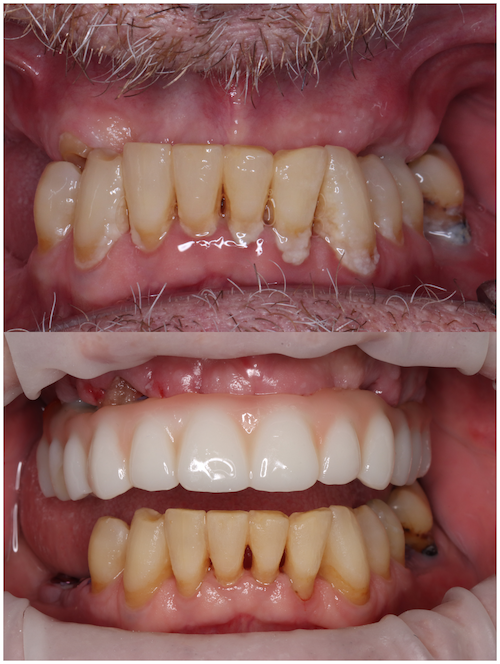
Patient Background
Full-mouth dental implants for missing teeth can offer a stable solution for patients who have lost many teeth. In this case, the patient was a 70-year-old male. He had suffered from multiple missing teeth for several years.
Recently, his removable denture became unstable. Therefore, eating became difficult. Speaking also felt less natural. In addition, the old upper-front porcelain restorations no longer provided good support.
The main patient concerns included:
- Long-term missing teeth
- Loose removable denture
- Poor chewing ability
- Old upper-front fixed restorations
- Chronic gum problems
- Desire for a more stable solution
Moreover, the patient had a history of hypertension. Because of this, the dental team needed to plan treatment with extra attention to medical safety. For older patients, implant treatment should never focus on teeth alone. Instead, it should consider the full oral condition, general health, bone quality, and long-term maintenance.
Dental Problems Analysis
The patient had complex dental problems. Therefore, a simple denture repair could not solve the full issue. His case involved tooth loss, gum disease, bone changes, and poor denture stability.
First, many teeth were missing. As a result, the chewing force could not spread evenly. The remaining teeth and old restorations had to carry more pressure.
Second, chronic periodontitis affected the oral foundation. Periodontitis can damage the gums and jawbone. Therefore, it can reduce support for both natural teeth and future implants.
Third, the removable denture moved during daily use. This often causes discomfort. It may also reduce confidence when eating in public.
The main clinical problems were:
- Upper dentition defect
- Lower dentition defect
- Chronic periodontitis
- Unstable removable denture
- Reduced bite support
- Possible bone loss around missing tooth areas
In short, this was a full-mouth rehabilitation case. So, the treatment plan needed to restore function, health, and stability together.
Why CBCT Is Important Before Implant Treatment
CBCT imaging is essential for full-mouth implant planning. It gives dentists a 3D view of the jawbone. Therefore, it helps the dentist measure bone height, bone width, and anatomical risks.
In this case, CBCT showed that the maxillary sinus area had limited space. This is important for upper posterior implants. If bone height is low, the dentist may need special planning. For example, sinus lift surgery or angled implant placement may be considered.
CBCT also helped evaluate the lower jaw. The report showed acceptable bone height, although bone quality was average. Therefore, the implant dentist needed to plan the implant position carefully.
CBCT can help answer key questions:
- Is there enough bone for implants?
- Are the sinuses close to the implant sites?
- Are nerves at risk?
- Is bone grafting needed?
- Can immediate restoration be considered?
- Which implant positions offer better support?
Therefore, CBCT does more than create images. It helps improve safety, accuracy, and treatment predictability.
Treatment Goals for Full Mouth Dental Implants
The goal of full-mouth dental implants for missing teeth is not only to replace teeth. More importantly, it should rebuild stable oral function. For this patient, the treatment plan needed to improve chewing, comfort, and long-term oral health.
The main treatment goals included:
- Restore chewing function
- Improve denture stability
- Support clearer speech
- Replace missing upper and lower teeth
- Control chronic periodontitis
- Improve bite balance
- Reduce pressure on remaining teeth
- Create a more natural-looking smile
For the upper jaw, the treatment plan considered All-on-6 dental implants. This method uses six implants to support a fixed full-arch restoration. It can provide stronger stability than a traditional removable denture.
For the lower jaw, implants were planned in key missing areas. This would help restore posterior bite support. As a result, the patient could chew more comfortably on both sides.
However, every implant plan must match the patient’s real condition. Age, gum health, bone quality, bite force, and medical history all matter.
Treatment Process
A successful implant case needs a clear step-by-step process. Therefore, the treatment should begin with examination and planning, not surgery alone.
A typical treatment process may include:
- Oral examination
- Periodontal assessment
- CBCT imaging
- Medical history review
- Bite analysis
- Removal of hopeless teeth, if needed
- Gum inflammation control
- Implant placement
- Temporary restoration, when suitable
- Final fixed restoration
- Long-term maintenance
In this case, the dentist considered immediate implant placement and implant-supported restoration in selected areas. This can reduce treatment time. However, it is only suitable when infection control and implant stability are acceptable.
For senior patients, comfort also matters. Therefore, the dentist should manage each visit carefully. Blood pressure, stress level, healing ability, and medication history should all be reviewed.
At Huangshan International Dental Hospital, experienced implant dentists follow international clinical standards. This helps support safer planning for complex cases, especially when patients have long-term tooth loss and periodontal disease.
All-on-6 Dental Implants for Upper Jaw Restoration
All-on-6 dental implants are often used for patients who have lost most or all teeth in one jaw. The method uses six implants to support a fixed bridge. Therefore, it can offer better stability than removable dentures.
For this patient, All-on-6 was considered for the upper jaw. This matched his need for stronger support and improved chewing comfort.
Possible benefits include:
- Stronger bite stability
- Less movement during eating
- Better speech comfort
- More natural appearance
- Improved confidence
- Reduced dependence on removable dentures
However, All-on-6 dental implants require careful diagnosis. The dentist must check bone height, bone width, sinus position, gum condition, and bite force. If the upper jaw has limited bone, extra planning may be needed.
In addition, patients must maintain the restoration well. Implant bridges still need daily cleaning. They also require regular dental checkups. Therefore, long-term success depends on both professional treatment and patient care.
Dental Implants for Seniors
Many older patients ask if they are too old for dental implants. In most cases, age alone is not the main limit. Instead, dentists focus on health, bone condition, gum status, and oral hygiene.
A 70-year-old patient may still be a good candidate. However, the dentist must evaluate the full situation first.
Important checks include:
- Blood pressure control
- Diabetes status, if present
- Medication history
- Bone volume
- Gum health
- Smoking history
- Healing ability
- Ability to maintain oral hygiene
Dental implants for seniors can bring real benefits. They may improve chewing power. They may also help patients eat a wider range of foods. In addition, fixed teeth can reduce embarrassment caused by loose dentures.
However, seniors need personalized care. The treatment should avoid unnecessary trauma. It should also balance comfort, cost, time, and long-term function.
Therefore, implant treatment for seniors should always begin with a detailed consultation and diagnosis.
Chronic Periodontitis Treatment Before Implants
Chronic periodontitis treatment is a key step before implant placement. Periodontitis damages the gums and bone around teeth. If it remains active, it may affect implant success.
Before implants, the dentist may recommend:
- Deep cleaning
- Plaque and tartar removal
- Gum inflammation control
- Extraction of hopeless teeth
- Bite adjustment
- Oral hygiene guidance
- Follow-up periodontal checks
Moreover, patients with periodontitis need long-term care. Gum disease can return if plaque builds up again. Therefore, the patient must clean teeth and implant restorations carefully every day.
This is especially important for full-mouth implant cases. Implants do not get cavities. However, the tissue around implants can still become inflamed. This condition is often called peri-implantitis.
For this reason, periodontal control is not optional. It is part of implant success. A healthy gum environment helps implants last longer and feel more comfortable.
Before and After Result
Before treatment, the patient had unstable dentures and poor chewing ability. He also had multiple missing teeth and chronic periodontitis. Therefore, daily eating was difficult. Social confidence may also have been affected.
After successful implant-supported restoration, patients may experience clear improvements.
Expected improvements may include:
- Better chewing comfort
- Stronger bite support
- More stable teeth
- Improved speech
- More natural smile appearance
- Less denture movement
- Better quality of life
However, results vary from person to person. Bone condition, gum health, implant stability, and aftercare all affect the final outcome.
The most important result is not only a nicer smile. More importantly, implant treatment can help restore daily function. Patients may chew more easily. They may speak with more comfort. They may also feel more confident during meals.
Still, regular maintenance remains essential. Without good cleaning and follow-up, implant problems can still occur.
Why Choose Huangshan International Dental Hospital
Huangshan International Dental Hospital offers several advantages for complex implant cases. For this case, two advantages are especially relevant.
First, the hospital provides international-level dental expertise. The implant team includes experienced dentists who follow clinical standards similar to those used in Europe and the United States. This is important for patients with severe tooth loss, chronic periodontitis, and complex bone conditions.
Second, the hospital uses an integrated clinic and in-house dental lab model. Dentists and dental technicians can communicate directly. Therefore, restorations can be designed with better fit, bite balance, and appearance.
This model may offer several benefits:
- Faster restoration design
- Better communication
- More precise fit
- Shorter waiting time
- Improved aesthetic control
- Better bite adjustment
Moreover, international patients can receive personalized plans. The hospital can help match treatment steps with the patient’s time, oral condition, and budget. This makes the treatment journey easier and more efficient.
Aftercare Tips After Full Mouth Dental Implants
Aftercare plays a major role in implant success. Even after a good surgery, patients still need daily cleaning and regular checkups.
Important aftercare tips include:
- Brush twice a day
- Clean under implant bridges daily
- Use interdental brushes if advised
- Use a water flosser when suitable
- Avoid smoking
- Avoid biting very hard objects
- Control blood pressure and blood sugar
- Visit the dentist regularly
- Report pain, swelling, or looseness early
In the first healing stage, patients should follow the dentist’s diet advice. Soft foods are often recommended at the beginning. Then, the patient can slowly return to normal chewing as healing improves.
In addition, professional maintenance is important. The dentist can check gum health, implant stability, bite pressure, and bridge fit. Early care can prevent small issues from becoming serious.
Therefore, implant aftercare is not difficult, but it must be consistent.
FAQ
Are full-mouth dental implants worth it?
Yes, full-mouth dental implants can be worth it for patients with severe tooth loss. They may improve chewing, speech, comfort, and confidence. However, the patient needs a proper diagnosis before treatment.
How long do full-mouth dental implants last?
Full-mouth dental implants can last many years with good care. Their lifespan depends on oral hygiene, bone health, bite force, smoking habits, and regular dental visits.
Can seniors get full-mouth dental implants?
Yes, many seniors can receive dental implants. Age alone is not the main problem. Dentists need to check general health, bone condition, gum disease, and healing ability first.
What is the difference between dentures and implants?
Dentures are removable and may move during eating. Implants are fixed in the jawbone and offer stronger stability. However, the best option depends on oral condition, budget, and treatment goals.
Is All-on-6 better than traditional dentures?
All-on-6 dental implants usually provide better stability than traditional dentures. They can improve chewing and reduce denture movement. However, patients need enough bone support and good gum health.
Can gum disease patients get dental implants?
Some gum disease patients can get implants after periodontal treatment. The dentist must control infection first. After implants, the patient needs strict cleaning and regular maintenance.
Conclusion
Full-mouth dental implants for missing teeth can help patients with severe tooth loss restore comfort, function, and confidence. This 70-year-old patient had multiple missing teeth, chronic periodontitis, unstable dentures, and upper and lower dentition defects. Therefore, he needed a detailed full-mouth treatment plan.
A successful plan should include CBCT imaging, periodontal control, medical safety review, implant placement, and precise restoration design. In suitable cases, All-on-6 dental implants can provide stable support for the upper jaw. Lower implants can also help rebuild chewing function.
Huangshan International Dental Hospital combines experienced implant dentists with an in-house dental lab. As a result, patients can receive more efficient, accurate, and personalized care.
In the end, implant treatment is not only about replacing teeth. It is about rebuilding a healthier oral system. With proper diagnosis, skilled treatment, and long-term aftercare, full mouth dental implants for missing teeth may help seniors enjoy better eating, clearer speech, and a more confident life.