

What Is an Underbite?
An underbite is a common orthodontic problem that concerns many parents.
Some children only show slightly prominent lower front teeth during early childhood. Their chin may also look a little forward. Therefore, parents often believe the problem is minor.
They may expect the bite to improve after the baby teeth fall out. They may also think that jaw growth will naturally correct it.
However, an obvious reverse bite should not simply be ignored.
A mild bite problem may change as permanent teeth erupt. Still, a clear anterior crossbite often needs professional assessment. In particular, a jaw-related problem may become more noticeable as the child grows.
Early evaluation helps the dentist identify the cause. It also allows the orthodontist to choose the right time for treatment.
In many cases, early treatment is simpler than treatment after facial growth is complete. It may also reduce the effect of the abnormal bite on the teeth and jaw development.
However, early treatment does not mean that every child needs an appliance immediately.
Instead, the main principle is simple:
Find the problem early, diagnose the type correctly, and treat it at the right time.
That approach can help children avoid unnecessary treatment and reduce the risk of the problem becoming harder to manage.
An Underbite Is More Than a Cosmetic Problem
A normal bite allows the upper front teeth to sit slightly in front of the lower front teeth.
The upper teeth usually cover a small part of the lower teeth. Meanwhile, the upper and lower jaws meet in a balanced position.
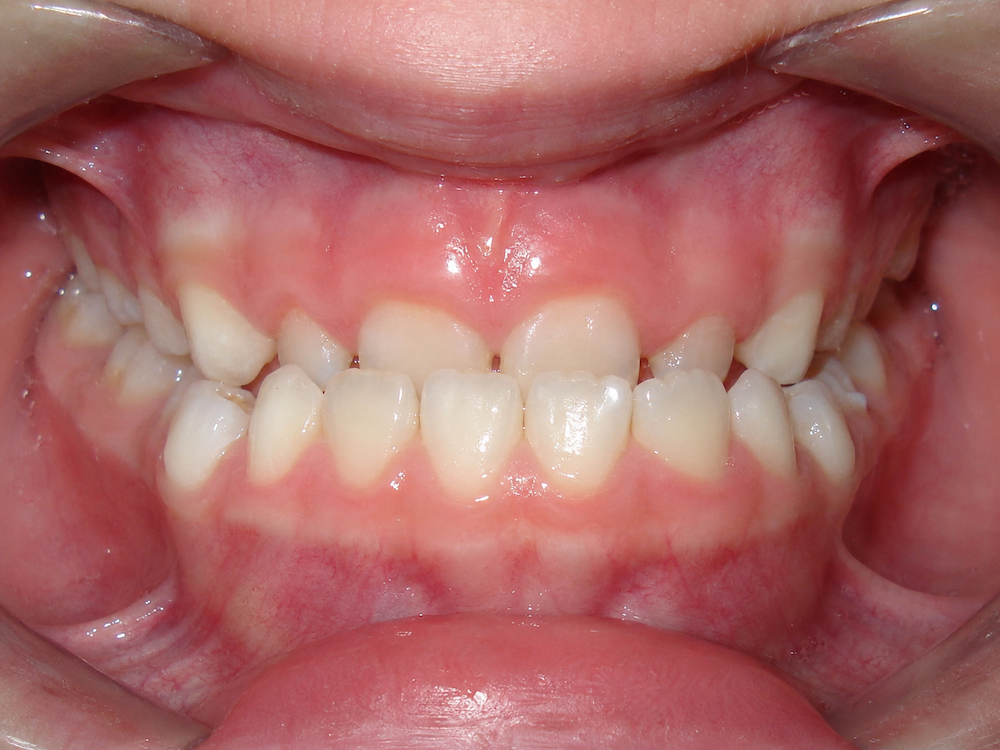
With an anterior crossbite, the relationship becomes reversed.
The lower front teeth sit in front of the upper front teeth. As a result, the chin may appear more prominent. The middle part of the face may also look flatter.
From the side, some children develop a concave facial profile. This profile is sometimes described as a crescent-shaped or “moon-shaped” face.
However, appearance is only one part of the problem.
A reverse bite may also affect chewing, tooth wear, speech, gum health, and jaw function.
The degree of harm depends on the type and severity of the condition. It also depends on how long the abnormal bite remains untreated.
Therefore, parents should not judge the problem only by how the child looks.
Even a mild-looking crossbite may create abnormal tooth contact. In contrast, a noticeable chin does not always mean the child has a severe skeletal problem.
A professional examination is needed to understand what is happening.
How Can It Affect Eating and Chewing?
The front teeth help cut food before the back teeth grind it.
When the lower front teeth sit outside the upper teeth, the child may not bite food normally. For example, biting noodles, meat, fruit, or bread may become less efficient.
As a result, the child may use the back teeth more often. The child may also move food to one side of the mouth.
Over time, this pattern can reduce chewing efficiency.
However, an anterior crossbite does not always cause obvious eating difficulties. Some children adapt to the abnormal bite and do not complain.
Even so, the teeth may still receive uneven force.
Certain front teeth may contact too heavily. Meanwhile, other teeth may not meet properly.
Therefore, a child can have an abnormal bite even without pain or difficulty eating.
Parents should pay attention if the child:
- Cannot bite food easily with the front teeth
- Often chews on only one side
- Moves the lower jaw forward when biting
- Avoids harder foods
- Complains that the teeth do not fit together
- Shows uneven wear on the front teeth
These signs do not confirm a diagnosis. Still, they suggest that an orthodontic assessment may be useful.
Can It Affect Speech?
Teeth and jaws help control airflow during speech.
Therefore, an abnormal bite may affect the way some sounds are produced. A child may have difficulty pronouncing certain sounds clearly.
For example, sounds that require the tongue to approach the front teeth may become less precise.
However, not every child with an anterior crossbite develops a speech problem.
Speech development also depends on tongue movement, hearing, muscle control, language habits, and other factors.
Therefore, parents should not assume that every pronunciation problem comes from the teeth.
If a child has both an abnormal bite and unclear speech, the dentist may recommend further evaluation.
In some cases, orthodontic treatment can improve the oral environment for speech. However, the child may still need help from a speech therapist.
The goal is not only to improve appearance. Instead, treatment should support normal oral function whenever possible.
Can It Damage the Teeth and Gums?
An abnormal bite changes the direction of force on the teeth.
For example, an upper front tooth trapped behind a lower tooth may receive pressure in an unnatural direction. The lower tooth may also push against the upper tooth during every bite.
As a result, the enamel may wear unevenly.
The gums around the affected teeth may also become irritated. In some children, a lower front tooth may be pushed forward in the bone.
This can make the gum tissue look thin. In more serious cases, gum recession may develop.
Other possible problems include:
- Chipping of the front teeth
- Tooth sensitivity
- Abnormal tooth mobility
- Uneven enamel wear
- Gum recession
- Difficulty keeping crowded areas clean
- Increased plaque accumulation
These changes do not happen in every patient. However, the risk increases when the crossbite creates heavy or repeated contact.
Therefore, early correction may sometimes protect the teeth and gums from further damage.
Can It Affect the Jaw Joint?
The jaw joints sit in front of the ears. They connect the lower jaw to the skull.
When a child has a functional reverse bite, the lower jaw may move forward every time the mouth closes.
This movement can change how the jaw muscles work.
Some children may experience:
- Jaw fatigue
- Muscle tension
- Clicking sounds
- Difficulty opening the mouth comfortably
- Discomfort around the jaw joints
However, an underbite does not automatically cause a temporomandibular joint disorder.
Jaw joint problems have many possible causes. Therefore, pain or clicking should be assessed separately.
Still, removing a forced forward jaw position may help the jaw close more naturally.
This is one reason why functional crossbites should not be ignored.
Can the Facial Profile Become More Obvious?
Childhood and adolescence are important periods of facial growth.
If the upper and lower jaws do not grow in balance, the facial difference may become more noticeable over time.
For example, the upper jaw may not grow forward enough. This can make the middle of the face look flat.
Alternatively, the lower jaw may grow forward more strongly. As a result, the chin may appear increasingly prominent.
Some children have both problems at the same time.
However, not every mild childhood reverse bite becomes a severe skeletal deformity.
Growth patterns differ from one child to another. Family history also plays an important role.
Therefore, the problem should not be described with absolute predictions.
The correct approach is regular observation.
An orthodontist can compare the child’s bite, profile, and jaw growth over time. When necessary, photographs, scans, and X-rays may also be used.
This helps the dentist decide whether the problem remains dental or is becoming more skeletal.
The Main Principle: Early Detection and Correct Diagnosis
The phrase “early treatment” can easily cause misunderstanding.
Some parents think it means that every child should start treatment at three or four years old.
That is not correct.
Early treatment means identifying the problem before it causes avoidable harm or becomes harder to manage.
Some children may need treatment during the primary dentition. Others may need treatment after the permanent front teeth erupt.
Meanwhile, some children only need observation.
The decision depends on:
- The type of reverse bite
- The severity of the bite problem
- The teeth involved
- The child’s growth stage
- The position of the jaws
- Whether a functional jaw shift is present
- The child’s ability to cooperate
- Family growth patterns
Therefore, age alone should not determine treatment.
A child with a simple tooth-position problem may benefit from short treatment. In contrast, a child with a strong skeletal growth pattern may need long-term monitoring.
Accurate classification can prevent the wrong appliance from being used.
It can also help parents develop realistic expectations.
Three Main Types of Reverse Bite
Clinically, an anterior crossbite can be divided into three main types:
- Dental anterior crossbite
- Functional anterior crossbite
- Skeletal anterior crossbite
These categories help orthodontists identify the main cause of the problem.
However, they are not always completely separate.
For example, a child may have a dental crossbite and a functional forward shift at the same time.
Likewise, a child with a skeletal jaw imbalance may also have tilted front teeth.
Therefore, the orthodontist must look at the whole condition rather than one tooth.
The treatment plan should address the main cause.
Moving the teeth may solve a dental problem. However, tooth movement alone cannot fully correct a severe jaw imbalance.
This is why identifying the type of underbite is one of the most important steps before treatment.
Dental Anterior Crossbite
A dental anterior crossbite mainly comes from the position or angle of the teeth.
The jaw bones may have a relatively normal relationship.
For example, one or more upper front teeth may tilt inward. At the same time, the lower front teeth may lean slightly outward.
As a result, the lower teeth appear in front of the upper teeth.
Common features may include:
- One or several front teeth in reverse contact
- No obvious jaw deformity
- A relatively normal facial profile
- No major forward movement of the lower jaw
- Adequate or limited space in the dental arch
- Abnormal eruption of an upper front tooth
This type often becomes clear when the permanent front teeth erupt.
In some cases, a retained baby tooth blocks the permanent tooth. In other cases, crowding forces the upper tooth to erupt inward.
A previous injury to a baby tooth may also affect the position of the permanent tooth.
Therefore, the dentist must check tooth eruption and available space.
How Is a Dental Crossbite Treated?
The main goal is to move the affected tooth or teeth into a normal position.
However, treatment depends on the amount of space available.
If enough space exists, the dentist may use:
- A removable orthodontic plate
- A fixed bite-opening appliance
- Partial braces
- A spring appliance
- Selected clear aligner treatment
- Other small tooth-moving devices
Sometimes the bite must be opened slightly before the upper tooth can move forward.
Otherwise, the lower tooth may block its movement.
If the dental arch lacks space, the orthodontist may first create room.
Treatment is often more straightforward when the problem involves only one or two teeth.
However, children still need to follow instructions carefully.
They should not push the tooth with their fingers or bite hard objects in an attempt to move it.
Uncontrolled force may damage the tooth, gum, or supporting bone.
Professional treatment applies force in a safer and more predictable way.
Functional Anterior Crossbite
A functional anterior crossbite is often more complex than a simple tooth-position problem.
In this condition, the lower jaw moves forward when the child closes the mouth.
The jaw may initially approach a more balanced position. However, the upper and lower teeth touch too early.
To avoid this contact, the child slides the lower jaw forward.
After repeated movement, the forward position may become habitual.
Parents may notice that the chin looks more prominent only when the child bites down.
When the mouth is relaxed, the facial profile may look more balanced.
This difference can help the orthodontist identify a functional component.
However, a full examination is still necessary.
The orthodontist may guide the lower jaw backward and compare the guided position with the child’s usual bite.
If the front teeth can meet edge to edge in the guided position, a functional shift may be present.
What Causes a Functional Forward Shift?
A functional forward shift may result from several forms of tooth interference.
For example:
- An upper front tooth may tilt inward
- The upper dental arch may be too narrow
- The front teeth may contact too early
- A baby tooth may remain longer than expected
- The permanent teeth may erupt in an abnormal position
- The child may have developed a habitual forward bite
In many cases, the child does not intentionally push the jaw forward.
Instead, the bite guides the lower jaw into that position.
Therefore, simply telling the child to stop moving the jaw forward is usually not enough.
The dental interference must also be corrected.
The orthodontist may use an appliance to adjust the tooth position, open the bite, or widen the upper arch.
The aim is to let the lower jaw close without being forced forward.
How Is a Functional Crossbite Treated?
Treatment usually focuses on two goals.
First, the orthodontist removes the bite interference.
Second, the child learns to close the jaw in a more natural position.
Depending on the condition, treatment may involve:
- A removable appliance
- An upper expansion appliance
- Partial fixed braces
- A bite-opening device
- Tooth movement
- Habit correction
- Regular growth observation
Once the interference is removed, the lower jaw may return to a more balanced position.
This can improve the bite and facial appearance.
However, treatment cannot completely control future jaw growth.
A child with inherited lower-jaw growth may still develop a skeletal imbalance later.
Therefore, the orthodontist should continue monitoring the child after early correction.
Successful early treatment solves the current functional problem. It does not guarantee that no further treatment will ever be needed.
When Should Dental and Functional Problems Be Treated?
Treatment timing should follow tooth eruption and the child’s individual condition.
Two commonly discussed stages are:
Primary Dentition Stage
This usually occurs around three to five years of age.
Treatment may be considered when the reverse bite is clear, stable, and affecting jaw closure.
However, not every preschool child can cooperate with an appliance.
Therefore, the dentist must consider behavior, severity, tooth condition, and treatment benefit.
Mixed Dentition Stage
This often occurs after the permanent front teeth begin to erupt.
Many children are around six to nine years old during this stage.
The orthodontist can assess the position of the permanent incisors and identify whether the problem remains dental or functional.
However, these ages are only general references.
The best time differs between children.
A child should be assessed when the problem is found rather than waiting for a fixed birthday.
Skeletal Anterior Crossbite
A skeletal reverse bite mainly comes from an imbalance in jaw growth.
The teeth may not be the primary cause.
There are two common patterns:
- The upper jaw does not grow forward enough
- The lower jaw grows too far forward
Some children have both patterns.
This type often affects several teeth rather than one single tooth.
The facial profile may also show clearer changes.
Possible features include:
- A prominent lower jaw
- A flat middle facial area
- A concave facial profile
- A wide reverse bite
- A family history of similar jaw growth
- A chin that becomes more obvious with age
- A large difference between the upper and lower jaws
Unlike a simple dental crossbite, skeletal imbalance cannot always be corrected by moving the teeth alone.
Therefore, treatment needs a broader plan.
Upper-Jaw Underdevelopment
In some children, the upper jaw is too narrow or does not grow forward enough.
The middle part of the face may look flat. Meanwhile, the lower jaw may appear prominent even when its size is relatively normal.
For selected growing children, the orthodontist may try to guide upper-jaw growth.
Treatment may include:
- Upper-jaw expansion
- A reverse-pull facemask
- Fixed or removable orthopedic appliances
- Bite correction
- Later braces when needed
An expansion appliance can widen the upper dental arch.
A facemask can apply forward force to the upper jaw.
The child usually needs to wear the appliance for a specific number of hours each day.
Therefore, cooperation has a major effect on treatment.
Early treatment may improve the relationship between the upper and lower jaws.
It may also make the facial profile look more balanced.
However, the response differs between children.
Age, growth stage, severity, appliance wear, and inherited growth patterns all affect the result.
Excessive Lower-Jaw Growth
In other children, the lower jaw grows forward more strongly than expected.
This pattern often has a genetic component.
Parents may notice that other family members also have a prominent chin or reverse bite.
True lower-jaw overgrowth is harder to control.
Some appliances may guide the bite or reduce a functional forward position. However, they cannot guarantee that the lower jaw will stop growing.
Therefore, doctors must explain the limitations of treatment clearly.
Mild cases may improve with orthodontic tooth movement.
Moderate cases may require early guidance followed by full braces.
Severe cases may need combined orthodontic and orthognathic treatment after facial growth is complete.
The final treatment plan depends on:
- The severity of the skeletal difference
- The child’s remaining growth
- The position of the teeth
- Facial appearance
- Chewing function
- The patient’s expectations
Regular growth assessment is especially important during puberty.
Why Some Skeletal Cases Need Jaw Surgery
Severe skeletal problems cannot always be corrected through braces alone.
Braces move teeth within the jaw bones. They do not greatly change the size or position of a fully developed jaw.
Therefore, an adult or older teenager with a severe jaw imbalance may need orthognathic surgery.
Treatment usually combines orthodontics and surgery.
Braces are often used before surgery to place the teeth in suitable positions.
Then, the surgeon repositions the upper jaw, lower jaw, or both jaws.
After surgery, orthodontic treatment continues to refine the bite.
Doctors usually wait until facial growth is nearly complete before performing corrective jaw surgery.
Otherwise, continued jaw growth may change the surgical result.
However, needing surgery later does not mean that early treatment failed.
Early treatment may still improve function, reduce tooth damage, correct a functional shift, or support upper-jaw growth.
Still, parents should understand that severe inherited skeletal growth may continue.
Does Every Child Need Early Treatment?
No.
Some children only need regular observation.
For example, the orthodontist may find a mild bite difference without tooth damage, functional shifting, or significant jaw imbalance.
In that situation, immediate treatment may not provide enough benefit.
The dentist may wait for more permanent teeth to erupt.
However, observation does not mean ignoring the condition.
The child should attend regular reviews.
During these visits, the orthodontist may check:
- Whether the reverse bite is becoming wider
- Whether the chin is becoming more prominent
- Whether the lower jaw is shifting forward
- Whether tooth wear is increasing
- Whether the gums remain healthy
- Whether permanent teeth are erupting normally
- Whether jaw growth is becoming more unbalanced
Treatment can then begin when the benefit becomes clearer.
This approach avoids both overtreatment and delayed treatment.
Will Full Braces Be Needed After Early Treatment?
The answer depends on the child’s later dental and jaw development.
The purpose of early treatment is usually to interrupt an abnormal growth pattern or correct an urgent bite problem.
It is similar to guiding the direction of oral development.
However, many permanent teeth have not erupted during early childhood.
Therefore, early treatment cannot always complete the final alignment of every tooth.
After the permanent teeth erupt, the orthodontist will assess the child again.
This often happens around 11 to 13 years of age. However, the exact time depends on dental development.
The dentist will check:
- Whether the permanent teeth are straight
- Whether crowding remains
- Whether spaces are present
- Whether the upper and lower arches fit
- Whether the bite is stable
- Whether jaw growth remains balanced
- Whether the facial profile has changed
Some children do not need another phase.
Others need limited tooth alignment.
Meanwhile, many children need full braces or clear aligners to complete the bite.
Therefore, early treatment should not be described as a guaranteed way to avoid braces later.
What Is the Purpose of Two-Phase Treatment?
Two-phase orthodontic treatment includes an early phase and a later phase.
The first phase focuses on growth, jaw position, crossbite correction, space, or harmful bite interference.
The second phase usually starts after most permanent teeth have erupted.
Its purpose is to refine tooth alignment and establish a stable final bite.
The first phase may:
- Correct a functional forward shift
- Improve upper-jaw development
- Reduce abnormal tooth contact
- Protect teeth and gums
- Create space for permanent teeth
- Reduce the severity of later treatment
The second phase may:
- Straighten the permanent teeth
- Close spaces
- Correct remaining crowding
- Coordinate the dental arches
- Improve the final overbite and overjet
- Refine chewing function
Not every child needs two phases.
A responsible orthodontist should recommend two-phase treatment only when early intervention offers a clear benefit.
When Should Parents Arrange an Assessment?
Parents should consider an orthodontic assessment when they notice:
- The lower front teeth sit ahead of the upper teeth
- The child pushes the chin forward when biting
- One upper tooth is trapped behind a lower tooth
- The facial profile looks increasingly concave
- The child struggles to bite food with the front teeth
- The front teeth show unusual wear
- The gums around a lower front tooth are receding
- Close family members have a severe reverse bite
Children can receive an orthodontic screening at around seven years of age.
However, parents should not wait until seven if an obvious reverse bite appears earlier.
Likewise, a child older than seven can still benefit from assessment and treatment.
The correct timing depends on the condition, not only the child’s age.
What Happens During the Examination?
The orthodontist first checks the child’s teeth and facial profile.
The child will be asked to bite naturally.
The doctor may then guide the lower jaw into a different position. This helps determine whether the jaw slides forward during closure.
The examination may also include:
- Checking the position of the front teeth
- Measuring the reverse bite
- Evaluating tooth crowding
- Assessing facial symmetry
- Examining gum health
- Reviewing tooth eruption
- Asking about family history
- Taking dental photographs
- Creating digital scans
- Taking X-rays when needed
The orthodontist then decides whether the problem is mainly dental, functional, skeletal, or mixed.
This diagnosis forms the basis of treatment.
Without this step, an appliance may only change the appearance of the teeth without addressing the true cause.
How Parents Can Support Treatment
Parents play an important role during orthodontic treatment.
Children may forget to wear removable appliances. They may also have difficulty cleaning around fixed devices.
Therefore, parents should provide practical support.
They can help the child:
- Wear the appliance for the prescribed time
- Brush carefully around the teeth and appliance
- Clean removable devices every day
- Avoid hard and sticky foods when required
- Attend every review appointment
- Report a broken appliance quickly
- Follow instructions for elastics or facemasks
Mild pressure or tenderness may occur after an adjustment.
However, severe pain, swelling, bleeding, or a loose appliance should be checked by the dentist.
Parents should also use positive language.
Treatment may take time, especially when jaw growth needs regular observation.
Encouragement can improve the child’s cooperation and make the process easier.
Common Misunderstandings About Reverse Bite Treatment
One common misunderstanding is that every childhood reverse bite will correct itself.
Some minor bite relationships may change during tooth eruption. However, an obvious or persistent crossbite should receive professional assessment.
Another misunderstanding is that early treatment can stop all future lower-jaw growth.
Orthodontic appliances may guide growth in selected cases. Still, they cannot fully control every inherited growth pattern.
Some parents believe one appliance can treat every case.
However, a dental problem, functional problem, and skeletal problem need different treatment strategies.
Another belief is that early treatment always prevents full braces.
In reality, many children still need later orthodontic treatment after all permanent teeth erupt.
Finally, some people think braces can correct every adult jaw problem.
Braces move teeth. They cannot completely correct a severe skeletal imbalance in a mature patient.
Therefore, severe cases may need jaw surgery.
Clear expectations help families make better treatment decisions.
Frequently Asked Questions
Can a Child’s Reverse Bite Correct Itself?
A mild bite relationship may change during tooth eruption. However, parents should not wait for an obvious or persistent reverse bite to correct itself. Early assessment is safer.
What Is the Best Age to Treat an Underbite?
There is no single best age for every child. Some cases need treatment during the primary dentition, while others are treated after permanent front teeth erupt.
Can Braces Correct a Skeletal Reverse Bite?
Braces can improve tooth position. However, they may not fully correct a severe jaw imbalance. Some patients need growth modification or jaw surgery.
Will My Child Need Braces Again?
Possibly. Early treatment often corrects a developing bite problem. Full braces may still be needed after the permanent teeth erupt.
Is Early Treatment Painful?
Most children experience mild pressure or tenderness. Severe or lasting pain is not normal and should be reported to the orthodontist.
Summary
An underbite may look like a simple tooth problem, but its causes can differ greatly.
Some cases come from tilted front teeth. Others result from a functional forward shift of the lower jaw. More complex cases involve abnormal upper-jaw or lower-jaw growth.
Therefore, the first step is not choosing an appliance.
The first step is identifying the type of reverse bite.
Dental cases may respond well to limited tooth movement. Functional cases often require removal of bite interference. Skeletal cases may need growth guidance, long-term observation, full orthodontics, or jaw surgery.
Early treatment can correct harmful bite contact and guide oral development.
However, it cannot guarantee that a child will never need braces or surgery later.
Parents should arrange an assessment when they notice the lower front teeth sitting ahead of the upper teeth.
With early detection, correct classification, and suitable treatment timing, children can avoid unnecessary detours and achieve a healthier, more stable bite.