


How Many Implants Are Needed for a Full Mouth?
“Doctor, all my upper teeth are gone. How many implants do I need?”
“Do I need one implant for every missing tooth?”
Many full-mouth missing teeth patients ask this at their first visit. In the past, many people believed one missing tooth needed one implant. Therefore, if all teeth were gone, they thought they might need more than twenty implants.
However, modern implant dentistry does not work that way in most full-mouth cases.
For patients with a full arch or full mouth of missing teeth, dentists commonly consider two mature solutions. One is traditional full-mouth implant treatment. The other is All-on-4 dental implants.
The biggest difference is simple. They use different numbers of implants.
Traditional full-mouth treatment often uses more implants. Meanwhile, All-on-4 uses only four implants to support one full arch of fixed teeth.
Therefore, patients do not need to panic. Full-mouth implant treatment is not always as complicated as “one tooth, one implant.”
Traditional Full Mouth Implants: Usually 4 to 6 Implants Per Arch
Traditional full-mouth implant treatment often places four to six implants in one jaw. The upper jaw and lower jaw may need similar numbers.
So, if both jaws need treatment, the total number may be around 8 to 12 implants. In some complex cases, dentists may use more implants. The exact number depends on bone condition, bite force, and bridge design.
After the implants heal, the dentist makes a fixed full-arch bridge. This bridge connects many artificial teeth together. The implants support the whole bridge.
This plan has a clear advantage. Each implant shares part of the chewing force. Therefore, the pressure can spread more evenly.
If the patient has enough bone and good health, traditional full-mouth implants can offer strong long-term stability.
However, the disadvantages are also clear.
- More surgery may be needed
- More implants increase the surgical area
- Bone volume requirements are higher
- Bone grafting may be necessary
- Total cost is often higher
- Treatment time is usually longer
Therefore, traditional full-mouth implant treatment suits some patients well. However, it may not suit every elderly patient or every patient with severe bone loss.
Why Traditional Full Mouth Implants Can Be More Complex
Many full-mouth missing teeth patients have worn removable dentures for years. Others have had loose teeth for a long time. Because of this, the jawbone may have already shrunk.
This bone shrinkage creates a problem. Dentists need enough bone to place implants safely. If the back tooth area has too little bone, the dentist may need bone grafting first.
For the upper jaw, the maxillary sinus may limit implant placement. Therefore, some patients need sinus lift surgery. For the lower jaw, the nerve canal may limit the available bone height.
As a result, traditional full-mouth treatment may involve several stages.
The patient may first need bone grafting. Then, they wait for the bone to heal. After that, implants are placed. Then, they wait again for osseointegration. Finally, the fixed bridge is made.
This process may take many months. In some cases, it may take one year or more.
Therefore, traditional full-mouth implants can be effective. However, the patient must have enough time, budget, bone volume, and physical tolerance.
All-on-4 Dental Implants: Four Implants Can Support One Full Arch
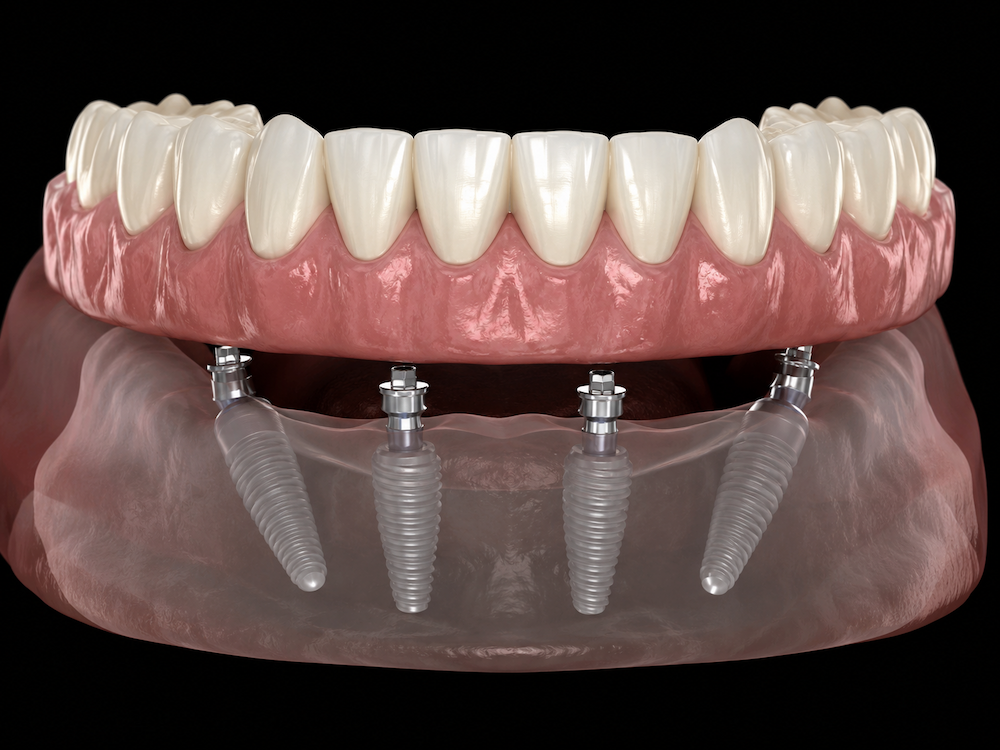
All-on-4 dental implants use four implants to support a full arch of fixed replacement teeth.
The name explains the idea clearly. “All” means a full arch of teeth. “On 4” means the full bridge sits on four implants.
This concept became widely known through Portuguese dentist Dr. Paulo Maló in the 1990s. Since then, dentists have used it for many full-arch missing teeth patients.
In a typical All-on-4 plan, the dentist places two implants in the front area. These implants are usually placed straight. Then, the dentist places two implants farther back. These back implants are often placed at an angle.
This angled design is very important. It helps avoid the maxillary sinus in the upper jaw. It also helps avoid the nerve canal in the lower jaw.
At the same time, the angled implants can increase the support range. Therefore, four implants can work like four strong support points under a fixed bridge.
This is why All-on-4 dental implants can restore a full arch without placing one implant for every tooth.
Why Can Four Implants Support So Many Teeth?
Many patients wonder why four implants are enough. The key is not just the number. The key is position, angle, and force distribution.
The front jaw area often has better bone than the back jaw area. Therefore, dentists use this stronger bone for support.
In many All-on-4 cases:
- The two front implants are placed vertically
- The two back implants are placed at an angle
- The angled implants avoid weak bone areas
- The bridge connects all four implants together
- Chewing force spreads across the full structure
You can imagine a table. A table does not need one leg under every plate. It needs strong legs in the right places.
Similarly, All-on-4 does not need one implant under every tooth. It needs four well-positioned implants and a carefully designed bridge.
However, this does not mean the surgery is simple. The dentist must plan the implant position very accurately. They must also check bone quality, bite force, gum condition, and general health.
Therefore, All-on-4 depends heavily on the doctor’s experience and treatment design.
Advantage One: Fewer Implants, Less Trauma, and Lower Cost
Compared with many traditional full-mouth implant plans, All-on-4 uses fewer implants.
One arch usually needs four implants. Both upper and lower arches usually need eight implants.
This is much fewer than some traditional plans. Therefore, the surgery may take less time. Also, the surgical area may be smaller.
The direct benefits may include:
- Fewer implants
- Shorter surgery time
- Less surgical trauma
- Less swelling in many cases
- Lower implant material cost
- Lower total cost in many cases
For elderly patients, this can be very meaningful. Many older patients cannot tolerate repeated or large surgeries. So, a simpler plan may improve comfort and safety.
However, patients should not choose All-on-4 only because it uses fewer implants. The plan still needs enough bone in the right places.
Therefore, a CT scan is necessary before treatment.
Advantage Two: It May Avoid or Reduce Bone Grafting
Many full-mouth missing teeth patients have severe bone loss in the back tooth area.
In traditional treatment, this often creates a problem. If the dentist cannot place implants directly, bone grafting may be needed first.
For example, upper jaw patients may need sinus lift surgery. Some patients may need ridge augmentation or other bone grafting procedures.
These surgeries can increase treatment cost. They can also extend the healing period by several months.
All-on-4 offers another approach. It uses tilted back implants to avoid areas with poor bone volume. It also makes better use of the front jawbone, where bone is often more available.
As a result, many patients can avoid major bone grafting. Some patients may only need minor grafting.
This is especially helpful for elderly patients, patients with bone loss, and patients who do not want long treatment.
However, All-on-4 cannot avoid grafting in every case. If the front jawbone is also too thin or too low, the dentist may need another plan.
Advantage Three: The Treatment Period Can Be Much Shorter
Traditional full-mouth implant treatment may take a long time.
If bone grafting is needed, the patient may first wait four to nine months for bone healing. Then, after implant placement, they may wait another three to six months for bone integration.
Finally, the dentist makes the fixed bridge. Therefore, the whole process may take one year or even longer.
All-on-4 can often shorten this process.
In selected cases, the dentist can remove bad teeth, place four implants, and attach a fixed temporary bridge on the same day.
This is why many people call it “teeth in a day.” The patient may leave the clinic with fixed temporary teeth instead of removable dentures.
However, this point needs correct understanding.
Same-day teeth do not mean you can chew anything immediately. During the first few months, the implants are still healing. Therefore, patients should eat soft foods only.
After about three to six months, once the implants become stable, the dentist can make the final bridge.
Advantage Four: Immediate Loading Can Restore Basic Chewing Sooner
Traditional implant treatment usually needs a healing period before fixed teeth are attached. During this time, patients may wear removable dentures. Some patients may even stay without teeth for a period.
However, All-on-4 can often support a temporary fixed bridge on the surgery day. This is called immediate loading.
Immediate loading can help patients restore basic function sooner. It can also improve speech, facial appearance, and confidence.
The benefits may include:
- No long toothless period
- Better appearance after surgery
- More stable temporary teeth
- Better speech comfort
- Basic chewing with soft food
- More confidence in daily life
However, patients must protect the temporary bridge.
In the first few months, avoid hard food, sticky food, and strong biting. Do not chew bones, nuts, hard bread, tough meat, or very crunchy food.
The temporary bridge helps in daily life. Still, it is not the final restoration. Therefore, careful use is very important.
Advantage Five: Higher Value for Full-Arch Missing Teeth
All-on-4 is not a cheap treatment. It still requires implants, surgery, a temporary bridge, and a final restoration.
However, compared with traditional full-mouth implant treatment, it may offer better overall value for many patients.
Why?
Because it usually uses fewer implants. Also, it may reduce or avoid major bone grafting. In addition, the treatment period may be shorter.
This can reduce:
- Implant quantity
- Bone grafting cost
- Surgery time
- Number of treatment stages
- Temporary denture discomfort
- Total treatment burden
For patients with limited budgets, All-on-4 may be more realistic than traditional full-mouth implant treatment.
However, value does not mean choosing the lowest price. A very cheap plan may use poor design or weak materials.
Therefore, patients should focus on safety, doctor experience, implant system, bridge design, and follow-up care.
A good plan should be affordable, but it must also be reliable.
Who May Be Suitable for All-on-4?
All-on-4 may suit many patients with half-mouth or full-mouth tooth loss.
It may also suit patients whose remaining teeth are very loose and need extraction. In these cases, the dentist may remove the bad teeth and place implants in one treatment plan.
Suitable patients may include:
- People missing all teeth in one jaw
- People missing all teeth in both jaws
- People with many loose teeth
- People with severe tooth damage
- People with limited back jaw bone
- People who want fixed teeth faster
- People who want to avoid major bone grafting
- Older patients who cannot tolerate repeated surgery
However, not every patient can receive All-on-4. The dentist must first check the bone condition, bite force, gum health, and medical history.
Therefore, patients should not decide by themselves. They need a full implant evaluation before choosing the plan.
Who Should Be More Careful?
Some patients need extra caution before choosing All-on-4.
For example, patients with uncontrolled diabetes may heal more slowly. Heavy smokers may also have a higher risk of implant problems.
Patients with severe teeth grinding also need careful planning. Strong grinding can place too much pressure on the bridge and implants.
Patients with very severe front jawbone loss may not have enough bone for All-on-4. Since All-on-4 relies heavily on the front jawbone, this area must be checked carefully.
Patients who should be cautious include:
- People with uncontrolled diabetes
- Heavy smokers
- People with severe bruxism
- People with untreated gum disease
- People with poor oral hygiene
- People with severe front jawbone loss
- People who cannot attend regular checkups
These patients may still have treatment options. However, they may need medical control, gum treatment, smoking reduction, night guards, bone grafting, or another implant plan.
What Should Patients Know After All-on-4 Surgery?
After All-on-4 surgery, the first few months are very important. The implants need time to bond with the jawbone.
Although the temporary bridge is fixed, patients must not treat it like natural teeth right away.
During early healing, patients should eat soft foods. Good choices include eggs, soft fish, tofu, oatmeal, soft rice, soup, and cooked vegetables.
At the same time, patients should avoid:
- Hard nuts
- Bones
- Hard bread
- Sticky candy
- Tough meat
- Ice cubes
- Strong biting with the front teeth
Also, patients should follow the dentist’s medication instructions. They should return for scheduled checkups.
If swelling gets worse, pain increases, pus appears, or the bridge feels loose, contact the dentist quickly.
Early care protects the implants and helps the final bridge work better.
Daily Cleaning Is Still Essential
All-on-4 teeth are fixed. However, they are not maintenance-free.
Food debris and plaque can collect under the bridge. They can also stay around the implants. If patients do not clean well, gum inflammation may develop.
Over time, this inflammation may cause bone loss around the implants. This can affect long-term stability.
Therefore, patients need daily cleaning tools.
Common tools include:
- Soft toothbrush
- Water flosser
- Implant floss
- Super floss
- Interdental brushes
- Low-abrasive toothpaste
The dentist or hygienist should teach the correct method. This is important because a full-arch bridge has special spaces that are hard to clean.
Also, regular professional maintenance is necessary. Many patients should return at least once or twice a year. Patients with gum disease, diabetes, or smoking habits may need more frequent visits.
In short, All-on-4 can restore fixed teeth. However, long-term success still depends on cleaning and maintenance.
A Middle Option: All-on-6 or All-on-3
Not every patient is best suited for four implants.
If the patient has good bone volume, a younger age, strong bite force, or higher long-term stability needs, the dentist may suggest All-on-6.
All-on-6 uses six implants for one full arch. Compared with All-on-4, it adds two more support points. Therefore, force distribution may become more balanced in selected cases.
However, All-on-6 requires more implants. It may also require more bone volume and a higher budget.
In some special situations, dentists may discuss All-on-3. This design uses three implants for one arch. It may suit selected patients with very limited bone or budget. However, it needs very careful case selection.
Therefore, patients should not choose based only on the number.
The right choice depends on:
- Bone volume
- Bite force
- Age
- Health condition
- Budget
- Gum condition
- Cleaning ability
- Long-term expectations
A CT scan and professional evaluation are necessary before deciding.
Conclusion
Full-mouth tooth loss can seriously affect quality of life. It may make eating difficult. It may also affect speech, nutrition, facial shape, and confidence.
Fortunately, full-mouth implant treatment does not always mean one implant for every missing tooth.
Traditional full-mouth implants may use more implants. This plan can provide strong support in suitable patients. However, it often requires more surgery, more bone volume, higher cost, and a longer treatment period.
All-on-4 dental implants offer another solution. With only four implants in one arch, they can support a fixed full-arch bridge. In many cases, they can reduce bone grafting, shorten treatment time, and allow patients to receive fixed temporary teeth on the same day.
However, All-on-4 is not suitable for everyone. Patients need a CT scan, oral exam, bite evaluation, and medical history review before treatment.
Also, same-day teeth do not mean same-day hard chewing. During the first few months, patients must eat soft foods and protect the temporary bridge.
All-on-4 dental implants have helped many patients who once thought they could not receive fixed teeth. With the right doctor, proper planning, careful cleaning, and regular maintenance, patients with full-mouth missing teeth may regain chewing comfort and a more confident smile.