


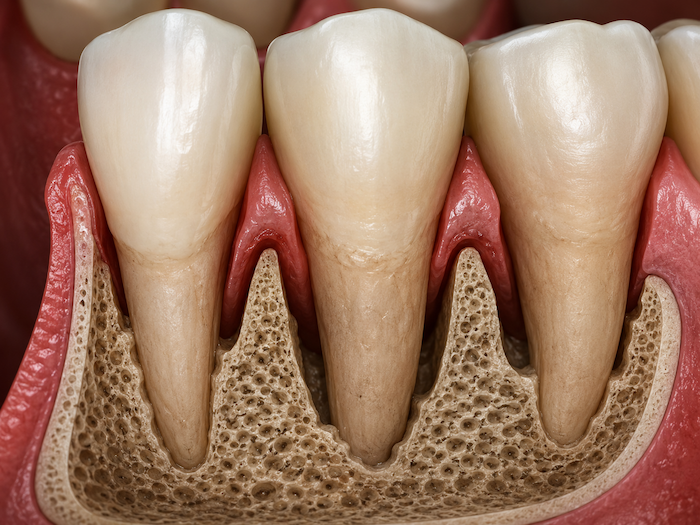
Why Does Bone Become”Not Enough” After Tooth Loss?
Dental implants with bone loss may still be possible. However, we must first understand why bone shrinks after teeth are missing.
Natural teeth are not only for chewing. They also send chewing force into the jawbone. This force gives the alveolar bone normal stimulation.
After a tooth is lost, this stimulation disappears. Therefore, the bone in that area begins to shrink slowly. This process is called bone resorption.
Common reasons include:
- Long-term missing teeth
- Gum disease
- Poorly fitting dentures
- Dental infection
- Trauma
- Aging
- Smoking
- Poor oral hygiene
Moreover, people who wear removable dentures for many years may lose bone faster. Dentures press on the gum and ridge. Over time, this pressure may make the ridge lower and flatter.
Therefore, missing teeth should not be ignored for too long. The longer the tooth is missing, the harder implant treatment may become.
Why Traditional Implants Need Enough Bone
Traditional implants need enough bone height and width. The implant must sit firmly inside the jawbone. If the bone is too thin or too low, the implant may not have stable support.
For example, the upper back jaw is close to the maxillary sinus. If bone height is limited, implant placement may become difficult.
Also, the lower back jaw is close to the nerve canal. If bone height is too low, the dentist must avoid nerve injury.
Important structures include:
- Maxillary sinus
- Inferior alveolar nerve
- Mental foramen
- Nasal cavity
- Thin alveolar ridge
- Severely resorbed posterior bone
In the past, patients with severe bone loss often needed bone grafting first. This could increase surgical trauma, cost, and waiting time.
Usually, bone graft healing may take several months. Therefore, many patients worry about the long treatment cycle.
Can Patients Still Get Implants If the Bone Is Flat?
Yes, many patients can still receive implant treatment even when the bone has shrunk. However, the dentist must check the bone condition first.
A flat ridge does not always mean treatment is impossible. Instead, it means the case needs advanced planning.
Possible solutions include:
- All-on-4 dental implants
- All-on-6 dental implants
- Bone grafting
- Sinus lift
- Short implants
- Angled implants
- Zygomatic implants in selected cases
- Digital guided implant surgery
Therefore, patients should not give up before diagnosis. A CBCT scan can show the real bone height, width, and density.
At Huangshan International Dental Hospital, we evaluate bone volume, gum health, bite force, and medical history before recommending a treatment plan.
Edentulous Immediate Loading: How Does It Help?
For patients with severe jawbone shrinkage, especially those without teeth, regular implants may not meet the need. This is common in full-mouth missing teeth cases.
In these cases, implant-supported fixed restoration can be considered. The idea is to use fewer implants in better bone areas. Then, the dentist uses smart angles to support a full-arch temporary bridge.
This approach may help:
- Reduce time without teeth
- Restore chewing function sooner
- Improve smile appearance
- Avoid some anatomical risks
- Reduce dependence on removable dentures
- Improve speech comfort
- Support soft-tissue shaping
However, immediate loading must meet strict conditions. The implants need good primary stability. The patient must also follow a soft diet during healing.
Therefore, immediate loading is not only “fast treatment.” It is a carefully planned clinical method.
All-on-4 Dental Implants
All-on-4 dental implants use four implants to support a full-arch bridge. The dentist often places the back implants at an angle. This helps avoid the maxillary sinus or lower jaw nerve.
All-on-4 may be suitable for patients with poorer bone volume. It can use the stronger bone in the front jaw area. Therefore, it may reduce the need for complex bone grafting in selected cases.
Possible benefits include:
- Fewer implants
- Less need for grafting in some cases
- Faster restoration
- Fixed teeth instead of loose dentures
- Better chewing comfort
- Improved confidence
However, All-on-4 also has limits. Because the implants are usually more forward, the back part of the bridge may have a longer cantilever.
This means bite design becomes very important. If force control is poor, the restoration may face more stress.
Therefore, All-on-4 is useful, but it must be planned carefully.
All-on-6 Dental Implants
All-on-6 dental implants use six implants to support a full-arch bridge. Compared with All-on-4, it can offer more support when bone volume allows it.
All-on-6 may be more suitable for patients with relatively better bone condition. It can reduce the length of the free-end bridge. It can also improve chewing efficiency and stability.
Possible benefits include:
- More implant support
- Better force distribution
- Shorter cantilever
- Higher chewing efficiency
- Stronger stability
- More restorative flexibility
However, All-on-6 usually needs more available bone. If the upper back jaw has a bone shortage, the patient may need a sinus lift or grafting.
For local posterior bone deficiency, sinus lift or bone grafting may expand treatment options.
Therefore, All-on-6 is not always better than All-on-4. It is better only when it fits the patient’s bone and bite.
All-on-4 or All-on-6: Which Is Better?
Patients often ask which option is better. The answer depends on the patient’s bone condition.
All-on-4 may fit patients who have:
- More severe bone loss
- Limited posterior bone
- Need to avoid sinus or nerve areas
- Suitable front jaw bone
- Desire to reduce grafting
- Stable bite force
All-on-6 may fit patients who have:
- Better bone volume
- Need stronger full-arch support
- Higher chewing demands
- Suitable posterior bone
- Desire for better force distribution
- Less need for long cantilevers
Therefore, the dentist should not choose based on a fixed rule. CBCT imaging, bite analysis, and oral examination should guide the decision.
In short, the right plan is not the most famous plan. The right plan is the safest and most stable plan for that mouth.
Why Digital Implant Technology Matters
Full-arch immediate loading requires high surgical precision. Therefore, digital technology plays an important role.
Before surgery, the dentist may use:
- Intraoral scanning
- Facial scanning
- CBCT 3D imaging
- Digital bite record
- Virtual tooth setup
- Implant path simulation
- Surgical guide design
These tools help the dentist plan each implant’s position, angle, and depth before surgery.
Moreover, digital planning can help avoid important anatomical structures. This includes the maxillary sinus, nerve canal, and thin bone areas.
At Huangshan International Dental Hospital, advanced AI-assisted dental technology supports imaging and treatment planning. This helps improve both accuracy and efficiency.
However, technology does not replace the dentist. It helps the dentist make better decisions.
Guided Surgery: Like Navigation for Implants
A 3D-printed surgical guide can help transfer the digital plan into the mouth. It works like a navigation tool during implant placement.
Guided surgery can help with:
- More accurate implant position
- Better control of angle
- Better control of depth
- Less surgical trauma in suitable cases
- Lower risk near nerves or sinuses
- More predictable temporary restoration
This is especially useful when bone is limited. In such cases, the dentist has less room for error.
However, a guide must fit well. The digital scan, guide design, and surgical execution all matter.
Therefore, guided surgery needs both technology and experience.
At Huangshan International Dental Hospital, our integrated planning workflow helps dentists and technicians work together from surgery to restoration.
Digital Impressions After Surgery
After implant placement, digital impressions can help capture the position of implants and soft tissue. This improves restoration design.
Compared with traditional impressions, digital impressions can be:
- More comfortable
- Faster
- Cleaner
- More accurate in suitable cases
- Easier to combine with preoperative data
The dentist can match post-surgery data with the original plan. Then, the lab can design temporary or final teeth more precisely.
This can improve:
- Bridge fit
- Bite comfort
- Gum contour
- Tooth shape
- Smile appearance
- Cleaning access
Moreover, digital workflow reduces the discomfort of traditional impression materials. This is helpful for full-arch patients.
Therefore, digital technology supports both surgery and restoration.
Why Choose Huangshan International Dental Hospital
Patients with bone loss need more than a basic implant service. They need experience, imaging, planning, surgery, restoration, and follow-up.
Two hospital advantages fit this topic well.
First, Huangshan International Dental Hospital offers international-level dental expertise. The dental team includes specialists trained at respected institutions, such as Nanjing Stomatological Hospital. Our doctors follow clinical standards comparable to those in Europe and the U.S.
Second, the hospital uses advanced AI dental technology. AI-assisted systems support imaging and treatment planning. This helps improve accuracy and efficiency in complex implant cases.
These strengths matter for patients with bone loss because the case often has higher difficulty.
Moreover, the hospital offers comprehensive services, including All-on-4, All-on-6, implant restoration, and restorative dentistry.
Who May Be Suitable for This Treatment?
Patients with jawbone loss may still be suitable for implants. However, the dentist must evaluate each case.
Possible candidates include patients with:
- Long-term missing teeth
- Loose removable dentures
- Full-mouth tooth loss
- Terminal dentition
- Moderate or severe bone loss
- Poor chewing function
- Desire for fixed teeth
- Stable general health
However, some patients may need extra treatment first. This may include gum treatment, extraction, infection control, bone grafting, or sinus lift.
Medical conditions also matter. Diabetes, smoking, osteoporosis medication, and immune problems can affect healing.
Therefore, patients should share their medical history honestly.
A personalized consultation helps the dentist choose a safer plan.
What Happens Before Treatment?
Before implant treatment, diagnosis comes first. The dentist must understand the bone, gum, bite, and general health condition.
The pre-treatment process may include:
- Oral examination
- CBCT scan
- Gum evaluation
- Bite analysis
- Medical history review
- Smile photos
- Digital scan
- Denture evaluation
- Treatment discussion
- Cost estimate
Moreover, the dentist checks whether an infection exists. Infection can affect implant success, so it should be controlled first.
The dentist also discusses expectations. Some patients want fixed teeth quickly. Others want to reduce grafting or control costs.
Therefore, communication matters. The treatment plan should match both clinical reality and patient needs.
What Happens During Surgery?
The surgical plan depends on the patient’s condition. Some patients receive All-on-4. Others receive All-on-6. Some need grafting or sinus lift.
A full-arch implant surgery may include:
- Local anesthesia or sedation options
- Tooth extraction if needed
- Implant placement
- Bone grafting when needed
- Surgical guide use
- Temporary bridge placement
- Bite adjustment
- Postoperative instructions
If immediate loading is suitable, the patient may receive temporary fixed teeth soon after surgery.
However, the temporary bridge is not the final restoration. It protects the appearance and light function during healing.
During this stage, patients must follow a soft diet. Heavy chewing too early may disturb healing.
Final Teeth After Healing
After implants integrate with the bone, the dentist can make the final bridge. This usually happens after the healing phase.
The final restoration should provide:
- Better chewing function
- Stable bite
- Natural tooth shape
- Comfortable speech
- Good cleaning access
- Better facial support
- Long-term durability
Digital impressions can help capture implant positions accurately. Then, the lab can design a better-fitting bridge.
At Huangshan International Dental Hospital, dentists and technicians work closely together. This integrated clinic and lab workflow can improve restoration precision and reduce waiting time.
However, final success still depends on maintenance. Even strong implants need regular checks.
Therefore, treatment does not end after the final teeth are placed.
##Aftercare Tips
After full-arch implant treatment, daily care is essential. Implants do not get cavities, but the tissue around them can become inflamed.
Patients should follow these tips:
- Brush twice a day
- Clean under the bridge daily
- Use a water flosser if advised
- Use interdental brushes
- Avoid smoking
- Control blood sugar
- Avoid biting hard objects
- Wear a night guard if needed
- Attend follow-up visits
- Report swelling or looseness early
Moreover, regular maintenance helps protect the result. The dentist can check bite, screw stability, gum health, and bone levels.
Patients with a history of gum disease need closer follow-up.
Therefore, aftercare is part of implant success.
FAQ
Can you get dental implants if you have bone loss?
Yes, many patients can still get dental implants with bone loss. However, they need a CBCT scan and implant evaluation first. Options may include bone grafting, sinus lift, All-on-4, or All-on-6.
What if I do not have enough bone for dental implants?
If bone is not enough, the dentist may recommend bone grafting, sinus lift, angled implants, short implants, or full-arch implant treatment. The best option depends on your jawbone condition.
Is All-on-4 good for bone loss?
All-on-4 can help some patients with bone loss. Angled implants may avoid the sinus or nerve areas. However, it is not suitable for everyone.
Which is better, All-on-4 or All-on-6?
Neither is always better. All-on-4 may suit patients with less bone. All-on-6 may suit patients with better bone volume and higher support needs.
Do I need bone grafting before implants?
Some patients need bone grafting. Others may avoid major grafting with angled implants or full-arch designs. A CBCT scan helps the dentist decide.
How long does bone grafting take before implants?
Bone grafting may add several months to treatment. Some cases need 3 to 6 months of healing. However, timing depends on the defect and treatment plan.
Are immediate-load implants safe?
Immediate-load implants can be safe for suitable patients. The implants must have good primary stability. The dentist must also control bite force during healing.
Summarize
Dental implants with bone loss may still be possible, even when the alveolar bone has shrunk or become flat. After tooth loss, the jawbone loses chewing stimulation. Therefore, bone can slowly resorb over time.