


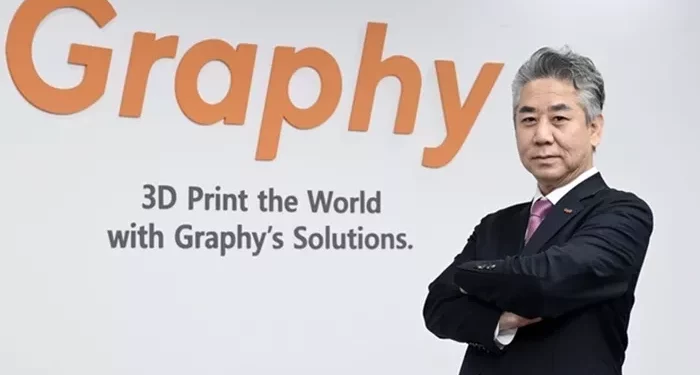
SEOUL — “For 40 years, 3D printing was held back by materials,” said Shim Woon-sup, CEO of Graphy (318060). “We have overcome what many believed was impossible.”
In an interview at the company’s headquarters in Geumcheon-gu, Seoul, Shim outlined how Graphy aims to reshape the global medical market with what it calls “living materials” — functional substances that move and respond inside the human body rather than simply forming static shapes.
Shim, who first encountered 3D printing three decades ago, has focused on producing final medical devices rather than prototypes. That vision led to the development of the world’s first shape-memory clear aligner, the SMA (Shape Memory Aligner).
Unlike conventional aligners made by thermoforming plastic sheets into fixed shapes, Graphy applies 4D printing technology. Its proprietary resin, “Tera Harz,” enables the aligner to remember and return to its original programmed shape.
The material reacts to body temperature inside the mouth, gradually restoring its design and delivering continuous, consistent force to teeth. According to Shim, this reduces discomfort and shortens treatment time.
The aligner can also be sterilized in hot water without losing functionality. It regains its original shape at oral temperature, improving hygiene and durability compared to traditional products.
Shim emphasized that the company’s claims are supported by academic validation. About 200 research papers published by independent university teams worldwide have examined and verified Graphy’s materials.
“We provided guidance, but external experts tested the products and confirmed their efficacy,” Shim said. “That independent data gives us strong credibility in global markets.”
Graphy is accelerating overseas expansion. In the United States, it has partnered with Benco Dental, a leading dental distributor. In Europe, it works with The Scheu Group to broaden its supply network.
A new central laboratory in Florida will serve as a production base for customized aligners and as a strategic hub for international growth.
Shim said global industry leaders are now paying close attention. “We are not following the existing framework. We are introducing a new paradigm,” he said.
Graphy’s ambitions extend beyond orthodontics. In recent joint clinical trials with university researchers, its material was injected into skull defects in rabbits. When exposed to light at specific wavelengths, the material expanded precisely to fill the damaged areas.
Shim said the technology could potentially support bone regeneration after tumor removal in osteosarcoma patients, provided biosafety standards are met.
The company expects 2026 to mark a turning point. Graphy has set a revenue target of 40 billion won and aims to achieve an operating profit turnaround by increasing exports of high-value-added materials.
With mass production from overseas facilities scheduled to ramp up in the second half of the year, Shim anticipates faster performance growth.
“We have moved beyond proving the concept,” he said. “Now it is time to scale.”