


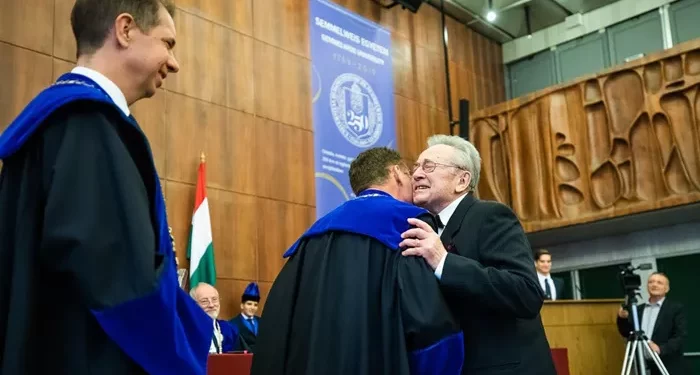
Dr. Gábor Gerber, dean of the Faculty of Dentistry at Semmelweis University, credits a multigenerational family tradition in dentistry for shaping his career.
He graduated from the Faculty of Dentistry in 1983 and, while practising in his family’s private office, developed a strong interest in teaching, anatomy and nervous system research.
After a research stint in the United States, Gerber returned to Semmelweis to teach anatomy, histology and embryology to dental and medical students.
He later took on leadership roles: vice-dean in 2010 and dean in 2015. Under his tenure the faculty expanded PhD programs and launched a translational medicine initiative to train the next generation of scientists.
Gerber emphasized that dentistry runs deep in his family. The practice in újpest — established in 1921 as a dental laboratory by his grandfather — remains active under his sister and brother-in-law.
Members of the family have long worked at the district dental clinic on Madách Square, where his father, Dr. Alajos Gerber, both treated patients and taught students and dental assistants.
His father was an early innovator in Hungarian periodontology, establishing the district’s first periodontal department in the 1980s and leading public dental health assessments.
Those family stories helped convince Gerber to pursue dentistry, though he ultimately shifted his academic focus toward neuroscience and anatomy. He now teaches at the Faculty of Medicine’s Department of Anatomy and holds an academic degree in neuroscience.
Gerber also maintained clinical practice and a commitment to sport. He completed a marathon at 50 and later an Ironman; he now competes in triathlons and heads the Semmelweis University Sports Club’s leisure sports section.
He worked alongside his father in the family practice until 2000, when Alajos Gerber turned to religious education after earning a theology degree. In 2019, Gerber presented his father with a diamond jubilee degree — a moment he described as touching and uplifting.
The family’s ties to Semmelweis extend beyond the dean. His wife transitioned from computational mathematics to mental health specialist training at the university.
Of their four children, two became teachers and two engineers. A daughter-in-law graduated as a dietitian; sons-in-law include a physical education teacher and a physician. A niece and his nephew, Dr. Péter Tajti, also trained at Semmelweis.
Tajti, now an assistant lecturer in prosthodontics, said Semmelweis offered the most comprehensive training and that he grew to love teaching after joining the department. He pursued PhD research on implant prosthetics and materials science.
Both he and Gerber stressed that family support helped but did not replace merit: Tajti said he earned his academic position on his own merits and that their familial connection is not widely known in his professional circle.
Gerber concluded by underscoring the value of community and alumni solidarity. He argued that strong family and university bonds boost the institution’s reputation — a tradition his family has sustained across generations.