


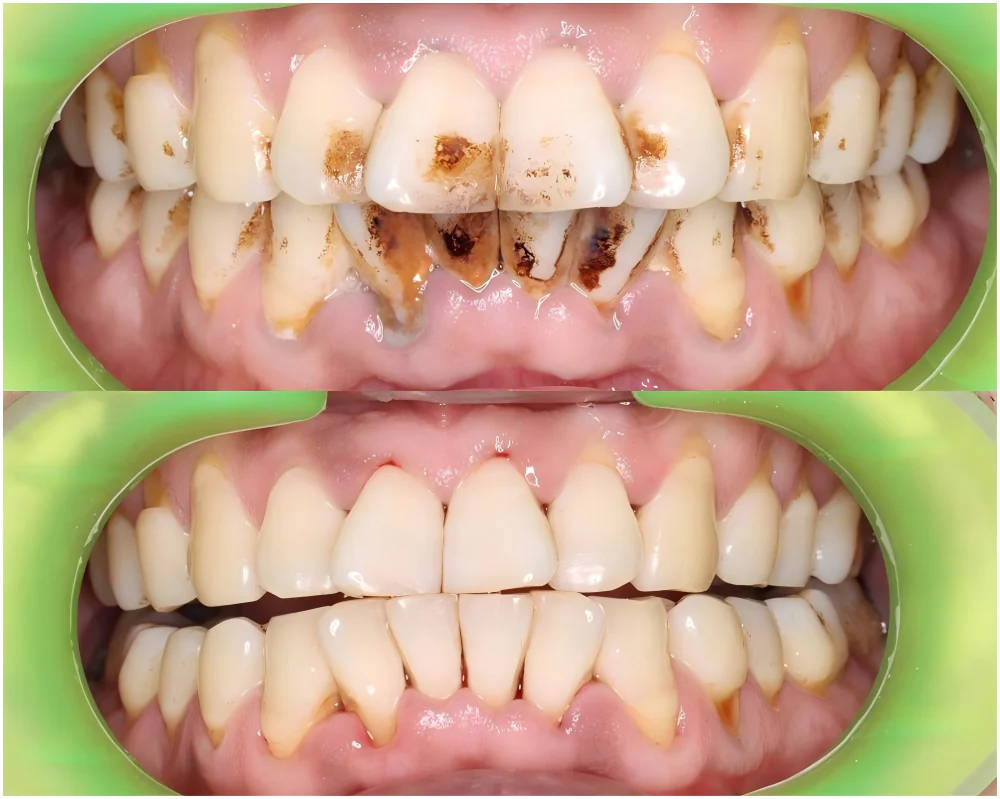
Yellow Teeth, Tea Stains, and Tobacco Stains Can Improve
People who smoke or often drink coffee and tea may notice darker teeth over time.
The teeth may become:
- Yellow
- Brown
- Dull
- Uneven in color
- Dark near the gumline
These changes can affect the appearance of the smile. Moreover, dark deposits may hide plaque, tartar, and gum problems.
Fortunately, many stains on smokers teeth develop on the outer surface. Therefore, professional dental cleaning can often remove or reduce them.
After treatment, the teeth may look:
- Cleaner
- Brighter
- Smoother
- More even in color
- Healthier around the gums
However, dental cleaning does not make every tooth bright white. The final result depends on the type of discoloration.
Some stains sit on the enamel surface. In contrast, others develop inside the tooth.
Therefore, the dentist must first identify the source of the color change. The correct treatment may involve cleaning, whitening, veneers, bonding, or crowns.
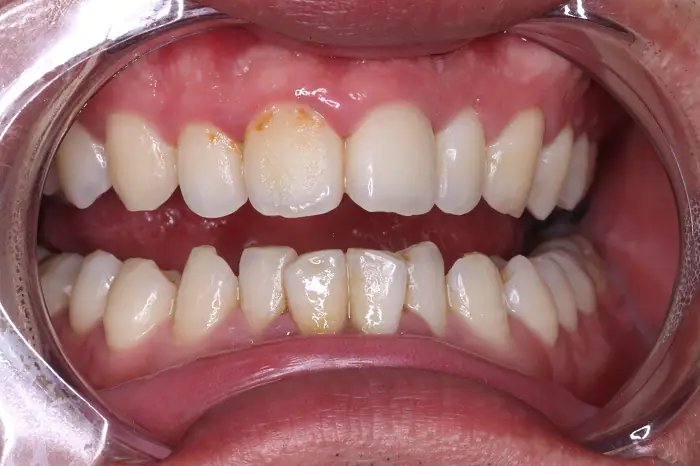
Where Does Tooth Discoloration Come From?
Intrinsic vs Extrinsic Discoloration
Tooth discoloration usually falls into two main groups:
- Intrinsic discoloration
- Extrinsic discoloration
The difference affects the treatment result.
Intrinsic Discoloration
Intrinsic discoloration develops inside the enamel or dentin. Therefore, ordinary scaling and polishing cannot remove it.
Common causes include:
Tetracycline Staining
The use of certain tetracycline antibiotics during tooth development may change the tooth color.
The teeth may appear:
- Gray-yellow
- Brown
- Dark gray
- Unevenly banded
Because the pigment lies deep inside the tooth, professional cleaning cannot remove it.
Some patients may benefit from dentist-supervised whitening. However, severe cases may require veneers or crowns.
Dental Fluorosis
Too much fluoride during tooth development may affect the enamel.
Mild fluorosis may create white or chalky patches. Meanwhile, more severe cases may cause yellow-brown stains or rough enamel.
Cleaning can remove deposits attached to the surface. However, it cannot correct the underlying enamel change.
Trauma or Nerve Damage
A tooth may gradually become gray or dark after:
- Dental trauma
- Deep tooth decay
- Nerve death
- Root canal treatment
In this case, the dentist may recommend internal bleaching, a veneer, or a crown.
Therefore, a single dark tooth should receive a dental examination.
Extrinsic Discoloration
Extrinsic stains form on the enamel surface or within shallow surface irregularities.
Common causes include:
- Cigarette smoking
- Cigar or pipe smoking
- Chewing tobacco
- Betel nut use
- Coffee
- Strong tea
- Cola
- Red wine
- Curry
- Blueberries
- Soy sauce
- Poor oral hygiene
- Long-term use of some antiseptic mouthwashes
Tobacco smoke contains nicotine and tar. Nicotine can turn yellow after contact with oxygen. Meanwhile, tar may create brown or black stains.
These stains often collect:
- Near the gumline
- Behind the lower front teeth
- Between crowded teeth
- Around old fillings
- On tartar deposits
- Inside natural enamel grooves
Plaque also creates a sticky surface. Therefore, tobacco and food pigments attach more easily when plaque remains on the teeth.
Why Smokers’Teeth Become Darker
Smoking stains the teeth gradually. As a result, many patients may not notice the change at first.
The color often becomes more obvious when smoking combines with coffee, tea, or poor plaque control.
Several factors affect the severity of staining:
- How often the person smokes
- How many years they have smoked
- Their brushing technique
- The amount of tartar present
- Their coffee and tea intake
- Tooth crowding
- Enamel roughness
- Existing fillings or crowns
Acidic drinks may also make staining worse.
Common acidic drinks include:
- Carbonated beverages
- Energy drinks
- Citrus juice
- Wine
Acid can temporarily soften the enamel surface. Therefore, dark pigments may attach more easily.
However, patients should not brush immediately after an acidic drink. Instead, they should rinse with water and wait before brushing.
Long-term use of chlorhexidine mouthwash may also cause brown surface stains. Still, patients should not stop prescribed mouthwash without advice.
The dentist can decide whether the product should continue and when stain removal is necessary.
In addition, plaque and tartar play an important role.
Plaque is a soft bacterial film. If it remains, minerals in saliva can harden it into tartar.
Tartar has a rough surface. Therefore, it collects tobacco, tea, and coffee pigments more easily than smooth enamel.
Once tartar forms, a toothbrush cannot remove it. Professional cleaning becomes necessary.
Ultrasonic Scaling and Air Polishing
External stains, plaque, and tartar affect more than appearance.
They may irritate the gums and contribute to:
- Gingivitis
- Periodontitis
- Bleeding gums
- Bad breath
- Gum recession
- Loose teeth
- Tooth loss
Professional cleaning is the main way to remove these deposits.
For patients with heavy tobacco, tea, or coffee stains, the dental team may combine ultrasonic scaling with air polishing.
These two methods perform different jobs.
Ultrasonic Scaling: Removing Hard Tartar
Ultrasonic scaling uses rapid vibrations to break up hard deposits.
At the same time, a water spray cools the instrument and washes away loosened debris.
It can help remove:
- Tartar
- Plaque biofilm
- Soft deposits
- Some surface stains
- Deposits near the gumline
The small tip can also reach areas that normal brushing may miss.
These areas include:
- Spaces between teeth
- The back of the lower front teeth
- Crowded tooth surfaces
- Areas close to the gumline
- Some shallow areas below the gum
Ultrasonic scaling offers several advantages.
First, it removes larger tartar deposits efficiently.
Second, it helps clean difficult areas.
Moreover, removing rough deposits makes daily brushing easier.
Some patients may feel mild sensitivity during treatment. This is more common when they have exposed roots, gum recession, or heavy tartar.
However, the dental professional can adjust the power and technique.
Air Polishing: Removing Fine Surface Stains
Air polishing uses a controlled mixture of:
- Air
- Water
- Fine polishing powder
The stream removes soft deposits and surface pigments.
It works especially well for:
- Tobacco stains
- Tea stains
- Coffee stains
- Cola stains
- Red wine stains
- Some mouthwash stains
Air polishing may also reach areas that a standard polishing cup cannot clean easily.
These areas include:
- Spaces between teeth
- Enamel grooves
- Crowded areas
- Surfaces around orthodontic appliances
- Irregular tooth surfaces
After treatment, the teeth may look brighter and feel smoother.
However, air polishing does not bleach the teeth. Instead, it reveals the natural shade under the stains.
The clinician must choose the correct powder and pressure. Special care is needed around exposed roots, implants, veneers, crowns, and sensitive teeth.
Therefore, patients should receive air polishing from a trained dental professional.
Why Combining Both Methods Gives Better Results
Ultrasonic scaling and air polishing complement each other.
First, ultrasonic scaling removes hard tartar and large deposits.
Next, the dentist or hygienist may use hand instruments to clean remaining areas.
Then, air polishing targets tobacco, tea, and coffee stains.
Finally, the teeth may receive additional polishing.
The combined treatment can provide:
- More complete stain removal
- Cleaner spaces between teeth
- Smoother tooth surfaces
- Less visible brown staining
- A brighter smile
- Improved gumline cleanliness
Therefore, patients with heavy surface staining may see a clear smokers teeth before-and-after difference.
However, cleaning cannot correct every type of discoloration.
Internal stains may remain after the surface becomes clean.
For example, the following problems may need other treatments:
- Tetracycline staining
- Dental fluorosis
- A darkened dead tooth
- Old discolored fillings
- Dark crowns
- Thin enamel
- Exposed yellow dentin
In these cases, the dentist may recommend professional whitening, composite bonding, veneers, or crowns.
Cleaning Is Not the Same as Whitening
Many patients think dental cleaning and teeth whitening are the same treatment.
However, they have different purposes.
Professional Dental Cleaning
Cleaning removes substances attached to the teeth, including:
- Plaque
- Tartar
- Tobacco stains
- Tea stains
- Coffee stains
- Soft deposits
After cleaning, the natural tooth shade becomes visible.
Therefore, a patient with heavy brown staining may notice a large improvement.
However, natural teeth are not always pure white. Healthy teeth may look ivory, cream, or slightly yellow.
Professional Teeth Whitening
Whitening uses bleaching agents to lighten pigments inside the tooth structure.
Therefore, it can make natural teeth lighter than their post-cleaning shade.
Whitening methods may include:
- In-office whitening
- Dentist-supervised home whitening
- Custom whitening trays
However, whitening does not remove tartar. It also cannot treat gum disease.
Therefore, professional cleaning often comes first.
The dentist can then:
- Check gum health
- Remove plaque and tartar
- Identify the natural tooth shade
- Assess sensitivity
- Plan whitening more accurately
Crowns, veneers, and fillings do not whiten like natural enamel. As a result, old restorations may look darker after whitening.
The dentist should discuss this difference before treatment.
Can Smoker Teeth Get Better?
Yes, smoker teeth can often improve significantly.
Professional cleaning may remove:
- Yellow tobacco deposits
- Brown surface stains
- Black tartar
- Plaque
- Tea stains
- Coffee stains
As a result, the teeth may become cleaner, smoother, and visibly brighter.
However, the final result depends on:
- The depth of the stains
- The natural tooth shade
- The condition of the enamel
- The amount of tartar
- Existing gum disease
- Old fillings and crowns
- Continued smoking
Cleaning cannot fully correct deep internal discoloration.
It also cannot rebuild lost enamel, gum tissue, or supporting bone.
Therefore, a full dental examination remains important.
Stopping smoking offers the greatest long-term benefit. It helps reduce new stains and supports better gum health.
Without habit changes, tobacco stains may return soon after cleaning.
How Do Smokers’Teeth Look?
Smokers’ teeth may appear:
- Yellow
- Brown
- Dark near the gumline
- Uneven in color
- Covered with rough tartar
- Stained between crowded teeth
- Dull rather than shiny
The inner surfaces of the lower front teeth may show heavy dark deposits.
Moreover, smoking combined with coffee or tea can deepen the discoloration.
However, tooth color alone cannot prove that a person smokes.
Non-smokers can also develop dark stains from food, drinks, medication, or poor oral hygiene.
Therefore, the dentist must assess the complete oral condition.
Can Smokers’Teeth Become White Again?
Yes, many smokers can achieve cleaner and brighter teeth.
Surface tobacco stains often respond well to:
- Ultrasonic scaling
- Air polishing
- Standard polishing
Once the deposits disappear, the natural tooth shade becomes visible.
If the patient wants a lighter shade, professional whitening may help.
Other options may include:
- Composite bonding
- Veneers
- Internal bleaching
- Ceramic crowns
The dentist selects the treatment according to the cause of discoloration.
However, continued smoking may cause new stains.
Therefore, reducing or stopping tobacco use helps preserve the result.
Do Most Smokers Lose Their Teeth?
No, not every smoker loses their teeth.
However, smoking increases the risk of gum disease and tooth loss.
Smoking can weaken the body’s response to gum infection. It may also reduce visible gum bleeding.
Therefore, periodontal disease may progress without obvious early signs.
As the disease becomes more severe, patients may develop:
- Gum recession
- Persistent bad breath
- Spaces between teeth
- Pus near the gumline
- Bone loss
- Loose teeth
Regular dental care can reduce these risks.
Smokers should receive:
- Routine dental examinations
- Professional cleaning
- Periodontal assessments
- Early gum treatment
- Oral cancer screening
- Smoking cessation support
Tooth loss is not unavoidable. However, prevention and early treatment are essential.
Summary
Smokers teeth often become yellow, brown, or dark because tobacco pigments attach to plaque, tartar, and enamel surfaces.
Coffee, tea, cola, red wine, and dark foods can make the stains more noticeable.
Tooth discoloration includes two main types:
- Intrinsic stains inside the tooth
- Extrinsic stains on the tooth surface
Intrinsic discoloration often requires whitening, bonding, veneers, or crowns.
In contrast, professional cleaning can remove many external stains.
Ultrasonic scaling removes hard tartar and plaque. Meanwhile, air polishing targets fine tobacco, tea, and coffee stains.
Therefore, combining both methods may create a noticeable improvement.
The teeth may look cleaner, smoother, brighter, and more even in color.
However, cleaning reveals the natural tooth shade. It does not bleach the inner tooth structure.
Most importantly, smoking affects more than appearance. It increases the risk of gum disease, poor healing, bone loss, and tooth loss.
With professional cleaning, good home care, and reduced tobacco use, smokers teeth can often become healthier and visibly brighter.