


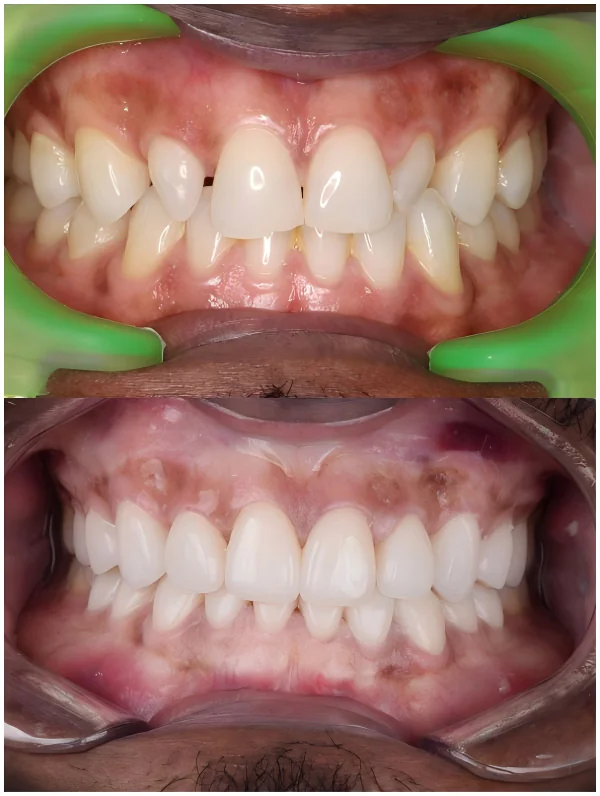
Patient Background: A Male Patient With Diastema
Diastema means a visible space between teeth. In this case, the patient was a healthy adult male. He had gaps between his upper and lower front teeth for several years. Although he had no tooth pain, he felt unhappy with his smile. Therefore, he wanted aesthetic dental restoration.
The patient had no history of systemic disease. Also, he denied drug allergies. This gave the dental team a stable health background for cosmetic planning. His main concern was not the chewing function. Instead, he wanted a more confident and balanced smile.
Clinical information showed several problems. His teeth were smaller than average. Also, the front teeth had scattered spaces. The tooth crowns looked short and narrow. In addition, the tooth shape appeared irregular. However, no obvious decay or missing tooth was reported.
After examination, the proposed plan was porcelain veneer restoration. The selected material was top-tier handcrafted bio-inspired veneers. This choice aimed to close gaps, improve tooth shape, and create a natural smile.
Dental Problems Analysis
The main dental issue was spacing between the anterior teeth. The patient had gaps in both the upper and lower front teeth. These spaces made the smile look less complete. Moreover, the teeth looked smaller because the gaps were scattered.
Several factors can cause this type of smile concern:
- Naturally small teeth
- Small tooth crowns
- Irregular tooth shape
- Wide dental arch space
- Poor contact between front teeth
- Mild tooth size and arch size mismatch
In this case, the teeth had no obvious cavities. This was important. Healthy tooth structure gives dentists more restorative options. However, the aesthetic issue still affected the patient’s confidence.
The problem was not only “a gap.” It was also a proportion problem. If the dentist only closed the spaces, the teeth might look too wide or unnatural. Therefore, the final plan needed to improve tooth width, length, shape, and contact points.
For this reason, handcrafted bio-inspired veneers were suitable. They could copy natural enamel features and improve smile harmony.
Why Small Teeth Create Smile Gaps
Small teeth can make gaps more visible. When tooth size does not match the jaw arch, spaces may appear between teeth. This can happen even when the teeth are healthy. Therefore, a patient may have no pain or decay but still dislike the smile.
Small teeth can affect the smile in several ways:
- The smile may look less full
- The front teeth may look too narrow
- The spaces may look larger
- The tooth edges may look uneven
- The smile line may lose balance
- The face may look less expressive when smiling
Also, irregular tooth shape can make the issue worse. Some teeth have narrow sides. Others may have short crowns. As a result, the contact points between teeth do not meet well.
Orthodontic treatment can move teeth. However, it cannot make naturally small teeth bigger. Therefore, veneers may work better when patients need both gap closure and tooth shape correction.
In this case, the patient needed a more complete aesthetic solution. So, porcelain veneers offered a practical and natural-looking option.
What Are Top-Tier Handcrafted Bio-Inspired Veneers?
Top-tier handcrafted bio-inspired veneers are high-quality ceramic restorations. They aim to imitate natural teeth. Unlike flat or overly white veneers, bio-inspired veneers focus on lifelike details. These details include translucency, surface texture, edge shape, and natural light reflection.
A good bio-inspired veneer does not simply cover a tooth. Instead, it improves the tooth while keeping a natural look. The dental technician studies natural enamel features. Then, the technician creates a veneer that matches the patient’s face and smile.
Key features may include:
- Natural enamel-like translucency
- Handcrafted surface texture
- Personalized tooth shape
- Balanced shade layering
- Natural incisal edge design
- Better harmony with lips and gums
This material choice was useful for this patient. His teeth were small and irregular. Therefore, the veneers needed to add shape without looking bulky. Also, the gaps needed closure without creating oversized teeth.
As a result, handcrafted bio-inspired veneers helped support a refined and realistic smile makeover.
Why Porcelain Veneers Were Recommended
Porcelain veneers were recommended because they can solve several problems at once. They can close selected gaps. Also, they can improve tooth size, shape, color, and symmetry. For patients with small anterior teeth, this makes veneers a strong choice.
The patient’s case matched several veneer indications:
- Small front teeth
- Scattered anterior spaces
- Irregular tooth shape
- Small tooth crowns
- Healthy teeth without obvious decay
- A clear cosmetic goal
In addition, veneers can create fast aesthetic improvement. Braces or aligners may take months. Bonding may work for small gaps, but it can stain or chip more easily. Porcelain veneers often provide better color stability and stronger long-term aesthetics.
However, veneers still need careful planning. The dentist must check the bite, gum health, enamel amount, and smile line. If these details are ignored, veneers may look fake or feel uncomfortable.
Therefore, the treatment plan focused on natural proportion. The goal was not only to close spaces. The goal was to create a smile that looked healthy, clean, and balanced.
Treatment Planning and Smile Design
Smile design begins before any veneer preparation. First, the dentist checks the patient’s teeth and gums. Then, the dentist studies the smile from different angles. This includes the lips, face shape, tooth length, gum display, and bite relationship.
The planning stage may include:
- Oral examination
- Smile photography
- Bite evaluation
- Gum health check
- Shade discussion
- Digital scan or impression
- Wax-up or mock-up design
- Patient expectation discussion
This step is very important for gap cases. If the veneers become too wide, the smile may look unnatural. However, if the veneers remain too narrow, the gaps may not close well. So, the dentist needs to balance tooth width and smile proportion.
Also, the dentist should plan the contact points. Natural teeth do not look like flat blocks. They have curves, texture, and slight differences. Therefore, handcrafted veneers can help create a more organic result.
In this case, the veneer design needed to make the teeth fuller while still looking masculine and natural.
Treatment Process
The treatment process usually starts with diagnosis and design. After that, the dentist prepares the teeth if needed. Some veneer cases require very little enamel removal. Others need slightly more adjustment to create space and proper alignment.
A typical veneer process includes:
- Step 1: Consultation and examination
- Step 2: Smile design and treatment plan
- Step 3: Shade and shape selection
- Step 4: Minimal tooth preparation
- Step 5: Digital scan or impression
- Step 6: Temporary veneer placement
- Step 7: Handcrafted veneer fabrication
- Step 8: Try-in and final adjustment
- Step 9: Veneer bonding
- Step 10: Bite check and polishing
During the try-in stage, the dentist checks the shape, color, and fit. The patient can also view the smile before final bonding. If needed, small adjustments can improve the result.
Finally, the dentist bonds the veneers to the teeth. A proper bonding process helps improve strength, comfort, and durability.
Before and After Result
Before treatment, the patient had visible gaps between the upper and lower front teeth. His tooth crowns were small. Also, the tooth shape was not ideal. These problems made the smile look less balanced.
After veneer restoration, the expected result included several improvements:
- Closed or reduced front teeth gaps
- Fuller anterior tooth shape
- Better tooth proportion
- More even smile line
- Natural tooth color
- Improved tooth symmetry
- More confident smile appearance
The result should not look exaggerated. Many patients worry that veneers may look too white or too thick. However, bio-inspired veneers focus on natural aesthetics. They aim to match real enamel, not create an artificial “plastic” smile.
For this patient, the key was proportion. The veneers needed to make small teeth look larger without making them look heavy. Also, the contact areas needed careful design. This helped the smile look smooth and continuous.
Therefore, the expected result was a natural smile makeover, not an obvious cosmetic cover-up.
Why Choose Huangshan International Dental Hospital
Huangshan International Dental Hospital is suitable for this type of veneer case because aesthetic restoration needs teamwork. A beautiful veneer result depends on both the dentist and the dental technician. The hospital’s integrated clinic and in-house lab model supports this process.
With an in-house dental laboratory, dentists and technicians can communicate directly. Therefore, they can adjust veneer shape, color, contour, and contact points more efficiently. This helps improve fit and aesthetic outcome.
This is especially useful for diastema cases. Gap closure requires accurate tooth width and contact design. If the contact points are wrong, the teeth may look too square or unnatural. Direct dentist-technician collaboration can reduce this risk.
Also, veneers can often be completed in approximately three days. This can help international patients or busy patients who have limited time. Fewer visits make treatment more convenient. Meanwhile, the team can still focus on detailed smile design.
Personalized Aesthetic Planning
Every smile makeover should match the patient’s face. A male patient may not want overly round or extremely bright teeth. Instead, he may prefer a clean, natural, and confident look. Therefore, personalized planning matters.
At Huangshan International Dental Hospital, the team can create a custom plan based on the patient’s needs. The plan may consider:
- Face shape
- Lip line
- Gum line
- Tooth size
- Skin tone
- Smile width
- Bite relationship
- Personal aesthetic goals
This softens the “one-size-fits-all” problem. It also helps patients understand their options before treatment. For example, some patients want a Hollywood-style smile. Others want a more natural and subtle change.
In this case, the patient’s main concern was long-term spacing and small teeth. So, the plan focused on closing gaps and improving tooth proportion. The selected handcrafted bio-inspired veneers supported this goal.
Veneers vs. Orthodontics for Tooth Gaps
Many patients ask whether braces, aligners, or veneers are better for tooth gaps. The answer depends on the cause of the gap. If the teeth are well-shaped but poorly positioned, orthodontics may be better. However, if the teeth are too small, orthodontics alone may not fix the shape problem.
Veneers may be better when the patient has:
- Small teeth
- Irregular tooth shape
- Mild or moderate spacing
- Discoloration
- Worn edges
- A need for fast aesthetic improvement
Orthodontics may be better when the patient has:
- Bite problems
- Crowding
- Large spaces from tooth position
- Jaw relationship issues
- Severe misalignment
Sometimes, both treatments work together. First, aligners move the teeth. Then, veneers refine the shape. However, this patient’s main issue involved small crowns and abnormal tooth form. Therefore, veneers matched the aesthetic goal well.
Still, a dentist should always evaluate the bite before choosing veneers.
Veneers vs. Dental Bonding
Dental bonding can also close gaps. It uses tooth-colored resin. Bonding is often faster and less expensive. However, resin usually stains faster than porcelain. Also, it may chip more easily.
Porcelain veneers offer different advantages:
- Better color stability
- Stronger surface gloss
- More natural translucency
- Better shape control
- Longer-lasting aesthetics
- More suitable for multiple teeth
Bonding may work well for one tiny gap. However, this case involved scattered spaces and small tooth crowns. So, a more complete restoration was needed. Handcrafted bio-inspired veneers allowed the team to redesign the smile more precisely.
Also, veneers can create a more refined surface texture. This matters for front teeth. The front teeth show during speaking, smiling, and laughing. Therefore, the material must look natural under different lighting.
For this patient, veneers offered a better balance of beauty, durability, and shape control.
Aftercare Tips for Veneers
After veneer treatment, patients need good daily care. Veneers can look beautiful for many years. However, they still need protection. The natural teeth around the veneers also need care.
Important aftercare tips include:
- Brush twice daily
- Floss once daily
- Use a soft toothbrush
- Avoid biting hard objects
- Do not chew ice
- Avoid opening packages with teeth
- Wear a night guard if grinding occurs
- Visit the dentist regularly
- Schedule professional cleanings
Also, patients should pay attention to bite changes. If a veneer feels high or uncomfortable, the dentist should adjust it. This helps protect the veneer from extra force.
Tea, coffee, and red wine may stain natural teeth over time. Porcelain resists stains better than resin. However, regular cleaning still helps keep the whole smile even.
Good care does not need to be complicated. It only needs to be consistent.
Long-Term Expectations
Porcelain veneers can last for many years with proper care. However, they are not lifetime restorations. At some point, they may need repair or replacement. Their lifespan depends on hygiene, bite force, material quality, and clinical technique.
Patients can support long-term results by:
- Keeping gums healthy
- Avoiding nail biting
- Avoiding hard food abuse
- Wearing a night guard if needed
- Treating small dental problems early
- Attending routine follow-up visits
Also, patients should understand veneer maintenance before treatment. If enamel preparation occurs, the tooth will need a veneer or another restoration in the future. Therefore, veneers are an aesthetic investment and a long-term decision.
In this case, the patient had healthy teeth and no obvious cavities. That gave the treatment a good foundation. Still, the dentist needed to protect tooth structure and design the veneers carefully.
FAQ
Can veneers fix diastema?
Yes, veneers can fix selected diastema cases. They work well when gaps come with small teeth or irregular tooth shapes. However, dentists must check the bite, gums, and tooth structure first.
What is the best treatment for gaps between front teeth?
The best treatment depends on the cause. Braces or aligners can move teeth. Bonding can close small gaps. Veneers can close gaps and improve tooth shape at the same time.
Are veneers better than bonding for gaps?
Veneers may look more natural and resist stains better than bonding. Bonding costs less and needs less time. However, bonding may chip or stain faster. The better choice depends on the case.
Do veneers look natural?
Yes, well-designed veneers can look very natural. Bio-inspired veneers can copy enamel color, translucency, and texture. However, the result depends on the design, material, and dentist skill.
How long do veneers take?
The timeline depends on the clinic and case. At Huangshan International Dental Hospital, veneer cases can often be finished in approximately three days. This can help patients with limited time.
Are veneers painful?
Most patients feel little discomfort. Some may feel mild sensitivity after preparation or bonding. Usually, this improves. If pain continues, the dentist should check the bite and tooth condition.
Do veneers ruin your teeth?
Veneers do not “ruin” teeth when dentists plan and perform treatment properly. However, some cases need enamel preparation. Therefore, patients should choose an experienced dental team and understand the process.
How many veneers do I need for front teeth gaps?
The number depends on gap size, smile width, and tooth shape. Some patients need only two veneers. Others need six, eight, or more for a balanced smile.
Can I eat normally after veneers?
Yes, patients can usually eat normally after veneers. However, they should avoid biting hard objects. They should also avoid habits such as chewing ice or opening things with teeth.
Summarize
This male patient had gaps between the upper and lower front teeth for several years. He also had small teeth, scattered spaces, abnormal tooth shape, and small crowns. Although he had no obvious decay or missing front teeth, the smile looked less balanced. Therefore, porcelain veneer restoration became a suitable plan.
The selected material was top-tier handcrafted bio-inspired veneers. This choice helped close spaces, improve tooth shape, and create a more natural smile. Unlike simple gap filling, this treatment focused on proportion, texture, translucency, and facial harmony.
For patients with diastema, small teeth, and irregular anterior tooth shape, veneers can be a strong aesthetic solution. However, every case needs careful diagnosis. Gum health, bite force, enamel condition, and smile design all matter.
At Huangshan International Dental Hospital, the in-house lab model and efficient veneer workflow support better-fitting restorations and faster treatment. In the end, diastema treatment should not only close gaps. It should also help the patient smile with comfort, balance, and confidence.