


Protect Every Baby Tooth and Save a Seat for Permanent Teeth
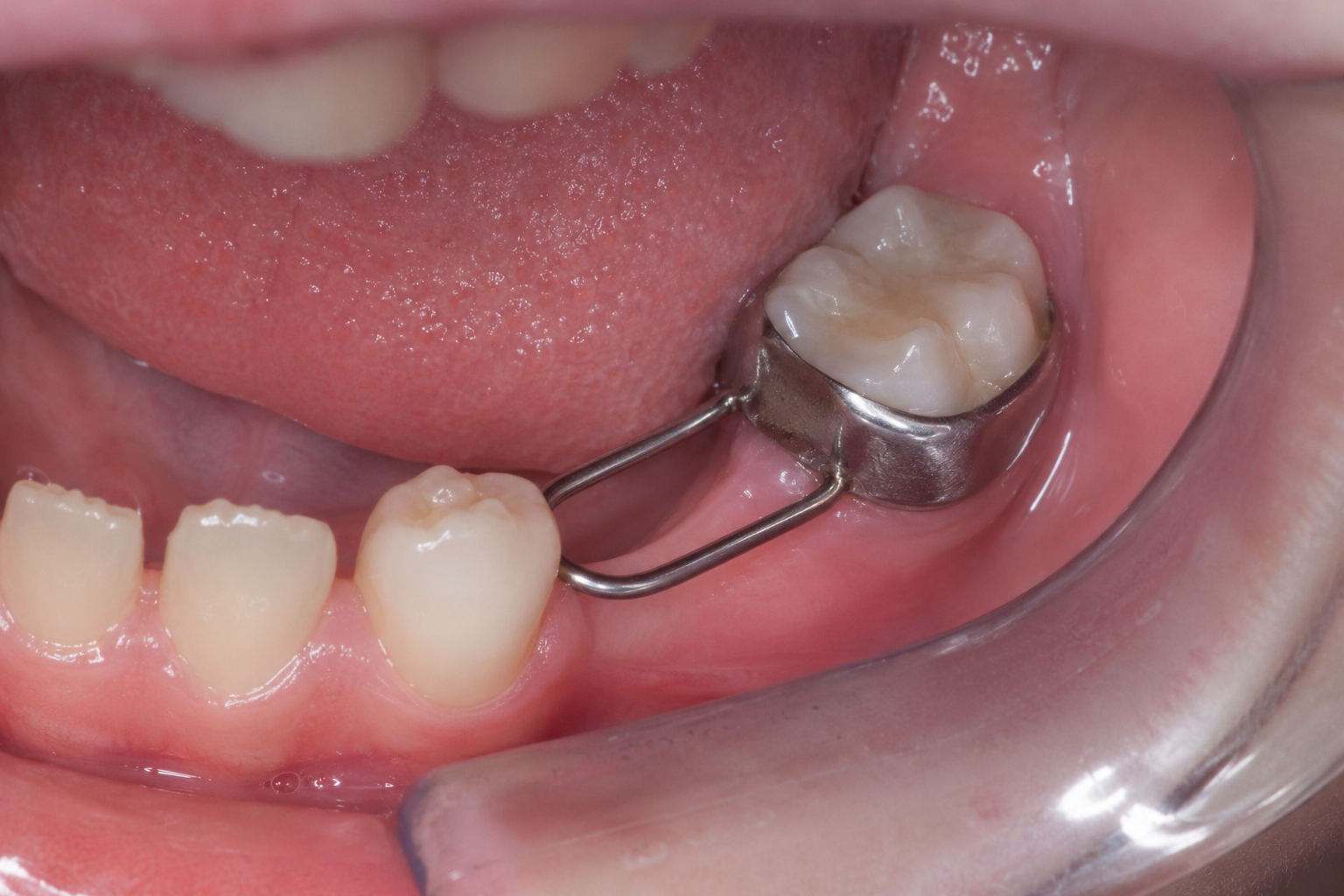
A space maintainer for children is a preventive dental appliance. It helps hold the space after a baby tooth is lost too early.
Many parents ask, “Baby teeth will fall out anyway. Do we still need to care?”
The answer is yes.
Baby teeth are temporary. However, their role is important. They help chew, speak, and guide permanent teeth into the right place.
If a baby tooth falls out too early, the gap may not stay open. Neighboring teeth can move. Opposing teeth can grow too far into the space. Then, the permanent tooth may lose its eruption path.
This may lead to:
- Crooked teeth
- Crowding
- Impacted teeth
- Blocked eruption
- Bite problems
Therefore, parents should take early baby tooth loss seriously.
Why Baby Teeth Need Attention
Baby teeth do more than fill a child’s smile. They also keep the dental arch in order.
Normally, tooth replacement follows a natural pattern:
- The permanent tooth develops under the baby tooth
- The baby tooth root slowly resorbs
- The baby tooth becomes loose
- The baby tooth falls out naturally
- The permanent tooth erupts into the space
This process helps teeth grow in an orderly way.
However, problems can happen when a baby tooth is lost too early due to:
- Severe tooth decay
- Root infection
- Gum abscess
- Dental trauma
- Early extraction
- Large untreated cavities
When this happens, the normal eruption pattern is disrupted. Therefore, the child may need a dental evaluation.
What Happens After Premature Baby Tooth Loss?
After premature baby tooth loss, the empty space may slowly close. This often happens without pain. So, parents may not notice the problem early.
Several changes may occur:
- Neighboring teeth tilt into the empty space
- Adjacent teeth drift forward or backward
- Opposing teeth over-erupt
- The original space becomes smaller
- The permanent tooth loses its path
- The bite becomes unbalanced
Moreover, once the space is lost, it may be hard to recover.
The permanent tooth below the gum may not have enough room to erupt. As a result, it may come in crooked. It may also become impacted or blocked.
Later, the child may need orthodontic treatment. In difficult cases, surgical exposure and traction may be needed.
Therefore, early intervention is much easier.
Do Not Turn a Small Problem Into a Big Problem
Premature baby tooth loss may look minor at first. However, it can create larger dental problems later.
If parents ignore it, the child may face:
- Crowded permanent teeth
- Misaligned eruption
- Impacted permanent teeth
- Bite disorder
- Chewing problems
- Longer orthodontic treatment
- Possible tooth extraction during braces
- More complex dental procedures
Therefore, a missing baby tooth should not always be treated as normal.
The key question is not only “Did the tooth fall out?”
The key question is “Did it fall out too early?”
If it fell out earlier than expected, the dentist should check whether the space needs protection.
This is where a space maintainer may help.
What Is a Space Maintainer?
A space maintainer is a dental appliance made for children. Its main purpose is simple: hold the space after early baby tooth loss.
It helps:
- Keep the empty space open
- Stop neighboring teeth from drifting
- Reduce unwanted tooth movement
- Protect the eruption path
- Help permanent teeth erupt more smoothly
- Maintain the dental arch shape
A space maintainer does not straighten teeth like braces. It also does not force a permanent tooth to erupt.
Instead, it works like a placeholder. It keeps the “seat” ready for the permanent tooth.
Therefore, it is a preventive tool, not an extra or unnecessary treatment.
Fixed Space Maintainers
Clinically, space maintainers can be divided into fixed and removable types.
Fixed space maintainers stay in the mouth. The child cannot remove them by themselves.
Common fixed types include:
- Band-and-loop space maintainer
- Crown-and-loop space maintainer
- Distal shoe space maintainer
- Lingual arch
- Nance appliance
These appliances can reliably hold the mesiodistal space. This means they help maintain the front-to-back width of the missing tooth area.
Fixed appliances are often suitable for younger children because they do not depend on daily wearing cooperation.
However, they also have limits:
- They do not restore chewing function well
- They cannot fully maintain vertical height
- Food may collect around them
- They need careful brushing
- They require regular dental checks
Therefore, fixed maintainers are stable, but they still need care.
Removable Space Maintainers
Removable space maintainers can be taken out. They are often used when more teeth are missing.
They may be suitable when:
- More than two baby molars are missing
- Baby molars on both sides are missing
- Front baby teeth are also missing
- Chewing function needs support
- Appearance matters
- Speech support is needed
Compared with fixed appliances, removable space maintainers can help maintain both mesiodistal space and vertical height. They may also restore some chewing function.
They may offer:
- Better appearance
- Easier speech support
- Some chewing function
- Easier cleaning outside the mouth
- Help with some harmful oral habits
However, they also have disadvantages:
- Stronger foreign body feeling
- Need for child cooperation
- Risk of loss or damage
- Need for regular adjustment
- Possible replacement as the child grows
Therefore, removable maintainers suit selected cases.
Which Children May Need a Space Maintainer?
Not every lost baby tooth needs a space maintainer. Parents should not decide only by looking at the mouth.
A dentist may recommend one when:
- A baby tooth is lost too early
- A baby molar is extracted early
- The permanent tooth is not ready to erupt
- X-rays show delayed eruption
- Neighboring teeth may drift
- The child has crowding risk
- Multiple baby teeth are missing
- The dental arch space needs protection
Baby molar loss often needs extra attention. These teeth keep space for premolars. If the space closes, the premolars may not erupt normally.
However, if the permanent tooth is about to erupt, the dentist may only monitor.
Therefore, diagnosis comes first.
Which Cases May Not Need One?
Some children may not need a space maintainer after losing a baby tooth.
The dentist may choose observation if:
- The tooth fell out near the normal time
- The permanent tooth will erupt soon
- The remaining space is enough
- The missing tooth is a front baby tooth
- There is low crowding risk
- X-rays show a normal eruption path
However, even when no appliance is needed, review is still important.
Teeth can shift gradually. Therefore, the dentist may need to recheck the space.
Parents should remember: no two children are exactly the same. The decision depends on age, tooth position, eruption stage, X-ray findings, and dental arch condition.
So, a professional dental exam is the safest choice.
How Long Should a Child Wear a Space Maintainer?
There is no fixed wearing time. The child usually wears the appliance until the permanent tooth is ready to erupt.
The dentist may remove it when:
- The permanent tooth crown breaks through the gum
- The eruption direction looks normal
- The space remains enough
- The appliance is no longer needed
- The dentist confirms safe removal
Some children wear it for a few months. Others may need it for a longer period.
Therefore, parents should not remove it at home.
If the appliance becomes loose, broken, or uncomfortable, the child should visit the dentist.
The goal is simple: keep the space stable until the permanent tooth can erupt naturally.
Review Time and Follow-Up
Regular follow-up is very important. Children’s mouths change quickly. Teeth erupt, jaws grow, and appliances may need adjustment.
A common review schedule is every 3 months.
During review, the dentist may check:
- Whether the space is still enough
- Whether teeth have shifted
- Whether the appliance is loose
- Whether the gums are healthy
- Whether food is trapped
- Whether the permanent tooth is developing
- Whether an X-ray is needed
- Whether the appliance should be removed
If necessary, the dentist may take an X-ray to observe permanent tooth development.
Therefore, parents should keep follow-up appointments. This helps avoid missing the best removal or adjustment time.
How Parents Should Care for It
A space maintainer works best when parents help maintain it well.
Parents should remind children to:
- Brush twice a day
- Clean around bands and wires
- Rinse after meals
- Avoid sticky candy
- Avoid chewing hard objects
- Avoid pulling the appliance
- Report discomfort early
- Attend dental reviews
If the appliance is removable, parents should also:
- Clean it daily
- Store it safely
- Avoid hot water
- Prevent loss
- Follow wearing instructions
Moreover, parents should check the child’s mouth regularly. Look for swelling, ulcers, looseness, or bad smell.
If anything seems wrong, contact the dentist.
Why X-Ray Evaluation Matters
If a baby tooth is lost early, X-rays can help the dentist make the right decision.
X-rays can show:
- Permanent tooth position
- Root development
- Eruption direction
- Remaining space
- Hidden infection
- Impacted tooth risk
- Bone condition
- Whether intervention is needed
Parents cannot see these details at home.
Therefore, dental imaging can help decide whether the child needs monitoring, a space maintainer, or another treatment.
This does not mean every child needs repeated X-rays. The dentist will decide based on risk and need.
In short, X-rays help protect the permanent tooth’s eruption path.
Why Early Treatment Matters
Early baby tooth loss should be managed quickly. The best time to protect space is before teeth move.
If parents wait too long, space may already be lost. Then, a simple space maintainer may not be enough.
The child may need:
- Space regaining
- Orthodontic treatment
- Extraction planning
- Surgical exposure
- Traction of impacted teeth
- More complex treatment later
Therefore, timing matters.
If a baby tooth has severe decay, root infection, or trauma, parents should take the child to a dentist as soon as possible.
Early treatment can help preserve the dental arch and reduce future complications.
Baby Tooth Decay Should Not Be Ignored
Severe decay is one of the main reasons for early baby tooth loss. If a cavity is not treated, bacteria can reach the nerve and root area.
This may cause:
- Toothache
- Gum swelling
- Abscess
- Bad breath
- Eating difficulty
- Sleep problems
- Early extraction
- Space loss
Therefore, protecting baby teeth also protects permanent teeth.
Parents should help children:
- Brush with fluoride toothpaste
- Limit sugary snacks
- Drink more water
- Visit the dentist regularly
- Treat cavities early
- Protect teeth during sports
If a baby tooth cannot be saved, then the dentist should evaluate space maintenance.
Common Parent Misunderstandings
Many parents delay treatment because of common misunderstandings.
Myth 1: “Baby teeth will fall out, so they do not matter.”
Truth: Baby teeth hold space for permanent teeth.
Myth 2: “A missing baby tooth is always normal.”
Truth: early loss can cause space problems.
Myth 3: “No pain means no problem.”
Truth: teeth can shift without pain.
Myth 4: “A space maintainer is braces.”
Truth: it holds space. It does not straighten teeth.
Myth 5: “It can stay in forever.”
Truth: the dentist removes it when the permanent tooth is ready.
Therefore, parents should ask a pediatric dentist instead of guessing.
FAQ
What is a space maintainer for children?
A space maintainer for children is a dental appliance that holds the gap after early baby tooth loss. It helps preserve space for the permanent tooth.
Does every child need a space maintainer?
No. Not every child needs one. The dentist must check the child’s age, tooth position, eruption stage, X-ray results, and space condition.
How long does a child wear a space maintainer?
A child wears it until the permanent tooth is close to eruption. The exact time varies. Regular reviews help decide when to remove it.
Is a space maintainer painful?
Usually, it is not painful. Some children need a short adjustment period. If pain, ulcers, or looseness appear, parents should contact the dentist.
Can a space maintainer prevent braces?
It may reduce crowding caused by space loss. However, it cannot guarantee that a child will never need braces.
What happens if early baby tooth loss is ignored?
Neighboring teeth may drift into the gap. Then, the permanent tooth may erupt crooked, become impacted, or lack enough space.
Summarize
A space maintainer for children is an important preventive tool. It helps hold the space after premature baby tooth loss and gives permanent teeth a better chance to erupt correctly.
Parents should remember:
- Baby teeth should not be ignored
- Early loss can cause space loss
- Neighboring teeth may drift
- Opposing teeth may over-erupt
- Permanent teeth may erupt crooked
- Some teeth may become impacted
- Fixed and removable maintainers serve different needs
- Not every lost baby tooth needs one
- Regular review is essential
- Early X-rays can guide treatment
In conclusion, a space maintainer for children is not extra treatment. It is a smart way to protect the dental arch after early baby tooth loss. If a child loses a baby tooth early because of decay, infection, or trauma, parents should arrange a dental exam quickly. Early evaluation can help protect the best “seat” for the permanent tooth.